Almost 2,400 years ago Plato described an island power rich in harbors, canals and military strength that fought ancient Athens and then disappeared in a catastrophe. In the Timaeus he placed Atlantis beyond the Pillars of Heracles and linked its destruction to earthquakes and floods.
Since then humanity has crossed the oceans, mapped the continents and learned to survey the seabed with satellites, sonar and remotely operated vehicles. Yet Atlantis refuses to disappear from public imagination. Every submerged settlement, unusual seabed structure or dramatic archaeological discovery revives the same question: what if Plato was using more than a philosophical story?
Atlantis endures because it is almost the perfect mystery: specific enough to search for, yet flexible enough that the search never has to end.
Plato left searchers something close to a map
The Timaeus and the unfinished Critias contain an unusual density of details: a location beyond the Pillars of Heracles, rulers, a plain, a mountain, concentric rings of land and water, canals, temples and harbors. That level of description makes the account easy to read as a damaged historical record rather than as philosophy. The Greek text and translations can be checked through Perseus.
But detail is not the same as documentation. Plato repeatedly used myth to develop philosophical arguments, and the Stanford Encyclopedia of Philosophy treats Atlantis within that broader Platonic use of constructed myth. Historians therefore have to test each detail independently rather than treat every number or location as a coordinate.
Why Atlantis stays between parable and history
The story works perfectly well as political and moral philosophy: a wealthy power loses restraint and is contrasted with an idealized ancient Athens. A literal Atlantis is not required for that argument.
Yet fiction can borrow from real disasters, places and collective memories. Plato could have combined memories of earthquakes, floods, maritime conflict or vanished settlements into a new story. That possibility is harder to rule out and helps explain why the question has survived even among people who do not accept a literal lost empire.
How Atlantis became a lost super-civilization
The modern Atlantis is partly a nineteenth-century creation. Ignatius Donnelly’s 1882 book Atlantis: The Antediluvian World presented the island as an ancient mother civilization whose influence supposedly spread across the world. From that point the legend expanded far beyond Plato, absorbing claims about Egypt, the Americas, lost technologies and global catastrophe.
Such theories are difficult to falsify because they can move whenever evidence fails. If the geography does not fit, Atlantis is relocated. If the chronology fails, the numbers are reinterpreted. If archaeology finds no empire, the claim becomes a search for a ‘prototype’. The legend survives, but the surviving version may have little left in common with Plato’s text.
Santorini shows why the idea is hard to abandon
At Akrotiri on Thera, modern Santorini, archaeologists uncovered a prosperous Bronze Age settlement buried by a major volcanic eruption. Buildings, streets and frescoes survived beneath the ash, providing a genuine example of a sophisticated island community overwhelmed by natural catastrophe.
Thera does not match Plato’s Atlantis geographically or chronologically. Still, it demonstrates something important: maritime societies can be devastated, towns can disappear from everyday memory, and archaeology can recover them millennia later. Such discoveries do not prove Atlantis, but they make the broader idea of a ‘lost city’ entirely real.
The ocean still leaves room for the unknown
The statement that the ocean is ‘unexplored’ is often used too loosely. According to NOAA, by April 2026 about 28.7% of the global seafloor had been mapped to modern high-resolution multibeam standards. Coarse global bathymetry is far more complete, while archaeological sites can be tiny compared with the scale of the seabed.
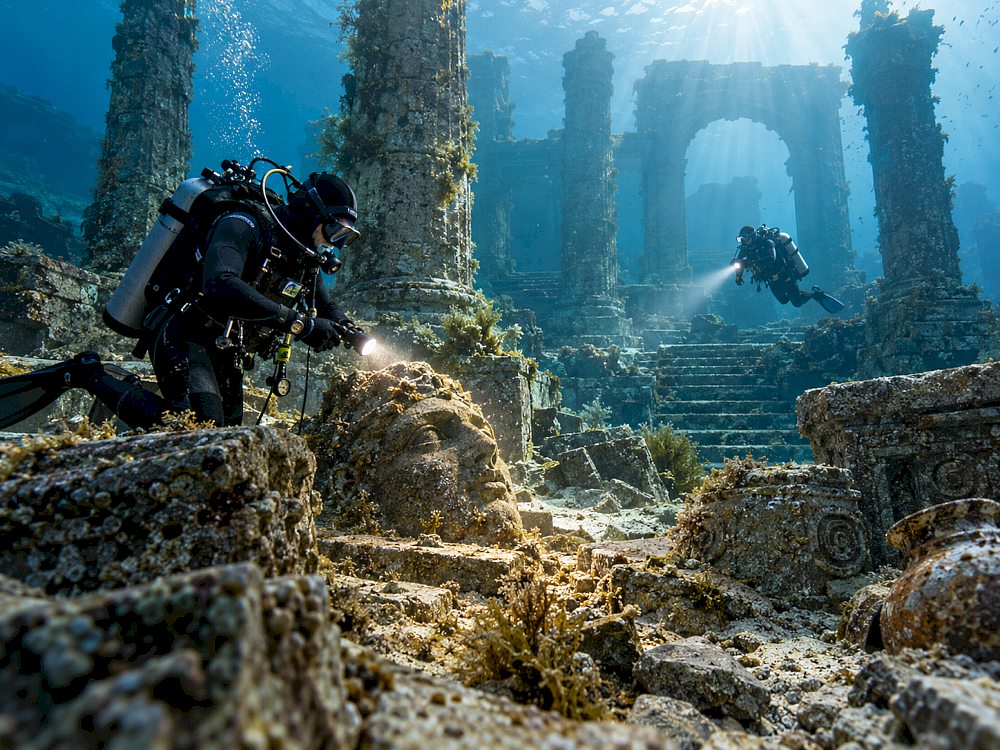
Submerged harbors, settlements, wrecks and prehistoric coastal landscapes can therefore still be discovered. That is very different from hiding an unknown continent or a vast undocumented empire. Underwater archaeology keeps the mystery interesting while simultaneously limiting the most extravagant versions.
Why people keep searching
Atlantis promises more than a location. Finding it would seem to convert one of humanity’s most famous legends into history and could force a reassessment of some assumptions about the ancient world. The search also offers a powerful personal narrative: the researcher who notices what everyone else missed.
Failure rarely kills the mystery. A failed expedition simply moves the next search elsewhere. New tools—satellite imagery, bathymetry, underwater robotics and geophysics—continually give an ancient legend modern methods.
What we are really looking for
No archaeological evidence currently confirms a state that matches Plato’s Atlantis in all essential respects. The possibility that his story drew on memories of real disasters or cultures remains an interpretation, not an established fact. Submerged ancient settlements and lost coastal landscapes, by contrast, are a real field of archaeology.
That may be the central paradox of Atlantis: the more we learn about the real past, the less we need a lost super-continent to explain history—yet the more genuine lost worlds we discover around the legend.
Disclaimer. This article may discuss legends, hypotheses, interpretations and unverified versions. They are not presented as established facts. Confirmed evidence is kept separate from speculation and unverified claims.