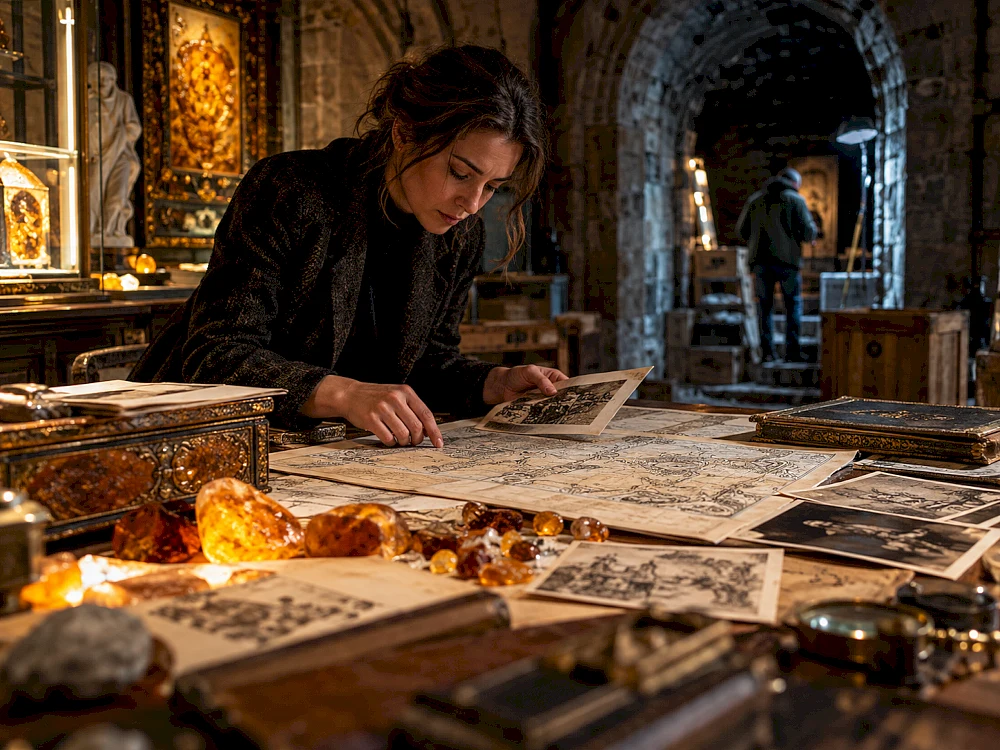
Some historical mysteries begin with the question of whether the object ever existed. The Amber Room is different. We know what it looked like, where it stood, who dismantled it and where it was taken. There are pre-war photographs, museum records, documentation of its display in Königsberg and even an authentic fragment that resurfaced in Germany more than half a century after the war.
Forecast details
Then the trail breaks. That makes the Amber Room one of the rare treasure legends in which the object of the search is unquestionably real. Yet the fact that it existed does not mean the main ensemble survived 1945.
Current ORBK.NET estimate: there is about an 18% probability that a substantial part of the original Amber Room will be found and reliably authenticated by 31 December 2040. Confidence in the estimate is 63/100.
The most likely scenario is still that the principal amber panels were destroyed or irreversibly damaged at the end of the Second World War. The probability is not zero, however: one genuine element did return after decades of obscurity, searches continue, and a future discovery might emerge from a private collection or archive rather than a dramatic bunker excavation.
What exactly counts as “found”?
The question requires a strict definition because individual elements of the Amber Room have already been recovered. In 1997 one of the original Florentine mosaics appeared in Germany. It was confiscated and later returned to Russia. In 2000 the Bremen Senate publicly discussed the return of the mosaic to the Catherine Palace; the official Bremen statement documents the episode.
YES criterion: by 31 December 2040 a previously unknown cache, archaeological context, private collection or other location is discovered containing at least one large original amber wall panel, or a group of authentic elements from the principal decorative ensemble, which at least two competent museum, scientific or government institutions independently recognise as a substantial part of the lost Amber Room.
NO criterion: no such authenticated discovery has been made by the end of 2040. Rumours, ground-penetrating-radar anomalies, unopened crates, isolated small decorations or claims by treasure hunters without authentication do not count.
Why there is a real object to search for
The Amber Room originated in Prussia in the early eighteenth century. In 1716 Frederick William I gave the amber panels to Peter I; the ensemble later moved to Russia and was enlarged at the Catherine Palace. Its creation and later reconstruction are described in detail by Gems & Gemology.
In 1941 German forces dismantled the decoration of the Catherine Palace and transported the Amber Room to Königsberg, where it was reassembled and displayed. It was later packed as the war approached East Prussia. After the destruction of Königsberg in 1944–1945, the reliable trail of the main ensemble disappears. Smithsonian has published a concise history of the disappearance.
This is what separates the Amber Room from Atlantis or many pirate-treasure stories. We are not trying to establish the existence of an object known only through an ancient narrative. The Amber Room certainly existed only a few years before it vanished. The unknown is what happened after it was packed in Königsberg.
The simplest explanation is also the least satisfying
Treasure mysteries reward complicated stories. A secret convoy, sealed bunker, mine or wreck at the bottom of the Baltic is more attractive than a fire. Yet destruction in Königsberg remains a serious possibility. The city suffered heavy bombing in 1944, and the castle experienced further destruction and fires in 1945. Amber is organic material and can deform, burn and break down under intense heat.
The fate of the decorative mosaics adds another clue. A specialist GIA review discusses reported remains of several Florentine mosaics in the castle ruins, while a fourth mosaic later resurfaced in Germany in 1997. That proves that not every component necessarily shared the same fate, but it does not prove that the principal amber panels were evacuated.
Why the 1997 recovery keeps the probability above zero
If no authentic object associated with the room had appeared after 1945, the forecast would be lower. But one did, and it emerged through private possession rather than a legendary secret bunker. That demonstrates that parts of the ensemble could have followed different routes.
A future discovery might therefore look mundane. The owner of an old collection may die and heirs may take an unidentified amber object to specialists. A transport document may surface in an archive. Renovation of a building may expose a sealed storage space. Digitised military records may narrow a search from an entire region to a specific property.
Why eight decades of searching weigh against an optimistic forecast
The negative evidence is stronger. The Amber Room has been sought almost continuously since the end of the war. Mines, bunkers, castles, lakes and shipwrecks have been checked. One prominent candidate was the steamer Karlsruhe, which left Königsberg in April 1945 and sank in the Baltic. Polish divers located the wreck in 2020, but no confirmed evidence of the Amber Room has emerged. Smithsonian reported on the wreck discovery.
In 2025 Polish heritage authorities authorised investigation near Dziemiany after a subsurface anomaly was detected; the link to the Amber Room remained the treasure hunters’ hypothesis rather than an established fact. Radio Gdańsk covered the case.
For forecasting purposes, another search site barely changes the probability until an artefact, document or material connection to Königsberg appears. More than eighty years of unsuccessful searching steadily reduce the plausibility of the simplest “intact in a known bunker” scenario.
Will technology change the odds by 2040?
Ground-penetrating radar, magnetometry, LiDAR, three-dimensional mapping, underwater drones and digital archive analysis are becoming cheaper and more capable. They allow investigators to test locations that would once have required largely blind excavation.
Technology solves only half the problem. Radar can identify a void but cannot label its contents. Sonar can locate crates inside a wreck but recovery may remain difficult. AI can compare thousands of archival documents, but it cannot reconstruct a transport ledger that no longer survives.
The strongest positive signal would therefore be a combination of archival and physical evidence: a document identifies a specific movement out of Königsberg, geophysics locates a cache along that route, and the cache contains objects with museum numbers or material characteristics matching the original ensemble.
Why no numerical base rate is used
A natural forecasting question is how often major cultural treasures are found eighty or one hundred years after disappearing. There is no sufficiently homogeneous reference class. Is a comparable case one painting, an entire museum collection, bullion, an archive, a religious relic or a multi-ton architectural ensemble? Selecting only famous recoveries would inflate the base rate, while including every wartime treasure legend would create a poorly defined sample.
This forecast therefore does not invent a numerical base rate. The most informative comparison is internal to the case itself: an original mosaic resurfaced 52 years after the war, while no principal amber wall panel has been found in more than eighty years.
Four scenarios to 2040
| Scenario | Probability | Meaning |
|---|---|---|
| The principal ensemble was destroyed in Königsberg or soon afterwards | 52% | No major recovery, although isolated dispersed objects may still appear |
| A substantial part survived and is found and authenticated by the end of 2040 | 18% | The forecast resolves YES |
| A substantial part survives but remains undiscovered beyond 2040 | 20% | A cache, private collection or wreck exists but searches fail to reach it in time |
| Only isolated fragments or disputed objects are found | 10% | A major headline occurs, but the YES criterion is not met |
The two scenarios in which a substantial part may still physically exist sum to 38%. Existence and discovery are different events, however. Once the difficulty of locating one specific cache among many hypotheses is considered, the probability of a qualifying discovery by 2040 remains 18%.
What would change the forecast?
The estimate would rise materially if an authentic transport record placed the main panels outside Königsberg after their last reliable sighting, if a new large fragment appeared with a traceable post-war provenance, or if a sealed wartime cache contained other objects from the same museum complex. Depending on the strength of the evidence, such a development could move the estimate into roughly the 30–45% range.
The strongest negative evidence would be documentary and archaeological confirmation that the main ensemble remained in the castle during its final destruction. If a reliable inventory and corresponding destruction layer both supported that conclusion, the probability could fall below 5–8%.
ORBK.NET forecast
The most likely outcome is that no substantial part of the original main Amber Room ensemble will be found by 2040.
Individual pieces may still appear. A bunker, wreck or previously unknown archive may be opened. There may even be a headline that briefly reads as if the Amber Room has finally been found. But a sensational claim and museum-grade authentication are very different thresholds.
The case nevertheless remains unusual among treasure mysteries because we already know that at least one lost element survived the war, decades of obscurity and eventual rediscovery. The door is not closed. It has simply become very narrow.
Forecast card
Forecast question: Will a substantial previously unknown part of the original Amber Room be found and independently authenticated by 31 December 2040?
Horizon: 1 October 2026 to 31 December 2040.
YES: At least one large original amber wall panel, or a group of authentic elements from the principal ensemble, is discovered and independently recognised by at least two competent institutions as a substantial part of the lost Amber Room.
NO: No such discovery and authentication occurs by 31 December 2040.
VOID: None planned.
Resolution check: January 2041.
Resolution sources: Official announcement by the relevant museum or heritage authority plus independent museum or scientific authentication.
Probability YES: 18%.
Confidence: 63/100.
Historical similarity: N/A — there is no sufficiently homogeneous reference class for a reproducible score.
Thematic index: Not used.
Snapshot date: 1 October 2026.
Main scenario: The principal panels were destroyed or damaged beyond a recoverable major discovery.
Forecast History
| Date | Probability | Confidence | Main scenario |
|---|---|---|---|
| 01.10.2026 — initial snapshot | 18% | 63/100 | No substantial recovery by 2040 |