A person who uncovered a giant jaw with finger-length teeth thousands of years ago did not know the word ‘dinosaur’. They simply had the remains of an animal far larger than most living predators they knew.
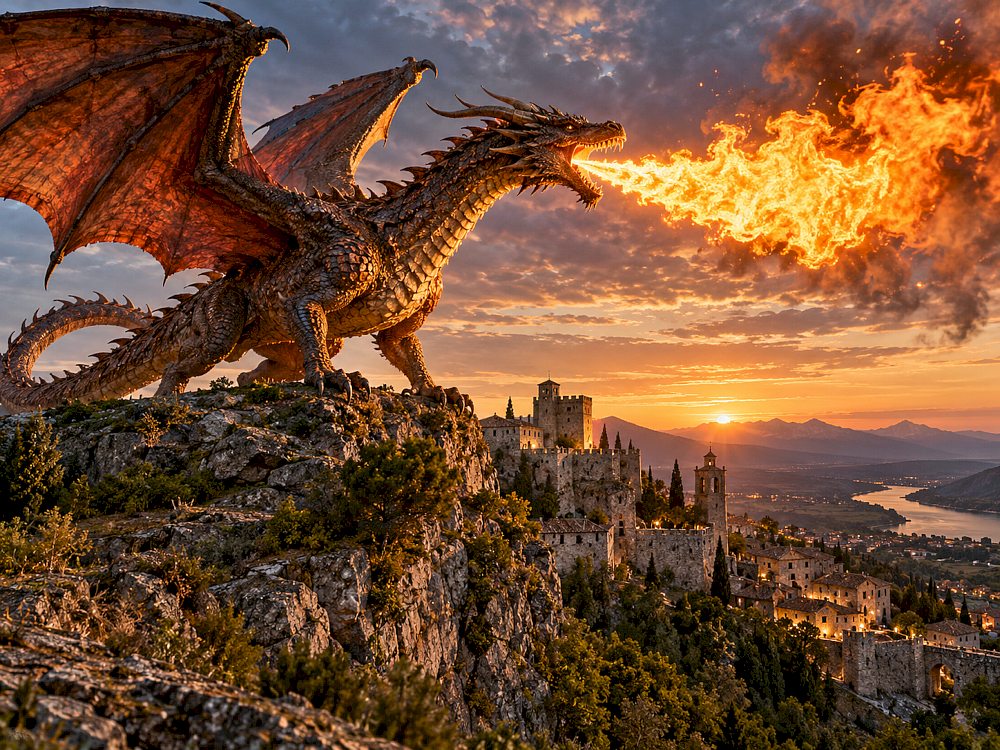
There is no reliable biological or paleontological evidence that humans ever shared the world with a species matching the classic dragon—a giant winged reptile capable of breathing fire. Yet almost every component of that image has a real analogue in nature.
Huge reptiles existed. Flying reptiles with wingspans around 10–11 metres existed. Giant marine predators ruled ancient seas, and three-metre monitor lizards still live today. The more useful question is therefore not ‘which animal was the dragon?’ but how fossils, living reptiles and human fear could combine into one creature.
Dragons appeared long before modern fantasy
Dragonlike beings occur in ancient cultures, but they are not anatomically consistent. Mesopotamia had the mušḫuššu associated with Marduk; Chinese dragons became linked to water, rain, power and good fortune; later European dragons increasingly became winged monsters defeated by heroes.
If all of these traditions described one biological species, we might expect more stable anatomy. Instead we see a flexible cultural idea: an exceptionally powerful reptilian or serpentine being shaped differently by different societies.
Fossils could reinforce the legend
Humans found large fossil bones long before paleontology existed. Richard Owen coined Dinosauria only in 1842. London’s Natural History Museum notes that ancient encounters with dinosaur fossils may have contributed to dragon traditions.
A single jaw, vertebra or massive limb bone gives no obvious clue that it belonged to an animal from the Mesozoic. In a culture that already knew stories of giant serpents or monsters, a fossil could become physical confirmation of the story.
Dinosaurs looked dragonlike, but humans never met them
Non-avian dinosaurs disappeared around 66 million years ago, vastly earlier than Homo sapiens. The Natural History Museum summarizes the evidence in its overview of dinosaur extinction.
Dinosaurs could therefore influence myths through their bones, but there is no evidence that people encountered living tyrannosaurs, stegosaurs or other non-avian dinosaurs.
Nature really did produce flying ‘dragons’
Pterosaurs were not dinosaurs but a separate lineage of flying reptiles. The largest forms, including Quetzalcoatlus, had wingspans of roughly 10–11 metres. A living animal of that scale would look perfectly at home in modern fantasy art.
They also vanished at the end of the Cretaceous. Humans did not see them alive. Their relevance is conceptual: a huge flying reptile was not biologically impossible—evolution really did build one.
Komodo dragons show how dragonlike a living animal can be
The Komodo dragon is the largest living lizard. Smithsonian’s National Zoo describes large adults, powerful jaws, claws and a venomous bite in its Komodo dragon facts.
For someone unfamiliar with the species, the first encounter with a giant monitor lizard could easily become the basis of a monster story. Elsewhere crocodiles, pythons, cobras and other large reptiles could play a similar role.
Where did the fire come from?
Fire-breathing is the feature that most clearly separates the European dragon from known biology. Animals can produce venom, irritating chemicals or electric discharges, but no known vertebrate generates and projects true flame.
Fire is therefore best understood as mythic amplification: a dangerous reptile acquired one of the most powerful and frightening forces known to humans.
Why did different cultures imagine similar creatures?
Closer comparison makes the similarities less exact. Chinese dragons are strongly tied to water and authority; European dragons become enemies, treasure guardians and later fire-breathers; Mesopotamian monsters combine features from several animals.
The shared core may simply be a universal human idea of an enormous reptile or serpent. Snakes, crocodiles, large birds of prey and fossil bones could independently feed similar stories in different regions.
So did dragons ever exist?
If ‘dragon’ means the classic winged fire-breathing reptile, current evidence does not support it as a real animal.
If the question is whether real creatures could inspire the image, the answer is clearly yes. Dinosaurs supplied bones and scale; pterosaurs show that giant reptilian flight was real; crocodiles and monitor lizards supplied armor, jaws and claws. Human imagination added the final element—fire.
Disclaimer. This article may discuss legends, hypotheses, interpretations and unverified versions. They are not presented as established facts. Confirmed evidence is kept separate from speculation and unverified claims.