Old sea maps often seemed to end where monsters began. Giant serpents coiled around ships, tentacled creatures dragged sailors beneath the surface, and strange carcasses thrown onto beaches appeared to prove that something terrifying lived beyond familiar waters.
Modern oceanography has sonar, satellites, submersibles and genetic analysis, yet part of the old monster tradition survived for an unexpected reason: the sea really does contain giant squid, ribbonlike fish several metres long, enormous sharks and animals that scientists have only recently filmed alive in their natural habitat.
There is no convincing evidence for legendary monsters that routinely sink ships or for hidden populations of gigantic ‘sea dragons’. But real animals that earlier sailors could reasonably have called monsters are very much alive.
The Kraken was not entirely imaginary
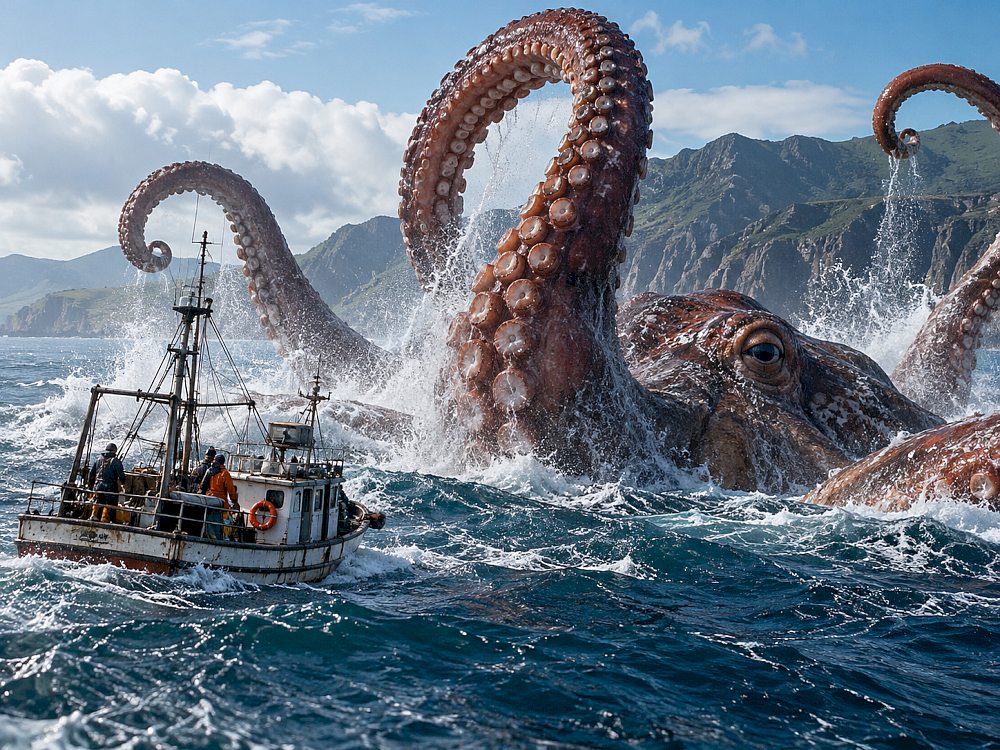
Scandinavian stories described the Kraken as a vast tentacled creature. Giant squid are not known to sink ships, but the animal itself is real. Architeuthis dux can reach roughly 13 metres in total length. According to Smithsonian Ocean, the first photographs of a living giant squid in its natural habitat were obtained only in 2004, with live video following in 2012.
The colossal squid Mesonychoteuthis hamiltoni provides an even more recent example. In March 2025 Schmidt Ocean Institute announced the first footage of a living juvenile in its natural habitat at 600 metres depth: first colossal squid footage.
Sea serpents have a remarkably real look-alike
One of the best candidates for old sea-serpent sightings is the oarfish, Regalecus glesne. It is the longest known bony fish, with a narrow silver body and a red crest. The Natural History Museum includes the oarfish among plausible sources for sea-serpent traditions in its overview of sea monsters.
A sailor might see only separate sections of the long body appearing between waves. A fish that is obvious in a complete photograph could look like the rolling spine of a much larger unknown animal at sea.
Sometimes the monster began after the animal died
The sea transforms carcasses. Skin, fins and soft tissues disappear, currents tear bodies apart, and familiar animals become almost unrecognizable. Even in modern times, supposed ‘plesiosaur’ or unknown-monster carcasses have sometimes turned out to be decomposed sharks or whales.
Without comparative anatomy, a strange carcass could be more convincing than any story. A physical body lay on the beach, while decomposition had erased the features that would have identified it.
Real sea monsters once ruled the oceans
Tens of millions of years ago the oceans genuinely contained animals worthy of the term: mosasaurs, plesiosaurs, ichthyosaurs and other large marine reptiles. Smithsonian presents them in its exhibition on ancient sea monsters.
They disappeared long before modern humans. Fossils show how spectacular marine predators can evolve, but they do not show that such populations survived into the present.
Why the ocean still leaves room for mystery
The history of giant squid invites a reasonable question: if a huge animal was difficult to film alive until recently, what else may remain poorly known? New marine species will certainly continue to be described, especially among small and deep-sea organisms.
Size still matters. A giant predator requires food, territory and a breeding population and leaves carcasses, DNA, feeding traces and accidental encounters. The possibility of undiscovered species therefore does not make every legendary monster equally plausible.
Why sailors saw more monsters than we do
Night, waves, unknown distances and poor optics created ideal conditions for misidentification. An observer might see a whale’s back, another animal’s tail and several fins in succession, while memory joined them into one creature.
Yet the sea supplied plenty of real material. Whales dwarfed almost every land animal most people had seen; giant squid occasionally reached human hands; oarfish looked like silver serpents. Myth did not need to invent everything from nothing.
So do sea monsters exist?
There is no good evidence for a ship-sinking Kraken, an enormous unknown sea serpent or a plesiosaur population that survived tens of millions of years.
But if ‘monster’ means an enormous, rare and extraordinary animal that earlier people could not identify, then yes. Giant and colossal squid are real, oarfish are real, enormous sharks and whales are real. The ocean has not confirmed the legends literally, but it has shown that their basic intuition was not absurd: the sea contains creatures strange enough to need very little help from imagination.
Disclaimer. This article may discuss legends, hypotheses, interpretations and unverified versions. They are not presented as established facts. Confirmed evidence is kept separate from speculation and unverified claims.