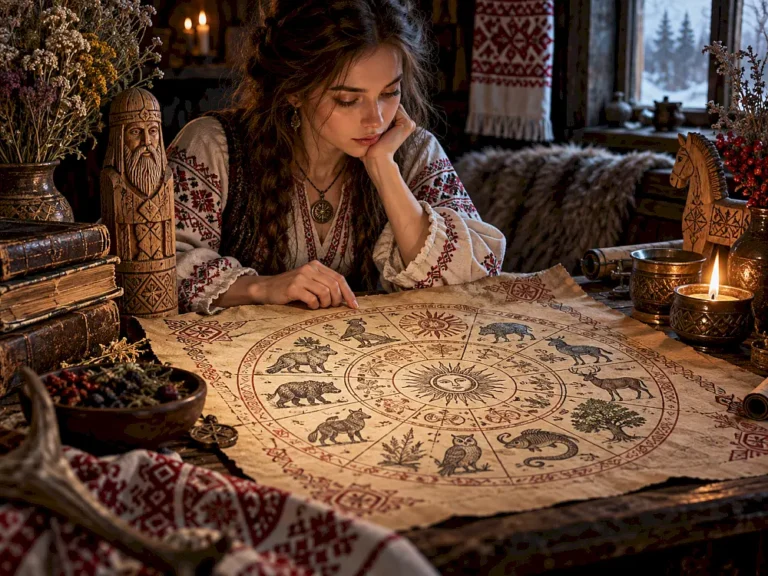
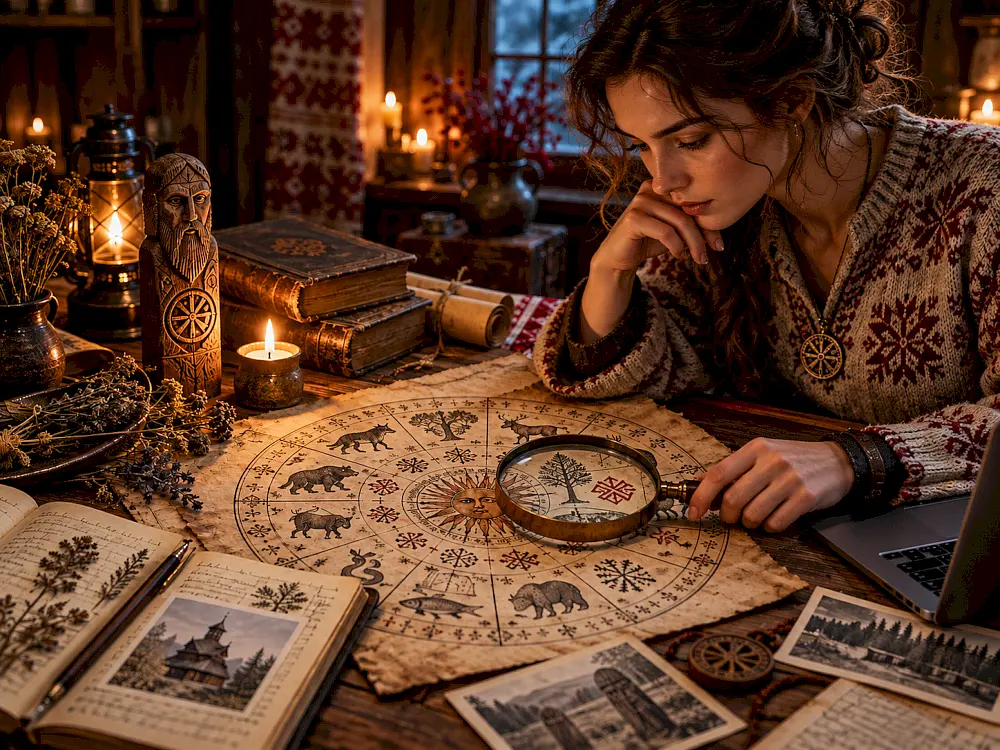
The same person can be a Fiery Horse in one “Slavic horoscope”, Svarog in another, and receive a patron plant in a third. That contradiction already tells us something important: there is no single stable system, but a family of modern schemes connected by the label “Slavic”.
So the question “is it true or invented?” is too simple. At least three different claims need to be tested: whether the system is genuinely ancient, whether its competing versions agree with one another, and whether there is evidence that it can actually describe personality from a birth year or date.
The result of that check is fairly clear: no reliable evidence has been found for the modern structured Slavic horoscope in the pre-Christian period; its popular forms are much better documented as twentieth- and twenty-first-century phenomena; and in the academic literature we checked, we found no controlled study showing that this specific horoscope predicts personality better than chance.
First, define what is being tested
Today, several very different systems are called the “Slavic horoscope”. One assigns animals such as the Dark Elk, Stinging Hornet, Fiery Squirrel, White Owl or Golden-Horned Bull. Another uses Slavic deities. Other versions rely on trees, flowers, elements, calendar periods or so-called halls.
The SEE Check investigation documents how these systems can give the same person different “signs”. That matters because a supposedly ancient and precise tradition should be able to explain why its modern versions disagree so sharply.
| What is being tested | Main question | State of evidence |
|---|---|---|
| Historical origin | Did this system exist among pre-Christian Slavs? | No evidence has been found for the modern 16-sign form |
| Consistency | Do different “Slavic horoscopes” produce the same result? | No, the systems differ substantially |
| Claimed accuracy | Does the sign predict personality better than chance? | No high-quality controlled test of this specific system was found |
What do we actually know about pre-Christian beliefs?
The problem begins with the evidence. The scholarly volume Sources of Slavic Pre-Christian Religion collects medieval texts concerning pre-Christian Slavic beliefs. It illustrates how heavily researchers depend on external or Christian-era descriptions because a large native corpus of pagan Slavic religious texts has not survived.
This does not mean that early Slavs lacked calendar rituals, divination, animal symbolism or observations of natural cycles. But there is a large evidential gap between saying such elements existed and claiming there was a specific 16-year personality system based on birth years.
Modern reconstructions are visible by the twentieth century
The clearest traces of a “Slavic zodiac” lead to the twentieth century. In Slavic Native Faith, Kaarina Aitamurto and Scott Simpson trace Western Slavic Native Faith calendars to the 1920s and 1940s and explicitly describe Władysław Kołodziej’s Slavic zodiac as his own creation.
In a 1947 calendar, conventional astrological signs are paired with “Lechitic” counterparts such as the Elk, Aurochs, Bison and Deer. It is not identical to the modern totem cycle, but it clearly demonstrates the mechanism: in the modern era, Slavic imagery was deliberately combined with astrological structures.
By the end of the twentieth century the idea was spreading further. SEE Check traces a “Slavic horoscope” reference to a 1996 Russian-language publication whose author reportedly admitted that he had heard about it on a radio programme and could not find a supporting source in the literature. During the 2000s, websites, forums and esoteric publications multiplied, carrying the now-familiar animal signs.
Why does it feel ancient?
The modern system is built from culturally persuasive details. Elk, wolf, aurochs, boar, pike, eagle, horse and owl fit naturally into the landscapes and folklore of Slavic-speaking regions. Archaic vocabulary, pagan deities, talismans, equinoxes and seasonal cycles reinforce the impression.
This creates an easy logical trap: if an individual symbol is ancient, the whole system that contains it must also be ancient. But old symbols can be reorganised into a new structure. The age of the bricks does not determine the age of the building.
How should “accuracy” be tested?
Historical authenticity and psychological accuracy are separate questions. Even a newly invented classification could, in principle, reveal an accidental statistical pattern. Therefore, showing that a tradition is modern is not itself a scientific test of whether its personality claims work.
But the statement “this description sounds exactly like me” is also weak evidence. Psychology has long documented the Barnum effect: people tend to accept vague, flexible or favourable statements as uniquely descriptive of themselves. A review of the research found that acceptance is influenced by perceived relevance and favourability, among other factors.
A fair horoscope test therefore needs blinding. Participants should receive several descriptions without knowing which one is supposed to be theirs. Researchers should also register the scoring rules in advance instead of changing the criteria after the results appear.
Shawn Carlson’s famous double-blind test, published in Nature in 1985, examined Western natal astrology, not the Slavic horoscope. It should not be presented as a direct refutation of the Dark Elk or Fiery Squirrel. What it does illustrate is the correct principle: claims that an astrological system can describe personality should be tested under controlled conditions, not by collecting testimonials.
How ORBK.NET could test the Slavic horoscope
First, one specific version would need to be frozen in advance: fixed year boundaries, all 16 signs and the complete personality descriptions. A sufficiently large participant group could then be recruited and, ideally, assessed with a standardised personality questionnaire.
The first experiment is simple. Each participant receives several anonymous sign descriptions, one of which is supposedly theirs, and chooses the best match. If four descriptions are shown, random selection would produce the “correct” choice about 25% of the time. A result consistently and substantially above that level, replicated in a new sample, would deserve further investigation.
A second test could examine whether people assigned to the same totem are actually more similar to one another on measured personality traits than people assigned to different signs. That is a much stronger question than simply asking whether someone likes their description.
Myth, tradition or cultural game?
The most accurate answer is that all three labels can apply, but to different claims.
If the popular 16-year horoscope is presented as a reliably preserved pre-Christian Slavic system, the available evidence does not support that claim. In this sense, it is a modern myth about antiquity.
If it is understood as a system created, reconstructed, retold and gradually incorporated into Native Faith and popular culture during the twentieth and twenty-first centuries, “tradition” is a reasonable word. Traditions do not need to be thousands of years old.
And for a person looking up their Wolf, Aurochs or Eagle simply for symbolism and entertainment, it can function as a cultural game — as long as it is not presented as established ancient history or a scientifically validated personality test.
Conclusion
The modern Slavic horoscope is better explained as a contemporary reconstruction and cultural tradition using genuine Slavic imagery than as a continuously preserved pre-Christian zodiac. Its ancient origin has not been demonstrated, and its claimed psychological accuracy would require separate blind testing.
That makes the subject more, not less, interesting. The larger mystery is how new systems acquire the authority of antiquity and become part of modern cultural memory.
Disclaimer. This article belongs to the “Myths and Mysteries” category. Legends, reconstructions, popular interpretations and psychological hypotheses are not presented as established historical or scientific facts.