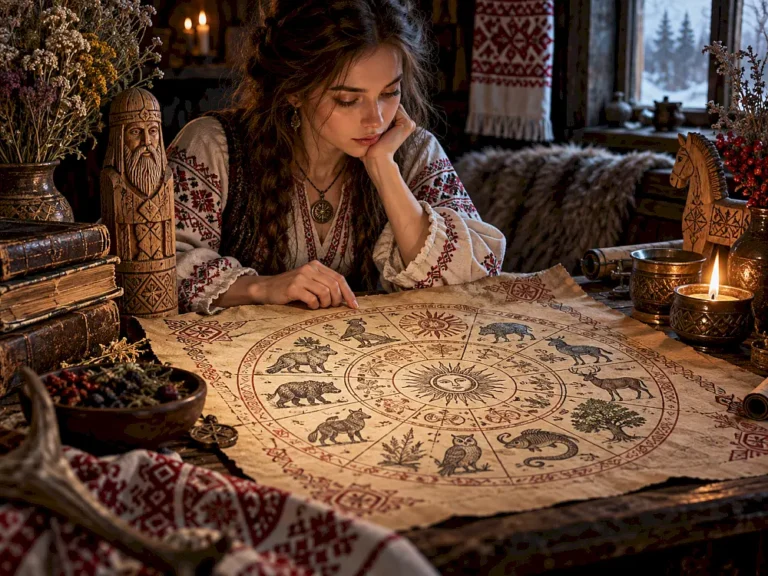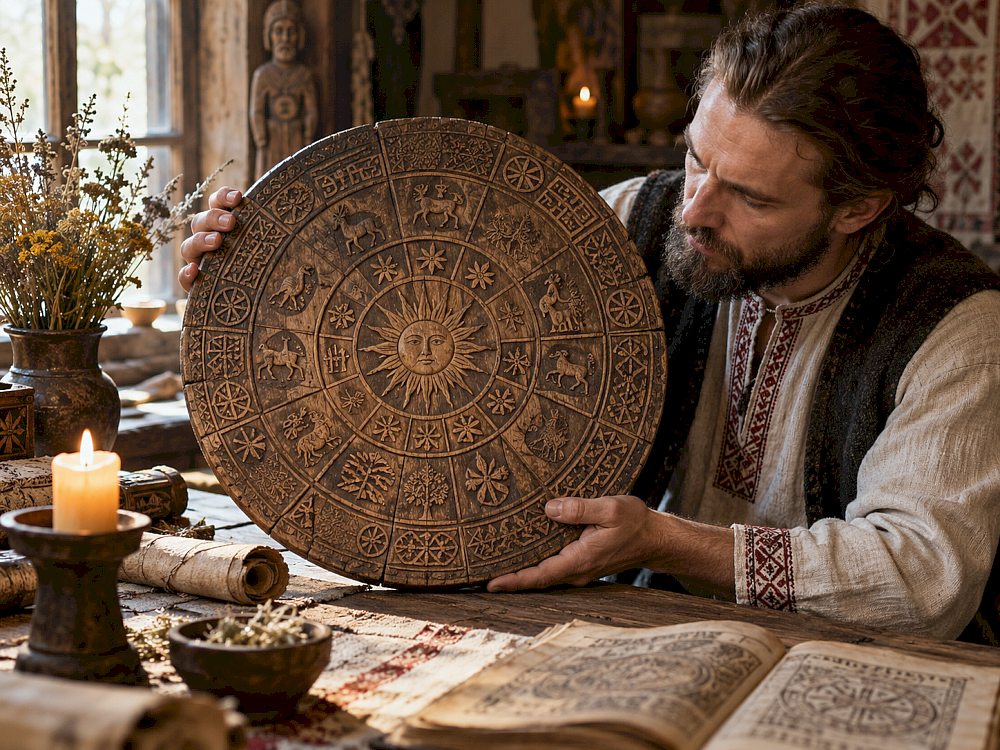
Sixteen “chambers,” patron deities, sacred trees, runes, precise birth dates and an alternative chronology: the modern Svarog Circle is often presented in such detail that it looks like a surviving fragment of a lost Slavic astronomical system. According to popular versions, pre-Christian Slavs supposedly divided the Sun’s annual path into 16 sectors and used a person’s birth chamber to identify character traits and a divine patron.
The difficulty begins when this elegant scheme is traced backwards. Historical sources do confirm pre-Christian Slavic deities, seasonal ritual calendars and complex religious ideas about nature and the heavens. The name Svarog also has a genuine medieval textual history. What they do not provide is the modern Svarog Circle as a complete system of 16 chambers with fixed dates, patron gods, trees, runes and personality profiles. The documented trail of that system is much clearer in modern Slavic Native Faith circles of the late twentieth and early twenty-first centuries.
What the Svarog Circle means today
In its best-known modern form, the Svarog Circle functions as a kind of Slavic zodiac. Instead of twelve zodiac signs, the year is divided into sixteen chambers. Lists commonly include the Maiden, Boar, Pike, Swan, Serpent, Raven, Bear, Stork, Wolf, Fox, Aurochs, Elk, Finist, Horse, Eagle and Rasa.
Each chamber is assigned a patron deity, and many versions add a sacred tree, rune or emblem and a description of the personality supposedly associated with the period. In more elaborate systems the Circle becomes part of the so-called Daa’rian Krugolet of Chislobog, with unusual month names, a nine-day week, 144-year cycles and much larger cosmic periods.
That complexity is one reason the system feels ancient. Yet complexity is not evidence of age: a sophisticated calendar, cosmology and symbolic system can also be constructed in modern times.
Svarog himself is not a modern invention
It would be equally misleading to dismiss every element of the system as recent. Svarog has a much older documentary history. One important source is the Slavic translation of John Malalas’ Chronicle, a passage of which entered the East Slavic chronicle tradition. In it the Greek Hephaestus is identified with Svarog and Helios with Dazhbog, described as his son. The complicated textual history of this passage has long been discussed by scholars of Slavic religion; an academic treatment is available in Studia Mythologica Slavica.
So the claim that modern horoscope writers invented Svarog would be wrong. But the existence of the name does not establish the existence of the Svarog Circle. These are two separate claims: a medieval attestation of Svarog, and a medieval attestation of a specific astrological-calendar system bearing his name. The first has documentary support; the second does not have the same evidential foundation.
Where is the ancient text describing sixteen chambers?
If the Svarog Circle had been a widely used Slavic calendar for centuries, we would hope to find some recoverable trace: a chronicle description, a stable list of chamber names, a calendar table, an archaeological object with a reproducible scheme, or later ethnographic material that preserves a continuous tradition.
That chain has not been demonstrated. The academic collection Sources of Slavic Pre-Christian Religion brings together known medieval texts relevant to pre-Christian Slavic religion. A central difficulty for researchers is precisely the scarcity of indigenous pre-Christian written material; much of what survives was recorded later or by outsiders.
Those sources contain debates about Perun, Veles, Dazhbog, Svarog, Sviatovit and Svarozhich, as well as sacrifice, divination, sanctuaries and ritual calendars. What is missing is a securely attested medieval description of the sixteen-chamber Svarog Circle in the form now circulated by horoscope and calendar websites.
This does not prove that no related oral tradition could ever have existed. It does mean that a modern reconstruction cannot be presented as an established ancient fact without an evidential bridge.
The trail becomes clearer in the 1990s
The late twentieth century is much better documented. In 1992 an Inglist religious organisation associated with Aleksandr Khinevich was established in Omsk. Kaarina Aitamurto and Scott Simpson place the movement within the broader history of contemporary Slavic Native Faith and trace its institutional development to the post-Soviet period. Their Cambridge study provides the wider modern religious context.
Bibliographic records then give us concrete dates. Russia’s National Electronic Library lists Slavic-Aryan Vedas, Book 2, published in Omsk in 1999. A bibliographic analysis of the publications also records a planned volume explicitly titled around the “Daa’rian Krugolet of Chislobog” and the “Svarog Circle.” The relevant Tomsk State University publication makes this modern publishing context visible.
This contrast matters. For the ninth, tenth or twelfth centuries we do not have a text presenting the familiar sixteen-chamber system. For the late 1990s and early 2000s we do have identifiable organisations, books and library records through which one of today’s best-known versions was disseminated.
Did one modern author invent the entire system?
The evidence does not justify such a simple claim. We can trace the dissemination of a particular elaborate version through Inglist circles much more confidently than we can prove that every symbol or component was invented by one individual.
Modern Slavic Native Faith developed through many overlapping reconstruction projects. Twentieth-century authors drew on folklore, archaeology, Indo-European comparisons, esotericism and popular literature. Some motifs may have circulated before they were incorporated into later printed systems.
A more careful conclusion is therefore that Inglist publications of the late twentieth and early twenty-first centuries provide one of the clearest documented environments in which the familiar system becomes fixed and promoted as ancient tradition.
Which parts may genuinely be old?
A modern structure can be built from old materials. Slavic communities genuinely lived by seasonal cycles; farming, commemoration, feast days and ritual life were tied to the annual calendar. The Sun, fire, thunder, fertility and seasonal change had religious significance.
Perun, Dazhbog and several other divine names have historical attestations. Svarog is a legitimate subject of scholarly debate. Wolves, bears, aurochs, elk, horses and birds were all part of the physical and symbolic world of Slavic societies.
That is why the Svarog Circle can feel authentic. It contains many old bricks. But the age of the bricks does not establish the age of the building. Combining genuinely old divine names, animals and seasonal symbolism into a sixteen-sector birth system may create an ancient-looking structure without proving that the complete structure existed in the pre-Christian period.
Why do sixteen chambers feel so convincing?
The system is more elaborate than the familiar twelve-sign zodiac, and complexity often creates an intuition of depth and antiquity. Sixteen sectors are supplemented with gods, trees, runes, special months and large numerical cycles.
Yet systematic detail and historical authenticity are different things. For historians, the decisive question is not how intricate the chart looks but where, when and by whom the system was actually recorded.
What about Peter the Great’s calendar reform?
A popular claim says that the Svarog Circle was the ordinary calendar of Rus’ until Peter the Great abolished it. A real historical reform is being combined here with a much broader conclusion. Peter did change the official chronology: from 1700 the Muscovite state moved away from the Byzantine era “from the creation of the world,” adopted dating from the Nativity of Christ and shifted the start of the year to 1 January.
But that reform does not itself establish a sixteen-chamber pagan calendar. The Byzantine era was a Christian chronological system. Connecting the reform specifically to the Svarog Circle requires independent evidence showing that such a circle was in use before 1700.
Reconstruction is not automatically deception
“Reconstruction” should not be treated as an accusation. Historians also reconstruct the past by combining chronicles, archaeology, language, folklore and ethnography. The crucial difference is transparency: a scholarly reconstruction marks where direct evidence ends and interpretation begins.
A religious or cultural reconstruction may have another purpose — creating a living tradition for a contemporary community. New calendars and symbols can acquire real cultural meaning even if they are not a thousand years old. The problem arises only when a modern reconstruction is presented as an archaeologically or textually established ancient fact.
So what is the Svarog Circle?
The evidence is best understood on three levels. There is a genuine historical foundation: Svarog is not an internet-era invention, and Slavic societies had deities, seasonal rites and sacred calendars.
The specific sixteen-chamber system is not securely attested as an ancient Slavic calendar. No known medieval source reproduces the same chamber list, dates, gods, runes and trees found in modern versions.
Its modern form is much more clearly documented in recent Slavic Native Faith environments, especially Inglist publications from the late 1990s and early 2000s.
Calling the Svarog Circle “just fake” would therefore be too crude. It has become a real part of modern culture and religious identity. But a modern tradition and an ancient tradition are not the same thing. If people continue to use this system for another century, it will indeed become an old tradition — simply one whose documented beginnings lie far closer to our own time than the legend suggests.