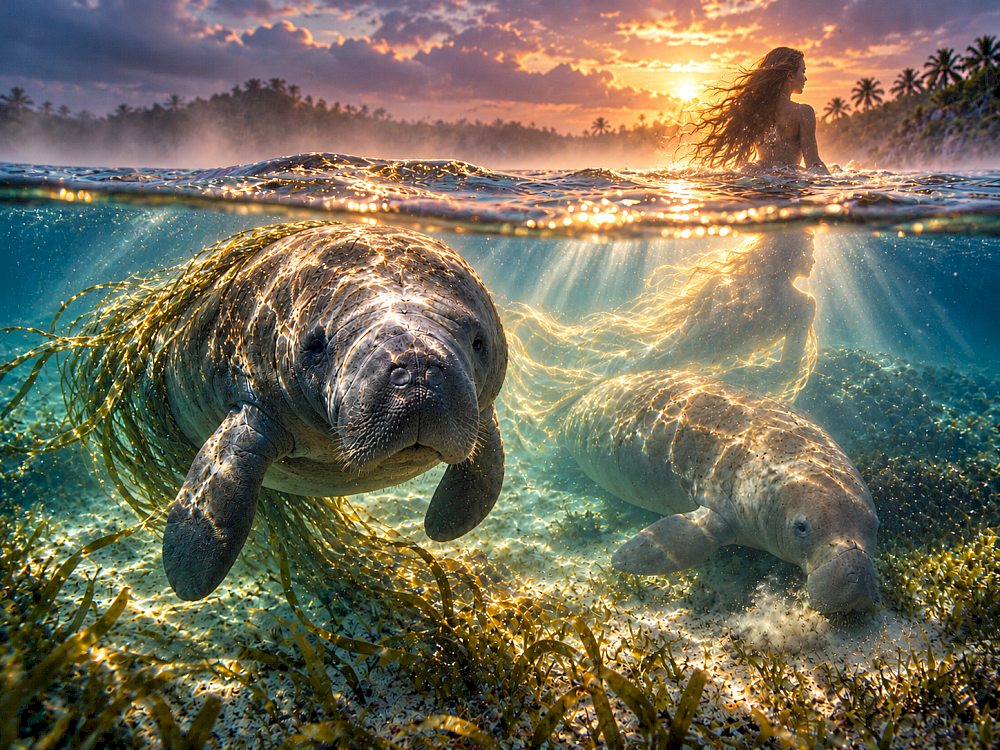
Show a modern reader a photograph of a manatee and few will shout, ‘Mermaid!’ Its bulky gray body and wrinkled skin look nothing like the beautiful sea-woman of popular culture. But sailors centuries ago did not examine wildlife through high-resolution images. They saw unfamiliar animals at a distance, through waves and often for only a few seconds.
Manatees and dugongs are the strongest zoological candidates for animals that reinforced stories of sea mermaids. Seals may have influenced northern tales of sea-people, while dried rays and taxidermy hoaxes supplied audiences with supposed ‘mermaid bodies’.
No single animal probably created every mermaid tradition. A more convincing model is that cultures already had stories about water beings, and real animals occasionally made those stories look observable.
Manatees: mermaids that sailors actually reported
One famous historical case involves Christopher Columbus, who recorded creatures interpreted as mermaids during his first voyage to the Americas. The US Fish and Wildlife Service connects that tradition with manatees.
Manatees surface to breathe, have two forelimbs shaped as flippers, can briefly hold their heads upright and nurse their young. Smithsonian discusses the anatomy and the long cultural connection in Mermaid or Manatee?.
Dugongs fit the classic silhouette even better
Dugongs are close relatives of manatees and belong with them to the order Sirenia. They have foreflippers and a split horizontal tail that looks more like a whale fluke than the rounded tail of a manatee. The Australian Museum notes that adults can grow to around three metres.
The mammary glands of sirenians are positioned near the base of the forelimbs. At a distance this could add another vaguely human feature, especially when a female stayed close to a calf.
Why sirenians are the strongest explanation
Their importance comes from more than superficial resemblance. Historical observers really did interpret these animals through the language of mermaids. That is much stronger than simply finding any marine animal that looks a little unusual.
Even so, manatees and dugongs did not have to invent the myth. Water spirits and female aquatic beings existed in many traditions. A real animal could instead turn a pre-existing story into an apparent eyewitness event.
Seals and northern stories of sea-people
In colder seas, sirenians cannot explain the folklore. Seals are better candidates: they have large forward-facing eyes, rounded heads and a surface behavior that can look unexpectedly human.
Scottish and Orcadian folklore includes the selkie, a seal said to shed its skin and take human form. National Museums Scotland discusses this tradition in its article on animal metamorphosis. Here the animal may have influenced the broader idea of sea-people rather than the fish-tailed mermaid.
Rays and manufactured ‘mermaid bodies’
For centuries Europeans displayed so-called Jenny Hanivers—dried rays or guitarfish deliberately shaped to resemble tiny dragons or humanoid sea creatures. The Natural History Museum notes that such objects were known by at least the sixteenth century in its survey of sea monsters.
Later taxidermy hoaxes combined parts of monkeys and fish. To an eighteenth- or nineteenth-century audience, a physical specimen could look like direct confirmation of stories already circulating.
The legend could teach people what to see
The mechanism could work in both directions. At first an unfamiliar animal might generate a story. Once the story became culturally familiar, later observers already had a template: flippers became arms, a tail fluke became a mermaid’s tail, and a brief glimpse above the surface became a human torso.
That means many witnesses did not need to be dishonest. The mistake could lie in interpretation rather than observation.
What about Ukrainian rusalkas?
Manatees and dugongs do not explain Ukrainian rusalkas. They do not live in Ukrainian rivers, and the traditional rusalka was not normally imagined as a half-fish creature.
For the Ukrainian tradition, cultural, ritual and psychological explanations are much stronger: beliefs about premature death, dangerous water, seasonal rituals and the world of the dead. The modern word may be shared, but the underlying myths are different.
Disclaimer. This article may discuss legends, hypotheses, interpretations and unverified versions. They are not presented as established facts. Confirmed evidence is kept separate from speculation and unverified claims.