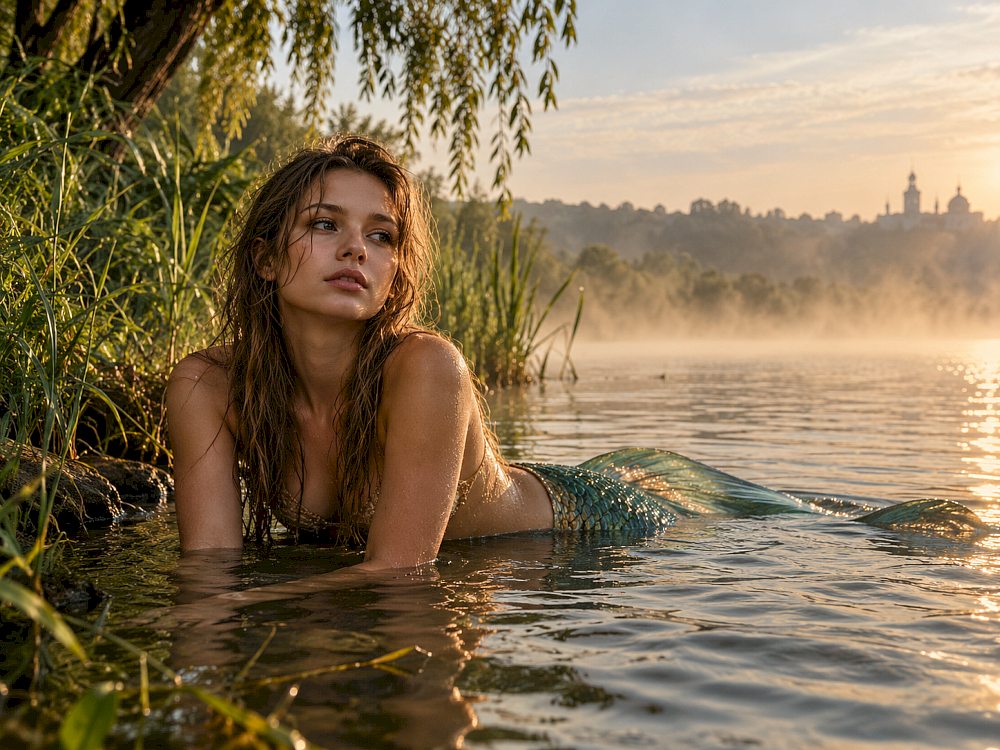
In Ukrainian villages, rusalkas (Mermaids) were not usually described as fairy-tale women with fish tails. In Polissia they were said to appear in rye fields, near forests, on meadows and by rivers. Some communities even performed rituals to symbolically ‘see the rusalkas (Mermaids) off’ after Rusalka Week.
That large body of testimony raises a fair question: could people have been describing real phenomena that we no longer interpret in the same way?
Ukraine unquestionably has an old and rich tradition of belief in rusalkas (Mermaids), numerous ethnographic accounts from people who said they encountered them, and rituals connected with the belief. But there is no physical or biological evidence for rusalkas as a separate species or supernatural population.
What Ukrainians meant by a rusalka
The traditional Ukrainian rusalka differs strongly from the modern sea-maiden. The Encyclopedia of Ukraine describes her as a figure of folk demonology, often linked to the soul of a drowned young woman or a child who died unbaptized.
Ethnologist Volodymyr Halaichuk notes that a fish tail is not typical of Polissian accounts. A rusalka might be an unmarried dead girl, a person who died during Rusalka Week, a drowned person or, in some local traditions, even a man. His fieldwork is discussed by Local History.
The case for: people genuinely reported encounters
Polissia preserves an especially dense body of rusalka stories, with related traditions also known in Volhynia, the Dnipro region, Podillia and the Carpathians. Depending on the village, an encounter could be dangerous or even interpreted as a good sign.
For a believer, repetition across generations looks important. Yet an ethnographic record establishes that someone told a story about an encounter; it does not automatically establish that the being described existed as an objective biological entity.
The case for: real rituals surrounded the belief
Ukraine had Rusalka songs, Green Week traditions and rites for ‘seeing the rusalkas off’. The ethnographic record documents them as genuine elements of seasonal culture.
This tells us that the belief was socially real and emotionally important. It does not by itself demonstrate a physical creature; societies throughout history have built elaborate rituals around gods, ancestors and seasonal spirits.
The case against: no body, bones or DNA
If rusalkas were physical beings, Ukraine would require a breeding population rather than a single mysterious individual. Such a population should leave bones, tissue, hair, DNA, feeding traces or other biological evidence.
None has been reliably identified. That matters because Ukrainian rusalka traditions place the beings around rivers, lakes, fields and forests in long-settled regions, not in an inaccessible deep-ocean habitat.
The case against: the descriptions conflict
Local accounts vary dramatically. A rusalka can be a young woman, a child, a man, a drowned person or someone who died at a particular time of year. She may emerge from water or a grave and appear in rye fields, forests or village roads.
Such variation is normal for folklore because stories adapt to local ideas. It is much harder to reconcile with one biological species, which should show relatively stable anatomy and behavior.
What people may have experienced
There is probably no single explanation for every story. Some encounters may have involved dreams, grief after a death, misperception in twilight, another person or an animal. Other narratives may have been ritual or cautionary from the beginning.
Culture can also shape perception. Someone raised to expect rusalkas in the rye during Rusalka Week already has a ready-made interpretation for an ambiguous movement in the field. The legend can therefore generate new testimony, and the testimony strengthens the legend.
So do rusalkas exist in Ukraine?
There is no persuasive biological evidence for an unknown physical population of rusalkas. As a part of Ukrainian culture, however, rusalkas are unquestionably real as a long-lived and well-documented folk image.
The most careful middle position is that some old experiences can no longer be reconstructed. But ‘we cannot identify what a witness experienced’ is not the same claim as ‘the witness encountered a rusalka’.
Disclaimer. This article may discuss legends, hypotheses, interpretations and unverified versions. They are not presented as established facts. Confirmed evidence is kept separate from speculation and unverified claims.