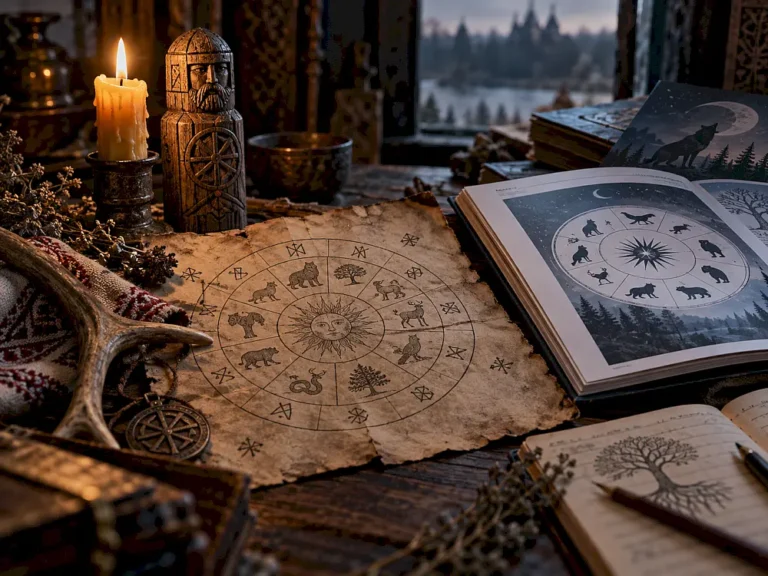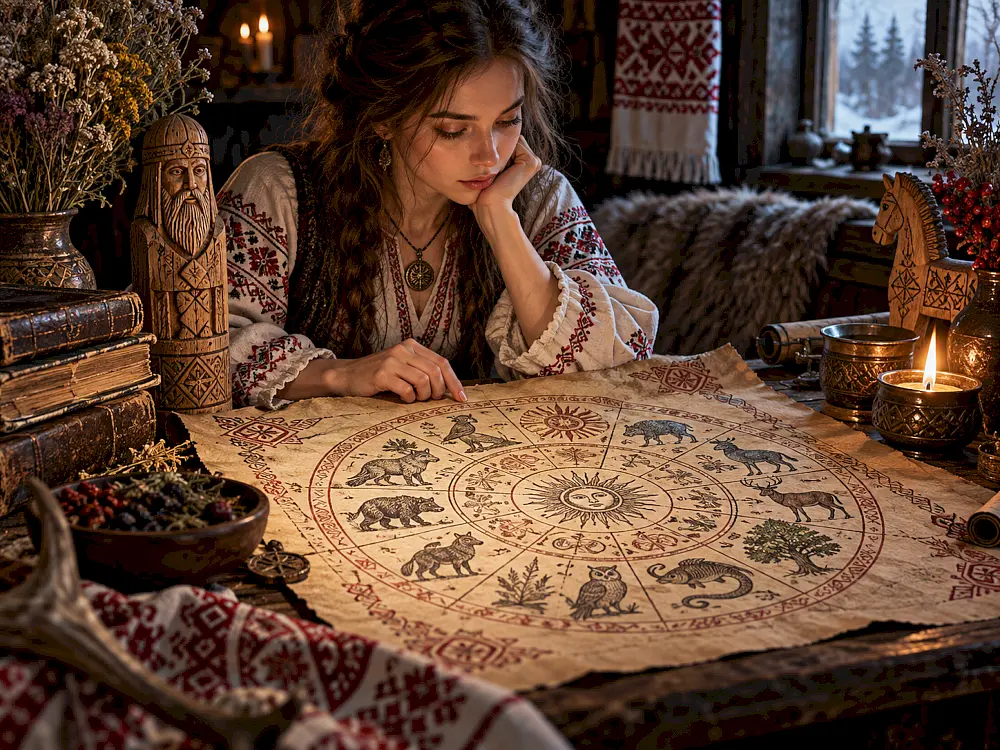
Dark Elk, Stinging Hornet, Fiery Squirrel, Pearl Pike, White Owl or Golden-Horned Bull — the popular “Slavic horoscope” looks very different from the familiar Western zodiac. Instead of Aries, Leo or Scorpio, it uses animals associated with the natural world of Slavic-speaking regions, arranged in a 16-sign cycle.
Finding your sign is easy in the most widely circulated modern version: it is determined mainly by birth year, and the cycle repeats every 16 years. One clarification is essential, however. The phrase “ancient pagan calendar” should not be taken literally. There is no reliable historical evidence that this exact 16-year system existed among pre-Christian Slavs. The table below therefore presents a popular modern reconstruction and cultural tradition, not a proven ancient horoscope.
How to find your sign
One common modern version of the totem year-cycle uses 16 animal signs. Lists of the signs and years circulate widely on astrology websites. One such version appears on Zodiac.kiev.ua; the later years below are mathematical extensions of the same repeating 16-year pattern.
| Sign | Birth years | Image in the modern tradition |
|---|---|---|
| Dark Elk | 1944, 1960, 1976, 1992, 2008, 2024 | Initiative, independence, leadership |
| Stinging Hornet | 1945, 1961, 1977, 1993, 2009, 2025 | Energy, persistence, quick reactions |
| Hidden Wolf | 1946, 1962, 1978, 1994, 2010, 2026 | Inner strength, freedom, self-reliance |
| Fiery Squirrel | 1947, 1963, 1979, 1995, 2011, 2027 | Agility, quick thinking, adaptability |
| Pearl Pike | 1948, 1964, 1980, 1996, 2012, 2028 | Calm, continuity, preference for the familiar |
| Bearded Toad | 1949, 1965, 1981, 1997, 2013, 2029 | Practicality, domesticity, stability |
| Wild Boar | 1950, 1966, 1982, 1998, 2014, 2030 | Determination, force, direct action |
| White Owl | 1951, 1967, 1983, 1999, 2015, 2031 | Observation, independence, solitude |
| Hissing Grass Snake | 1952, 1968, 1984, 2000, 2016, 2032 | Flexibility, patience, avoiding obstacles |
| Stealthy Fox | 1953, 1969, 1985, 2001, 2017, 2033 | Resourcefulness, caution, strategy |
| Curled Hedgehog | 1954, 1970, 1986, 2002, 2018, 2034 | Attention to detail, defensiveness, loyalty |
| Soaring Eagle | 1955, 1971, 1987, 2003, 2019, 2035 | Freedom, idealism, independent views |
| Spinning Spider | 1956, 1972, 1988, 2004, 2020, 2036 | Planning, patience, bringing people together |
| Crowing Rooster | 1957, 1973, 1989, 2005, 2021, 2037 | Visibility, activity, emotional intensity |
| Golden-Horned Aurochs | 1958, 1974, 1990, 2006, 2022, 2038 | Endurance, stubbornness, protectiveness |
| Fiery-Maned Horse | 1959, 1975, 1991, 2007, 2023, 2039 | Energy, freedom, movement and novelty |
If your year is not shown, add or subtract 16. For example, the sign assigned to 1992 repeats in 2008 and 2024.
What if you were born in January, February or March?
This is where modern versions begin to disagree. One popular rule says the cycle starts on 21 March, near the spring equinox. Under that convention, anyone born before 21 March is assigned the previous year’s totem.
Using that version, a person born on 10 February 1992 would receive the previous sign — the Fiery-Maned Horse — rather than the Dark Elk.
Other publications use 20, 21 or 22 March, while some simply follow the calendar year beginning on 1 January. This disagreement matters: there is no single historically established rule for the modern totem horoscope.
Why 16 animals?
The list feels plausibly Slavic. Elk, wolf, boar, pike, fox, hedgehog, eagle, aurochs and horse fit naturally into the forests, steppes and river environments of Central and Eastern Europe. Archaic names make the system feel even older.
But cultural plausibility is not historical proof. The scholarly corpus Sources of Slavic Pre-Christian Religion contains no known description of this 16-year animal cycle. At the same time, the modern study Slavic Native Faith shows that Slavic calendar and zodiac reconstructions were actively created in the twentieth century.
The SEE Check investigation likewise finds no ancient source for the popular system and traces the spread of several “Slavic horoscope” variants to much later periods.
WOW:
What do the personality descriptions mean?
Labels such as “independent Elk”, “strategic Fox” or “enduring Aurochs” are not established psychological traits of people born in those years. They are short summaries of how the totems are portrayed in the modern popular tradition.
It is easy to recognise ourselves in broad and favourable descriptions. Psychology describes a similar process as the Barnum effect, in which general statements can feel uniquely personal.
A more interesting question is therefore not only “does my sign sound like me?”, but “could I identify my own description among several anonymous alternatives?”. A blind test could reveal whether the system offers anything beyond chance self-recognition.
So what is your Slavic sign?
If you choose to use the popular 16-year totem cycle, find your birth year in the table. If you were born early in the year, first decide which convention you are following: a calendar-year system or the version that changes near the spring equinox.
But interpret the result correctly. If you were born in 1992 and receive the Dark Elk, that does not mean historians have found an ancient Slavic manuscript with that rule. It means that in one popular modern reconstruction, the Elk is assigned to your birth year.
Conclusion
The Slavic totem horoscope can be an enjoyable cultural game built around nature symbolism and personality archetypes. Historically, however, it is more accurate to call it a modern reconstruction or popular tradition than a proven ancient pagan calendar.
That makes its central mystery even more interesting: not only “what is your sign?”, but “how did a relatively new symbolic system come to look so convincingly ancient?”
Disclaimer. This article belongs to the “Myths and Mysteries” category. The sign descriptions are presented as part of a modern popular tradition, not as a scientifically validated personality system or a historically established pre-Christian calendar.