
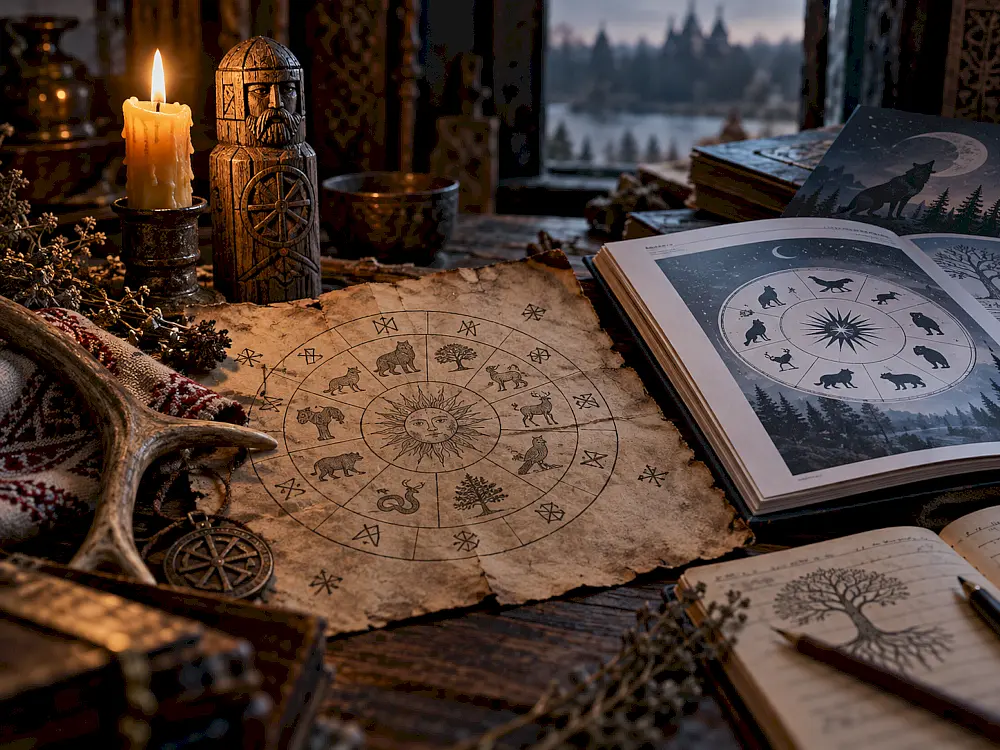
The Slavic horoscope is often presented as a system supposedly used by pre-Christian Slavs. Online versions feature the Dark Elk, Stinging Hornet, Fiery Squirrel, Bearded Toad, Golden-Horned Bull and other animal signs arranged in a 16-year cycle. The archaic names make the system feel ancient. Yet when the history is traced forward from dated sources rather than backward from modern websites, a different picture emerges.
There is no reliable evidence that the familiar 16-year “Slavic horoscope” existed among pre-Christian Slavs in the form used today. What can be documented much more clearly are modern attempts to build Slavic calendar and zodiac systems in the twentieth century, followed by the much later spread of the popular totem version.
No ancient original has been established
Researching pre-Christian Slavic religion is difficult because of the nature of the surviving evidence. The scholarly volume Sources of Slavic Pre-Christian Religion assembles medieval texts that refer to Slavic beliefs before and during Christianisation. These are largely external or Christian-era testimonies, not a surviving pagan manual written by the Slavs themselves.
This means we cannot prove that no Slavic community ever had birth-related divination, calendar beliefs or symbolic relationships with animals. But that is very different from demonstrating a structured 16-sign horoscope in which a birth year fixed a person’s totem and personality. No known early source contains the modern sequence beginning with the Dark Elk, Hornet, Wolf and Fiery Squirrel.
The 1940s: a Slavic zodiac is being created in modern times
One of the clearest documented trails leads to twentieth-century Poland. In Slavic Native Faith, Kaarina Aitamurto and Scott Simpson trace Western Slavic Native Faith calendars to writings from the 1920s and to Władysław Kołodziej’s calendars of the 1940s. They explicitly describe Kołodziej’s Slavic zodiac as a creation of his own.
In the 1947 Kalendarz Słowiański, familiar astrological signs receive “Lechitic” counterparts: Aquarius is paired with the Elk, Taurus with the Aurochs, Leo with the Bison and Scorpio with the Deer. Plants, birds, colours and seasonal symbolism appear alongside them. This is not a copy of a medieval manuscript; it is a modern effort to formulate a Slavic alternative to an astrological calendar.
Some images overlap with later totem lists, but that does not prove that today’s 16-year cycle descends directly from Kołodziej. What the document does prove is that people were consciously constructing “Slavic zodiac” systems by the mid-twentieth century.
The 1990s: the idea circulates, but its source is already unclear
A later stage was reconstructed by the fact-checking project SEE Check. It traces a reference to a “Slavic horoscope” to a 1996 publication by I. S. Smetannikov. The revealing detail is that the author reportedly said he had heard about it on an unidentified radio programme and had been unable to find supporting information in the literature available to him.
By the mid-1990s, then, the idea was circulating in the Russian-speaking information space, but even someone writing about it could not point to an ancient text or ethnographic source. That pattern looks more like the emergence of a new tradition than the recovery of a well-documented pre-Christian system.
In the early twenty-first century, the familiar totem cycle takes shape
During the 2000s, “Slavic horoscope” material spread through themed websites, forums and esoteric publications. The now-familiar 16-year sequence appears with signs such as the Dark Elk, Stinging Hornet, Hidden Wolf, Fiery Squirrel, Pearl Pike and Bearded Toad.
No single document has yet been identified in which one clearly named author first creates this exact sequence and explains its origin. Assigning the popular 16-year totem cycle to one proven inventor would therefore go beyond the available evidence.
What can actually be dated
| Period | What is documented | What it means |
|---|---|---|
| 1920s–1940s | Modern reconstructions of Slavic calendars and zodiac systems | The idea of a Slavic alternative to the zodiac existed before the internet |
| 1947 | Kołodziej’s calendar includes an author-created “Slavic zodiac” | A direct example of modern system-building is documented |
| 1996 | A Russian-language reference to a “Slavic horoscope” appears without a reliable historical source | The idea is circulating, but its origin is unclear |
| 2000s | Animal, deity, plant and other variants spread online | The modern family of “Slavic horoscopes” takes shape |
If we are asking about one of the earliest clearly documented modern Slavic zodiacs, a name can be given: Władysław Kołodziej and his 1940s calendars. If we mean the popular 16-year animal cycle used today, its original author has not been established.
Why does it feel so ancient?
The system is culturally persuasive. Elk, aurochs, boar, wolf, pike, owl, fox and horse belong naturally to the landscapes and folklore of Slavic-speaking regions. Archaic vocabulary adds an extra layer of authenticity, as do references to pagan gods, seasonal cycles, talismans and equinoxes.
But the antiquity of individual symbols does not demonstrate the antiquity of the entire structure. Old cultural elements can be recombined into a new system. Without evidence of continuity, it is more accurate to describe the horoscope as a modern reconstruction or cultural tradition.
Conclusion
The Slavic horoscope familiar today does not have a demonstrated lineage back to the pre-Christian period. The best-documented history runs from twentieth-century reconstructions to the rapid spread of multiple “Slavic” horoscope systems in the late twentieth and early twenty-first centuries.
That makes the subject no less interesting. Its real mystery may be how folklore, nature symbolism, pagan imagery and astrology were assembled into a modern picture of the past convincing enough to be remembered as ancient tradition.
Disclaimer. This article belongs to the “Myths and Mysteries” category and discusses legends, reconstructions and competing accounts of their origins. Unverified claims are not presented as established historical facts.