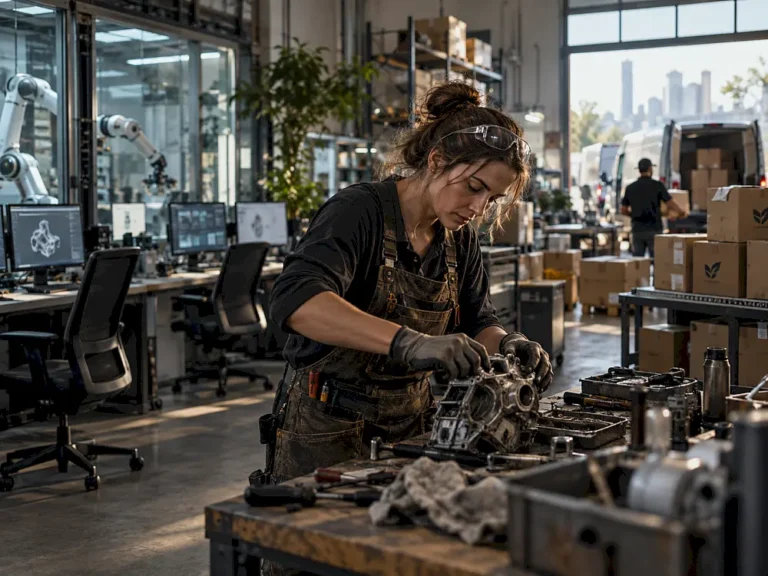
China’s livestream-shopping market already offers a glimpse of the next decade’s creator conflict. A digital host can stay on air around the clock, does not get tired, does not negotiate a fee for every stream and can be scaled across languages. According to reporting by Reuters, JD.com says AI hosts can reduce livestream operating costs by 80–90%. Yet people inside the industry also point to the machine’s weakness: building the kind of trust that makes a customer buy remains harder.
Forecast details
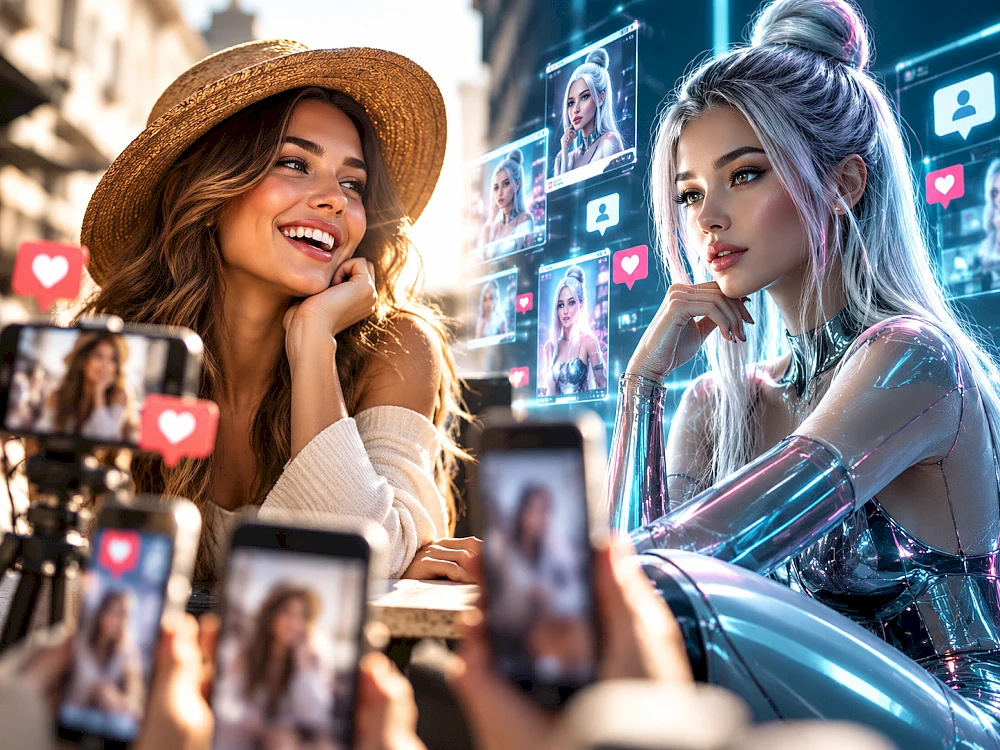
That tension is likely to shape the next decade of influencer marketing. An AI creator can be cheaper, available 24/7 and produce hundreds of localized variations in a day. A real person owns something far less scalable: a biography, reputation, lived experience, unpredictability and the ability to tell an audience, “I actually used this.”
ORBK.NET’s current estimate is that fully synthetic AI influencers have about a 25% probability of displacing humans enough to capture a majority of global paid creator/influencer marketing spend by the end of 2035, with a working range of 20–35%.
The base-case forecast is therefore no. AI influencers are very likely to become a normal part of social media and absorb a substantial amount of advertising work, but the more likely outcome is a market split between humans amplified by AI and fully synthetic personalities.
There is already a large market to disrupt
Influencer marketing is no longer a small advertising experiment. WARC estimated global brand spending on creators at about $37 billion in 2026. AI is entering a mature market where brands pay people for audience access, content production, product recommendations and the transfer of personal trust onto a product.
The production side of that equation is especially attractive to synthetic influencers. Photos, videos, product demonstrations, short conversations, wardrobe changes, backgrounds and language localization are becoming cheaper. One virtual creator can theoretically operate many accounts, respond to thousands of users and produce personalized ads at a scale no individual human can match.
If advertising is judged mainly by output volume, publishing frequency and cost per contact, synthetic characters have a structural advantage. The problem begins when the brand is buying not just content, but trust.
Humans still own something that is difficult to synthesize
An influencer does not work simply because a face appears in a feed. Their influence accumulates over months or years. Followers see how the person lives, changes opinions, makes mistakes and behaves outside individual campaigns. Even imperfection becomes part of reputation.
An AI persona can be given a biography, childhood photos, friends, an apartment, memories and years of synthetic posts. That technological barrier will continue to fall. But knowing that none of those experiences were actually lived may still change how audiences interpret a recommendation.
A 2025 systematic review of 51 virtual-influencer studies in Acta Psychologica found that trust, perceived authenticity and transparency about the character’s origin remain central to audience engagement. The research review does not support a simple rule that humans always outperform virtual creators, but it shows that authenticity remains a core problem for synthetic personalities.
In 2026, Sprout Social found a similar signal in a survey of 2,250 consumers in the United States, United Kingdom and Australia: 44% said they were uncomfortable with brands using AI influencers. This is not a global forecast of future behavior, but it shows that the ability to create a convincing digital person does not automatically produce willingness to trust that person’s recommendations.
Where AI influencers can win quickly
Not all influencer marketing depends on deep personal trust. Much of it is closer to scalable advertising production. Fashion, beauty imagery, gaming, entertainment, mass-market products, travel visuals, virtual shows, e-commerce and parts of technology marketing are particularly suited to synthetic creators.
If the main job is to display a product attractively, maintain a recognizable style and appear frequently in front of a target audience, a real biography may be unnecessary. Livestream commerce already shows the economic incentive: digital hosts can work continuously at lower operating cost, while human hosts remain stronger where nuanced product judgement, unusual questions and trust matter.
The market may therefore split according to the value of human presence. Where brands need thousands of simple videos across products, countries and small audience segments, AI gains a growing advantage. Where a single public voice must persuade millions of people to make an expensive or complex purchase, authentic human presence may become more valuable rather than less.
The strongest rival to an AI influencer is a human influencer using AI
Full displacement is less likely because real creators will not remain technologically unchanged. They will also use generative video, automated editing, voice translation, digital doubles, script systems, personalized responses and autonomous agents.
YouTube already requires disclosure for realistic synthetic or meaningfully altered content, while disclosure itself does not automatically make content ineligible for monetization. The platform’s AI disclosure rules suggest a plausible future model: AI becomes a standard creator tool, but increasingly transparent.
A successful influencer in 2035 may therefore be a real person who physically records only part of what the audience sees. Their AI double could translate videos into many languages, answer common questions, create short versions of long content and appear in virtual ad scenes. In this forecast, that does not count as a fully synthetic influencer as long as the public identity, reputation and accountability remain tied to a real person.
The hybrid model currently looks like the strongest candidate for the future: the human provides name, experience and trust; the machine provides scale.
Why a fully synthetic creator could still break through
Low trust today does not guarantee low trust tomorrow. A generation that grows up with AI personalities in its feed may not treat artificiality as a defect. The most important shift will be from pre-produced posts to continuous interaction: an AI influencer could remember earlier conversations with an individual follower, respond personally, livestream and maintain millions of parallel relationships.
WOW:
At that point, the definition of authenticity itself may change. The question becomes less “is this person real?” and more “is my relationship with this character meaningful to me?” If audiences accept that model, the current human advantage could weaken quickly.
There is also a strong business incentive. A fully synthetic personality can be owned as intellectual property. It cannot leave for a rival, demand a larger contract after becoming famous or derail a campaign with an unexpected public statement. But that same control creates a weakness: if the audience sees the character as nothing more than a polished corporate asset, it loses the independence for which brands hire human creators in the first place.
Transparency may matter more than realism
The technology race is often framed as a question of when AI people become visually indistinguishable from real ones. For the influencer economy, another question may matter more: will platforms and regulators allow their synthetic nature to remain hidden?
If synthetic-content labeling becomes normal, the most successful virtual creators may not be those pretending to be human. They may be openly artificial personalities with their own aesthetics, humor and identity. In that case, the AI influencer becomes a distinct genre — closer to an animated character, virtual performer or game personality — rather than a cheap copy of a human.
That is another reason why “replace” may be the wrong description of the future. A new class of creators can build its own audience without eliminating the old one.
What historical analogies suggest
There is no sufficiently large historical sample to calculate a meaningful base rate for AI influencers. Fully generative public personalities are too new. Broader media transitions, however, show a recurring mechanism: photography did not eliminate painting, film did not eliminate theatre, television did not eliminate cinema, and social media did not eliminate traditional celebrities. New formats tend to take over some functions, create new genres and force existing participants to adapt.
The creators at greatest risk are those whose value consists mostly of inexpensive, interchangeable content production. If a creator mainly reads a prepared ad script and adds little expertise, personal experience or community value, that work is far easier to automate than the work of someone with a strong reputation and loyal audience.
Four scenarios through 2035
| Scenario | Probability | What happens |
|---|---|---|
| Human + AI becomes the standard | 45% | Most major human creators actively use AI doubles, translation, generation and automation. Fully synthetic creators grow, but human identity remains the main carrier of trust. |
| AI influencers become a large but secondary market | 25% | Virtual creators take substantial shares of fashion, gaming, e-commerce, entertainment and mass advertising content but do not capture most spending. |
| AI influencers displace humans across most of the ad market | 25% | Synthetic characters become cheap, personalized and persuasive enough to capture more than half of influencer marketing spend. |
| A strong social backlash limits adoption | 5% | Trust problems, regulation and cultural pushback keep fully synthetic creators a relatively small niche. |
Only the third scenario meets the formal displacement criterion. That is why the central estimate is about 25%. Importantly, AI still transforms the market in three of the four scenarios; the difference is who remains the public face of that economy.
What would change the forecast?
The estimate should rise if fully synthetic creators do more than generate views during 2027–2030 and begin delivering sales conversion close to human creators; if major brands move from experiments to multi-year contracts; and if synthetic personalities build durable communities that return specifically for them.
A particularly strong signal would be AI influencers successfully selling expensive or high-consideration products such as cars, complex electronics, travel or education. If audiences trust a synthetic character where a mistake costs real money, the advantage of lived human experience becomes much weaker.
The estimate should fall if AI influencers remain mainly a tool for cheap e-commerce and entertainment content; if mandatory disclosure systematically reduces their commercial performance; if major human creators successfully scale through their own AI versions; or if brands begin using “real human” as a premium signal of trust.
The key metric is not the number of AI accounts. Creating a million virtual creators may become technically easy. The real turning point comes when brands move most of the money because synthetic personalities sell as well as humans.
Who is most at risk?
The greatest risk may not be to celebrities. A distinctive personality with millions of followers has a strong moat because the name itself is an asset. The more exposed group is the broad middle layer of creators producing standardized reviews, sponsored integrations, lifestyle clips, marketplace videos and UGC advertising.
If one human creator costs a brand as much as hundreds of localized AI videos, some of that work will almost inevitably be automated. At the same time, this raises the value of what is harder to automate: genuine expertise, access to real life, exclusive experience, live events, reputation and community.
So will AI influencers replace real influencers?
By 2035, probably not. Synthetic influencers will have one of the strongest economic advantages in digital advertising: they can be created at scale, localized across markets, tightly controlled and operated continuously. They are likely to absorb a substantial amount of advertising content, especially where human life experience is not part of the product.
But the influencer economy grew because audiences began trusting particular people more than impersonal advertising. When a brand replaces that person with a character it fully owns, it gains control but risks losing the independent trust that made influencer marketing valuable.
The most likely creator of 2035 may therefore remain a real person whose digital presence is increasingly produced by machines. AI does not necessarily take the influencer’s audience. It is more likely to become part of the influencer.
Forecast card
| Forecast question | Will fully synthetic AI influencers capture at least 50% of global paid creator/influencer marketing expenditure in calendar year 2035? |
|---|---|
| AI influencer definition | A public persona that does not represent a specific real person and whose appearance, voice and core content are predominantly generated synthetically. |
| Excluded from AI influencer category | A real person using AI for editing, generated scenes, translation, digital doubles or automation if their personal identity and reputation remain the core of the public brand. |
| Meaning of “replace” | Fully synthetic creators capture ≥50% of global paid influencer/creator marketing expenditure. |
| Horizon | December 31, 2035 |
| Probability | 20–35%; central estimate about 25% |
| Confidence | 55/100 — moderate |
| YES criterion | The best available global market data show ≥50% of paid creator/influencer spend going to campaigns built around fully synthetic personas in 2035. |
| NO criterion | The share remains below 50%. |
| VOID condition | By June 30, 2036, available data cannot separate synthetic creators from human-led or hybrid creators even using two independent global estimates. |
| Resolution date | By June 30, 2036 |
| Resolution method | Global WARC data plus at least one independent comparable industry dataset. |
| Historical similarity | N/A |
| Thematic index | N/A |
| Snapshot date | September 30, 2026 |
| Planned reviews | 2028, 2030 and 2033 |
Forecast disclaimer: This forecast does not claim that the event will occur. It is a current probability estimate based on information available at the time of the forecast and may change as new information appears.