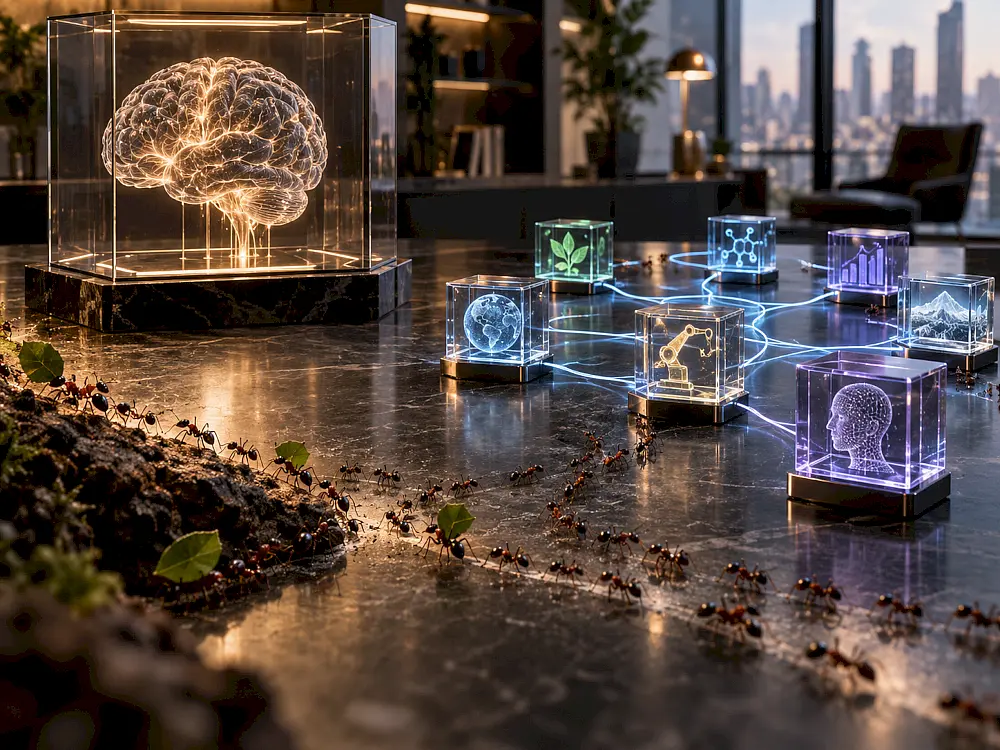
Future artificial intelligence may develop not as one ever-larger model, but as a system of specialized agents that divide work among themselves. Yet the natural parallel with ants has one important limit.
Forecast details
An ant colony has a queen, but no boss. The queen does not assign tasks or command workers. Biologist Deborah Gordon has described colonies as systems without centralized control: individual ants respond to local information and interactions with others, while complex behavior emerges at the level of the colony as a whole. In her Nature essay available through Stanford, one detail is especially important: no single ant has a complete picture of what is happening, yet the colony can still regulate foraging and respond to environmental conditions.
Modern artificial intelligence developed for a long time according to almost the opposite logic. The main bet was on an increasingly capable general-purpose model: more compute, better reasoning, longer context, more tools — one digital “brain” to which we give a task.
But by 2026, another trajectory is already visible alongside that one. One agent receives a task, breaks it into parts, creates other agents, sends them to investigate different directions, and then gathers the results. Some agents can search for information, others can write code, check calculations, work with documents, or criticize the conclusions of their “colleagues.”
The most likely outcome is that future AI will indeed become much more colony-like. But not instead of a large brain. The most realistic architecture by the end of the decade is a large brain with a colony around it.
The current estimate that multi-agent architecture will become a full production capability in at least three of five pre-defined major AI ecosystems by the end of 2030 is about 75%. Confidence in this estimate is 65 out of 100: the direction is already visible, but we still do not know how quickly stronger single models will reduce the advantages of collective work.
AI agents are already starting to divide work
An AI agent differs from an ordinary chatbot because it can do more than generate an answer. It can carry out a sequence of actions: plan the work, use tools, obtain new information, check intermediate results, and adjust the next steps.
The next level is a multi-agent system. Instead of one agent playing every role, there is a team.
This is no longer only a laboratory concept. Current OpenAI developer guidance describes native multi-agent orchestration: a lead agent can distribute parallel work among subagents and then collect their results for final synthesis. The important point is that this is not merely an experimental repository but an architectural mechanism in a production API.
Anthropic has taken a similar route with its Research system. The company describes an architecture in which a lead agent plans the research, creates specialized subagents, and lets them work in parallel on different parts of the question. Their results then return to the coordinator. According to internal Anthropic data, this approach performed especially well on broad research tasks but came with a much higher computational cost: the company reported that its multi-agent systems could use roughly 15 times more tokens than ordinary chat interactions. Anthropic also explicitly noted that tasks with many sequential dependencies can be poor candidates for this architecture.
So the first half of the natural parallel already works. One complex process can be divided among many relatively autonomous participants.
But the second half is much more interesting.
Ants have no manager. AI agents still do
If we look at the most visible multi-agent architectures today, they resemble not a pure anthill but an organization with a manager.
There is a coordinator. It receives the initial task, decides who should do what, and assembles the final answer.
An ant colony works differently. No individual ant holds the colony’s global plan in its head. Local interactions gradually shape the behavior of the whole system. This is where the analogy begins to break — and that matters, because a natural parallel should not be turned into proof of the future.
AI may borrow division of labor, specialization, parallelism, and local interaction from a colony while keeping a centralized layer of control. Today, that combination looks more practical.
The reason is simple: someone has to check whether all the agents were even solving the same task.
When ten agents work in parallel, they can do more than expand the volume of intellectual work. They can also make ten different kinds of mistakes.
The colony’s biggest problem is coordination
Imagine a simple task: find information about ten independent companies.
It is natural to split it among ten agents. They can work at the same time with little interference, and a coordinator can merge the results afterward.
Now consider a different task: edit a complex software system where each next change depends on the previous one. If ten agents start changing different parts at the same time, they may no longer be working from the same project state. The advantage of parallelism quickly turns into synchronization costs.
That is what one of the most important 2026 studies illustrates. Authors of a paper in Nature compared single-agent and multi-agent systems across 260 controlled configurations, covering six task types, five architectures, and three families of large language models. The result looked nothing like the simple rule “more agents means more intelligence.”
On one structured financial task, the best multi-agent configuration outperformed the single-agent setup by about 81%. On sequential planning, some multi-agent architectures instead lost as much as 70%. The researchers concluded that what matters is not simply task difficulty, but whether the task can be naturally divided into independent parts. In addition, the better one agent already performs, the less guaranteed benefit comes from adding several more.
That changes the forecast itself.
The future probably does not belong to a system that launches twenty agents for every question. It belongs to a system that understands when it needs a colony and when it is better to remain one brain.
Evolution may favor better role allocation, not simply more agents
This is where the natural parallel becomes especially interesting.
An effective colony is not made of thousands of insects all trying to do the same thing at once. Its strength comes from the division of functions and rules of interaction.
A similar principle may gradually become established in AI.
For a large research task, one agent might cover academic sources, another the market, a third statistics, a fourth counterarguments, and a fifth calculation checks. They do not even have to use the same model: a stronger and more expensive model can remain the coordinator while cheaper models perform narrow operations.
This is economically more important than it seems. If every digital “worker” must be the most powerful model on the market, the colony becomes very expensive. If the system learns to route hard tasks to a strong agent and simple ones to cheaper specialists, the economics change sharply.
Then the unit of competition among AI companies may gradually shift from the model to the system: model plus memory, tools, agents, verification, routing, and coordination.
That may become one of the most important technological shifts of the second half of the decade.
Agents from different companies may also learn to “recognize” one another
There is another signal that makes the colony scenario more interesting.
WOW:
If all agents belong to one provider, they are relatively easy to manage. It is much harder to build a system in which an agent from one company can find another agent, understand its capabilities, hand off part of the work, and receive a result.
That is why standards for agent-to-agent interaction have begun to emerge. The A2A protocol, initiated by Google and transferred to the Linux Foundation, is being developed as an open standard for interaction between agents from different platforms. Major technology and enterprise vendors joined the project during its formation, and stated goals include interoperability, secure interaction, and shared infrastructure for agents.
This is not yet a mature “internet of agents.” A standard does not guarantee mass adoption, and company participation does not prove that the future market will necessarily be open.
But the direction matters.
If such protocols take hold, a future system may be able to choose not only an internal function but an external specialist. One agent could call a financial-data agent, another a legal agent, a third a logistics agent, while a fourth checks their work.
In such an architecture, the parallel with a living ecosystem becomes much stronger.
Why one giant brain is not going away
It is easy to imagine the opposite future: if a powerful model can itself read millions of tokens, use dozens of tools, remember previous actions, and plan increasingly well, why create a team at all?
This is the strongest counterargument to the forecast.
Multi-agent systems solve the throughput limits of one agent, but they create another problem at the same time: information must be transferred among participants. Context can be lost; duplication, contradictions, extra cost, and new points of failure can appear.
That is why improvements in base models may paradoxically reduce the need for teams of agents in some tasks. If one strong agent can reliably complete in ten steps what previously required five weaker agents, the simpler architecture wins again.
So the question “one brain or a colony?” is almost certainly too rigid.
The most likely answer is both.
At the lower level, increasingly capable general models will remain. Above them, a software layer will decide when one model is enough, when a specialized agent is needed, and when it is worth launching an entire team.
Users may not even know how many agents worked on their task. They will ask one question, and the system itself will choose the necessary organization of work.
That moment would mark the real transition.
Four scenarios to 2030
Current evidence does not support a future in which one type of architecture eliminates all the others. It is more realistic to divide the future into four trajectories.
| Scenario | Probability | What happens |
| Coordinator + specialized agents | 60% | A strong general model manages a team of subagents and launches them only for tasks where division of labor creates an advantage. |
| One strong agent remains dominant | 25% | Models improve memory, tools, and long-horizon reasoning so much that multi-agent systems remain a specialized feature. |
| Cross-platform agent networks | 10% | Interaction standards mature and agents from different companies routinely delegate work to one another. |
| A truly decentralized “swarm” | 5% | A meaningful share of complex work is coordinated without a permanent central agent through local interaction among autonomous participants. |
The first scenario carries the most weight. It already has production analogues, does not require abandoning strong foundation models, and allows work to scale where a problem can be naturally decomposed.
A true ant-colony architecture — a system without a central coordinator — still looks much less likely. Here the biological metaphor is ahead of the technology.
What could raise or lower the forecast
The 75% estimate should rise if independent tests over the next few years begin to show a stable multi-agent advantage not only in isolated demonstrations but across a broad range of practical parallel tasks. A fall in coordination cost would also be a strong signal: if a team of agents costs only modestly more than one agent, the economic barrier weakens substantially. Even more important would be a shift from multi-agent systems as developer tools to a standard hidden behavior inside mass-market AI products.
The forecast should be lowered if strong single models increasingly achieve the same or better quality at lower cost; if independent studies continue to find serious error accumulation as agent counts rise; or if control, security, and audit requirements make large autonomous networks too risky for real businesses.
One signal matters especially: not how many companies start using the phrase “multi-agent” in marketing, but what actually happens inside task execution.
Nature shows a direction, not a ready-made answer
There is no honest historical base rate for this question. Modern language agents have existed for too short a time to collect dozens of genuinely comparable technological transitions and say that, for example, 73% of complex intelligent systems moved from one center to a network of participants.
So ants are not statistical proof here.
They are useful for another reason.
An ant colony shows that complex adaptive behavior can emerge without one participant knowing everything. It demonstrates the power of specialization, local signals, parallel work, and simple rules of interaction.
Artificial intelligence is already beginning to experiment with the same principles — but it adds things an ant colony does not have: a powerful central coordinator, global memory, and the ability to deliberately choose an architecture for a particular task.
So by 2030 we probably will not see a moment when the “big AI brain” suddenly disappears and is replaced by thousands of digital ants.
Something else is more likely.
The big brain will learn to create a colony for itself when it needs one.
And if that transition really happens, the most important question of the future will no longer be “which model is smartest?” but “which system organizes the work of many different intelligences best?”
Forecast card
| Field | Recorded version |
| Forecast question | By December 31, 2030, will at least 3 of the 5 fixed ecosystems — OpenAI, Google, Anthropic, Microsoft, and Meta — have a fully documented production multi-agent architecture for complex user or developer tasks? |
| Probability | About 75% |
| Confidence | 65 out of 100 — moderate |
| YES criterion | At least three of the five ecosystems offer not merely a demonstration but a stable product or API capability that can automatically divide one task among at least three agents/subagents, exchange results, and produce a joint output. |
| NO criterion | No more than two of the five ecosystems meet this criterion by the deadline. |
| Time horizon | Through December 31, 2030 |
| Resolution date | January 15, 2031 |
| Forecast snapshot date | September 7, 2026 |
| Forecast history | September 7, 2026 — initial estimate: 75%, confidence 65/100 |
| Main trajectory | Strong coordinator + specialized subagents |
Disclaimer
This forecast does not claim that the event will happen. It reflects a current probability estimate based on information available at the time of the forecast. The estimate may change as new information appears.