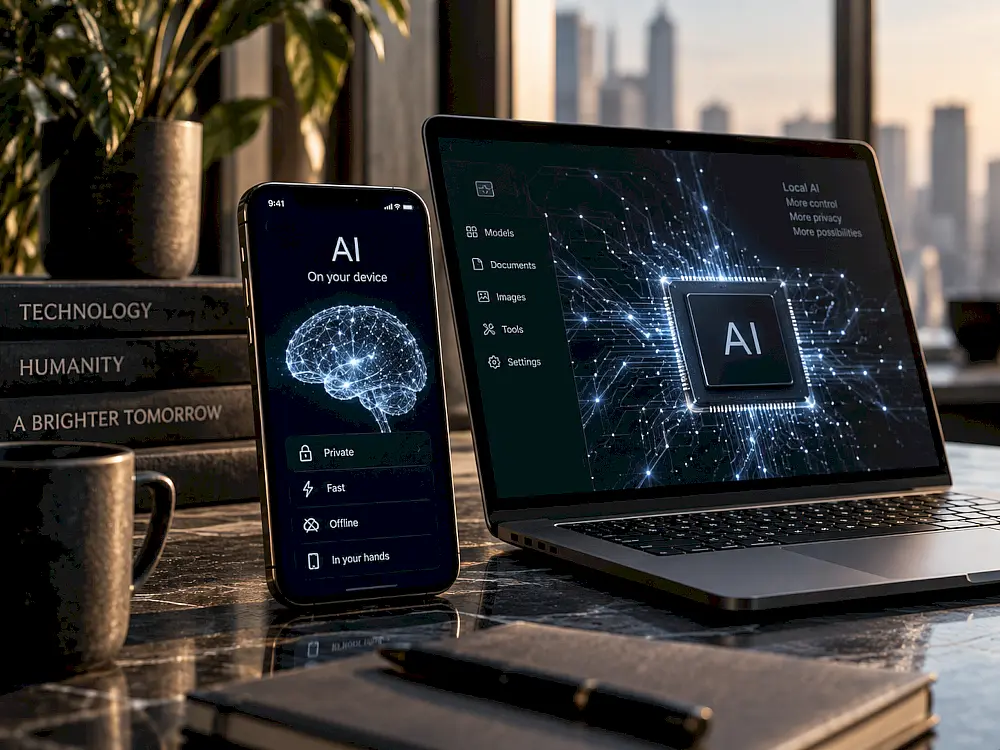
Only a few years ago, generative AI followed a simple pattern: a phone or laptop accepted a request, sent it to a data center and returned the answer. The device itself was mostly a window into a remote computing system.
Forecast details
By 2026, that architecture is already changing. Apple combines on-device foundation models with server models in Private Cloud Compute. Android is developing hybrid inference that can balance workloads between Gemini Nano on the device and cloud models. In Windows, the Copilot+ PC category is built around NPUs, while Microsoft sets 40+ TOPS as a requirement for a number of local AI features.
ORBK.NET’s current estimate is that by the end of 2030 a substantial share of everyday consumer AI inference will move directly onto smartphones and PCs. Probability: about 75%, with a working range of 70–80%.
This is not a forecast that the cloud disappears. The more likely standard is hybrid: simple, private and frequently repeated operations run locally, while the heaviest requests remain in data centers.
What does it mean for AI to move onto the device?
If we count all AI computation — training frontier models, generating video and running large agent systems — personal devices will not capture a major share of global compute. This forecast focuses on end-user inference: processing text, voice, images, documents, local context and lightweight actions after a model has been trained.
The formal question is whether local execution becomes the standard route for a substantial share of everyday AI tasks on smartphones and PCs by December 31, 2030.
“Substantial” means that in at least two of the three major ecosystems — Apple, Android and Windows — local processing becomes the default route for at least three of five task classes: text; speech and translation; image and audio analysis; personal local context; and lightweight agent actions.
Why local AI is economically attractive
A personal AI assistant may perform hundreds of small operations each day: listening for commands, sorting messages, reading the screen, finding files, translating speech, recognizing images and working with personal context.
If those tasks can run on hardware the user has already purchased, the provider reduces cloud-inference cost, the user gets lower latency, and some private data never needs to leave the device. Local execution is therefore especially attractive for voice, camera, translation, personal-file search and personalization.
Why the cloud will remain stronger
Servers can combine enormous pools of accelerators and memory. The best cloud model can be far larger than anything that fits inside a phone, and server-side models can be upgraded instantly for every user. Battery life, heat, memory and bandwidth remain hard physical limits on consumer devices.
On-device AI is therefore unlikely to replace the cloud. Instead, it will take the workloads for which remote execution no longer provides enough advantage.
Why 2030 gives hardware time to turn over
The near-term constraint is the installed base. In February 2026, Gartner said rising memory costs were likely to delay 50% AI-PC market penetration until 2028.
That is a serious counterargument: local AI depends on physical replacement cycles. Yet several generations of phones and processors will ship before the end of 2030. If NPUs become as ordinary as GPUs, the question shifts from “does the device support local AI?” to “which tasks does it run locally by default?”
History suggests a mechanism, not a clean base rate
Foundation models are too new for a robust historical sample of directly comparable transitions, so inventing a numerical base rate would create false precision. The mechanism, however, is familiar: when a workload becomes common and specialized hardware gets cheap enough, some computation moves closer to the user.
The counterexample matters too: GPUs, codecs and mobile accelerators did not eliminate servers. End devices and data centers became more powerful at the same time. History therefore supports a hybrid future.
Three scenarios through 2030
| Scenario | Probability | What happens |
|---|---|---|
| Hybrid AI becomes the default | 55% | Frequent, lightweight tasks run locally; complex requests go to the cloud. |
| A strong shift to the edge | 20% | Model efficiency and consumer hardware improve faster than expected. |
| The cloud keeps clear dominance | 25% | Frontier models maintain a large lead and on-device AI remains auxiliary. |
What would change the forecast?
The estimate should rise if local models are used systematically for personal agents, file handling and multi-step actions during 2027–2028; if powerful compact models run well on mainstream laptops; and if developers materially reduce cloud inference through local execution.
The estimate should fall if server inference becomes dramatically cheaper, frontier models maintain a large practical quality gap, agents require too much memory, or device replacement cycles slow further.
The strongest signal is application behavior. The inflection point arrives when developers naturally choose device first, cloud when necessary.
Where will AI live in 2030?
Most likely, in both places. Data centers will remain central to frontier-model training, complex reasoning and compute-heavy generation, while smartphones and PCs gain a persistent local intelligence layer.
The defining shift is unlikely to be that AI leaves the cloud. It is that the cloud stops being the place where every AI operation has to go.
Forecast card
| Forecast ID | TECH-AI-EDGE-2030 |
|---|---|
| Forecast question | By 31 Dec 2030, will local execution become the standard route for a substantial share of everyday consumer AI tasks on smartphones and PCs? |
| Probability | 70–80%; central estimate about 75% |
| Confidence | 65/100 — moderate |
| YES criterion | In at least two of Apple / Android / Windows, local execution is the default route for at least three of the five defined task classes. |
| NO criterion | Local processing remains mainly auxiliary and most defined task classes still require remote inference by default. |
| Resolution date | 31 March 2031 |
| Historical similarity | N/A |
| Thematic index | N/A |
| Snapshot date | 9 September 2026 |
Forecast disclaimer: This forecast does not claim that the event will occur. It is a current probability estimate based on information available at the time and may change as new information appears.