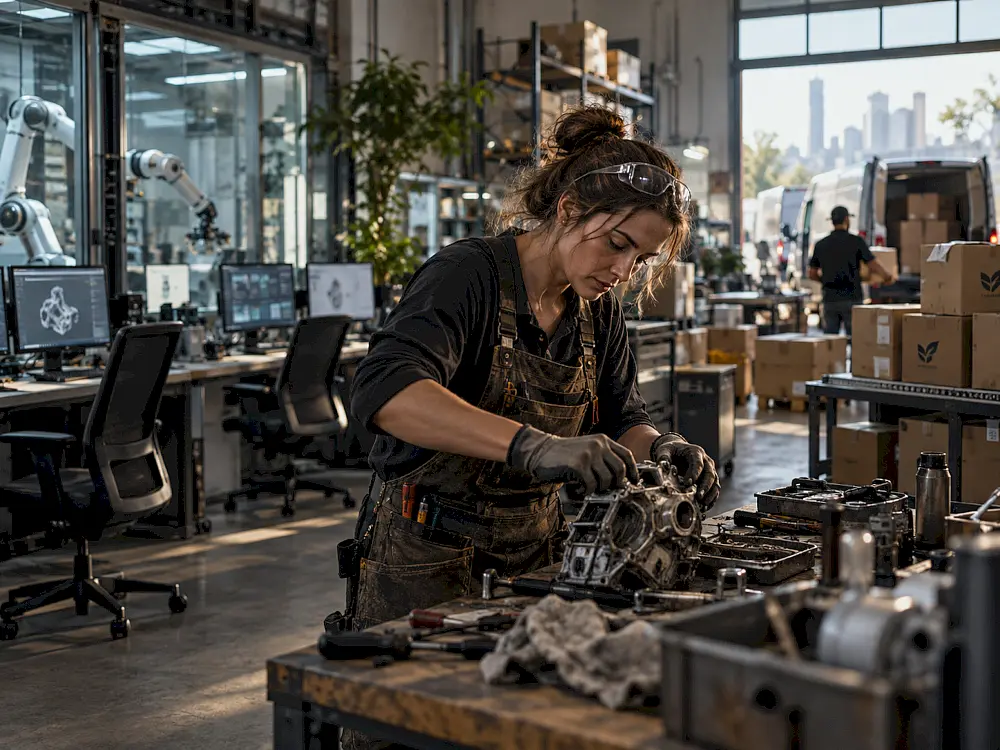
Artificial intelligence is unlikely to split the labor market neatly into “human jobs” and “machine jobs.” A more likely outcome is that it changes the rules of selection themselves: what becomes more valuable will not simply be whatever humans can still do better than AI, but work that is difficult to digitize, cheap to scale, or safely hand over to an algorithm.
Forecast details
There is a strange paradox. A programmer works almost entirely on a computer, which means the job exists in an environment that artificial intelligence can “see” relatively easily. An electrician enters an old building where the wiring does not match the diagram, part of the problem must be diagnosed on site, and a mistake can cause a fire. A nurse performs information work — keeping records, reading indicators, filling out documents — but also touches the patient, notices changes in condition, and is responsible for actions in the physical world.
If we treat the arrival of AI as a kind of technological natural selection, it will not sort professions according to the simple rule “smart work versus simple work.”
Some highly complex intellectual tasks are much easier to automate than fixing a pipe in an unfamiliar basement.
That is already visible in the data. In April 2026, the International Labour Organization highlighted a shift in the old logic of automation: current measures of AI exposure often show higher vulnerability in cognitive, analytical, administrative, and managerial work, while manual occupations, care work, and skilled trades sit further from the center of direct impact. At the same time, “AI exposure” does not itself mean job loss — it indicates which share of tasks the technology may be able to change. This distinction is emphasized by the ILO.
The main answer follows from this: the best chances of surviving AI selection belong not to professions that AI will “never touch,” but to professions that retain a scarce human core after part of the work is automated.
There are at least five such cores: physical action in complex environments, personal responsibility, trust and human contact, work on new and poorly defined problems, and the ability to manage AI itself.
The biggest mistake is looking for a list of jobs AI will “never replace”
Such a list becomes outdated very quickly.
Only a few years ago, creative work was often treated as almost naturally protected from automation. But new models already generate text, images, music, video, and software code. In a 2025 ILO study, advances in image, voice, and video generation increased the estimated automability of some media and web occupations. Clerical occupations remained the most exposed, but the zone of impact was also moving into highly skilled digital work.
The World Economic Forum received a similar signal from more than a thousand large employers. Occupations expected to decline fastest by 2030 included cashiers, administrative workers, and secretaries, while graphic designers appeared for the first time near the group with the weakest outlook. At the same time, employers listed big-data specialists, AI specialists, software developers, and cybersecurity professionals among fast-growing roles. The pattern appears in the WEF.
At first glance, this looks contradictory: if AI is strong at code and data, why do programmers and data specialists not disappear first?
Because the ability to automate tasks and the ability to eliminate an occupation are different things.
A person may perform 20 tasks. AI takes over ten of them. If one worker can then do work that previously required two, two very different outcomes are possible. The company can cut half its staff. Or production can become cheaper, demand can grow sharply, and the company can hire even more workers.
That is why the important question is not “what can AI do?” but “what happens to demand once AI learns to do it more cheaply?”
The first group to survive: people who work in unpredictable physical environments
For a language model, an office is surprisingly convenient.
Documents are already digital. Emails are digital. Databases are digital. Spreadsheets are digital. Accounting entries, applications, contracts, presentations, and code all exist in an environment software can access directly.
Now send the same system to repair a power network after a storm.
Suddenly the job requires hands, movement, tools, spatial orientation, work with damaged objects, safety judgment, and the ability to act in situations that were not fully anticipated by instructions.
Robots will gradually reduce this advantage too. Plumbers, electricians, and mechanics do not have permanent technological immunity. But replacing them requires more than a capable language model — it also requires robotics that is cheap, reliable, and sufficiently general.
The latest U.S. projections show this difference well. The Bureau of Labor Statistics expects electrician employment in the United States to grow by roughly 9% between 2025 and 2035. BLS links part of the additional demand to the expansion of energy infrastructure, including data centers and rising electricity use by AI systems. The figures are reported by the BLS.
The result is almost ironic: AI can create additional work for occupations that are difficult for AI to automate.
That places electricians, installers, industrial machinery mechanics, technicians, some construction occupations, repair workers, and other specialists who combine knowledge with physical work in changing environments in a relatively resilient group.
What protects them is not “having hands” by itself. It is the high cost of a general-purpose robot capable of replacing those hands.
The second group: care, medicine, and work where the person is part of the service
AI can analyze medical information. It can prepare documentation, help search the literature, flag possible risks, and automate administrative work.
But a medical service often does not end with the correct answer.
Someone has to examine the patient. Help them stand up. Perform a procedure. Notice that the patient’s behavior is different from an hour ago. Persuade them to follow treatment. Explain an unpleasant decision to the family. And ultimately, someone has to carry professional responsibility.
Demography adds another force.
The latest BLS projection for 2025–2035 expects the U.S. healthcare and social assistance sector to add more than 2.2 million jobs, about 37% of total projected employment growth in the U.S. economy. Among the drivers are population aging and the prevalence of chronic conditions.
As a result, fast-growing occupations include advanced-practice nurses, physical and occupational therapy assistants, psychiatric technicians, and other care roles. The BLS projects roughly 194,700 more registered nurses by 2035 than in 2025.
This is where the mechanism of AI selection becomes especially clear.
The more administrative work AI takes away from nurses or doctors, the more those professions can concentrate on the part that is harder to automate.
Medicine may therefore become simultaneously one of the most AI-saturated and one of the most human industries of the future.
The third group: psychologists, advisers, and professions built on trust
At first, this looks like a weak point in the forecast. Modern models can already hold long conversations, remember context, and provide personalized explanations. That will almost certainly make some standardized consultation cheaper.
But there is a difference between language interaction and a professional relationship.
When the outcome affects health, family, career, large sums of money, or legal responsibility, people are not buying information alone. They are buying another person’s judgment, reputation, and responsibility for the decision.
That does not guarantee immunity for psychologists, financial advisers, lawyers, or managers. On the contrary, much of the preparatory work in these professions may be automated.
But the higher-value layer of the job may become more valuable.
Mental health offers a useful example. The U.S. BLS currently projects roughly 18% growth in employment for substance abuse, behavioral disorder, and mental health counselors from 2025 to 2035, and about 6% for psychologists.
That does not prove that AI will be unable to perform part of their work. It almost certainly will perform more of it.
But the profession may survive technological selection precisely because its product remains not conversation itself, but a trusted relationship and accountable judgment.
The fourth group is stranger than the others: people whose work AI automates the most
This group includes data specialists, cybersecurity professionals, computer and information researchers, and some software developers.
These are highly exposed technology occupations. They work precisely with information, which AI handles especially well.
Yet the latest BLS projections place data scientists among the fastest-growing U.S. occupations: about +35% from 2025 to 2035. Computer and information research scientists are projected at roughly +22%, and information security analysts at about +21%. Software developer employment is also expected to rise even as much of the work inside the occupation is rapidly automated.
For computer programmers, however, BLS projects the opposite direction in its current tables — around −7% from 2025 to 2035. This appears in the BLS tables.
This may be one of the most interesting dividing lines in the future labor market.
“Writing code” and “building software systems” increasingly mean different things.
If AI can cheaply generate a thousand lines of code, human value shifts away from typing commands and toward problem definition, architecture, integration, verification, security, and responsibility for the final system.
In other words, AI can destroy tasks inside an occupation while simultaneously increasing demand for the occupation itself.
That is likely to be one of the main mechanisms of AI selection.
The fifth group: people who make decisions where there is no correct answer
Imagine two tasks.
The first: compare 50 contracts and find deviations from a standard clause.
The second: decide whether a company should close a loss-making factory, knowing that doing so would cut costs, destroy the main employer in a small town, potentially cause conflict with authorities, and perhaps prove to be a mistake three years later.
The first task is almost perfectly suited to automation.
The second can also be analyzed with AI. But someone still has to choose.
WOW:
- >>> Efficiency vs Resilience: Why the World May Move Away from Maximum Optimization
- >>> Why the Most Expensive Advantage Can Become a Burden
- >>> Arms Race: Why Competitors Force Each Other to Spend More
- >>> Why the Fastest Does Not Always Win: When Waiting Pays
- >>> Why Being Visible Is Both Valuable and Dangerous
Executives, entrepreneurs, crisis managers, strong negotiators, and professionals who work under uncertainty therefore do not receive automatic immunity from AI. AI will take over presentations, information search, part of the analysis, meeting notes, and scenario modeling.
What remains is the part that is hardest to scale: choosing under uncertainty and taking responsibility for the consequences.
That is why the World Economic Forum simultaneously expects technology skills to rise in importance while analytical thinking, leadership, social influence, resilience, flexibility, and adaptability remain highly valued. The pattern appears in the WEF.
It also explains why “learning to use AI” is not enough. If everyone learns to use the tool, that skill itself stops being a major advantage.
The advantage becomes what a person can do with AI better than other people who have access to the same AI.
What about teachers and creative professions?
This is where simple lists of “safe jobs” fail most often.
A teacher is not protected merely because they work with children. AI can explain a topic, generate exercises, grade some assignments, adapt tasks, and answer questions individually.
The same applies to designers. Creativity itself is no longer a reliable barrier when a machine can cheaply generate hundreds of image variants.
Resilience appears at another level.
For a teacher, it lies in diagnosing why a particular child does not understand the material, motivation, discipline, group interaction, parental trust, and responsibility for the education process. For a designer, it lies in defining the problem, understanding the brand, selecting among hundreds of variants, working with the client, and making the final decision.
Professions are therefore not completely safe or completely unsafe.
Within one occupation, the lower layer can disappear while the upper layer becomes more valuable.
That may become one of the most painful consequences of AI selection for younger workers. What used to be entry-level work — preparing a first draft, a simple analysis, a basic illustration, routine code, or a short briefing — is often exactly what is easiest to hand over to a machine.
The problem is then no longer only the number of jobs.
A new question appears: where will the future expert get experience if AI takes away the beginner’s work?
Six traits of an occupation with a good chance of surviving AI selection
Instead of a list of one hundred job titles, it is more useful to examine how a job is structured.
The most resilient work tends to combine several of the following characteristics:
- The physical world is difficult to standardize. The worker has to move, use their hands, and respond to unexpected conditions.
- Mistakes have real consequences. Someone must be legally, professionally, or reputationally responsible for the outcome.
- The human is part of the product. Patients, clients, students, or teams value trust and interaction with a specific person.
- The task is poorly defined in advance. The worker must not only find an answer but determine what question should be asked.
- Automation creates new demand. This can happen in cybersecurity, data, energy, and parts of software.
- The worker can use AI as a multiplier of personal productivity. The technology removes routine work without eliminating the main reason the occupation exists.
The more of these traits a job contains, the stronger its position.
The opposite combination is especially dangerous: digital input → standard operation → digital output → low responsibility for exceptions.
That is why many administrative, secretarial, routine accounting, operator, and basic information functions face greater pressure. In the current BLS projection, the entire office and administrative support group declines by roughly 4% from 2025 to 2035, or by more than 750,000 jobs. AI and other automation tools are among the forces cited behind this trend.
Most likely, professions will not disappear — they will split into layers
This is where the natural-selection parallel becomes useful, but it should not be taken literally.
In evolution, the environment does not ask which species is “smarter.” It creates conditions in which some traits provide an advantage while others stop paying off.
AI is doing something similar to occupations.
It sharply reduces the cost of certain abilities: writing a standard text, finding information, creating a first image draft, preparing a routine table, generating code, or classifying a document.
When an ability becomes cheap, the market stops rewarding the mere fact that someone possesses it as highly as before.
A future accountant will therefore not compete with AI in data-entry speed. A programmer will not compete in the number of lines of code written. A designer will not compete in the number of generated variants. A lawyer will not compete in how quickly a standard contract can be read.
They will compete in what happens after generation: what to verify, what to reject, whom to trust, which risk to accept, what the client actually needs, and who is responsible if everything goes wrong.
The dividing line will therefore not run simply between “human and machine.”
It will increasingly run between a person with AI and a person without AI — and later between two people with equally powerful AI.
Four scenarios to 2035
The most likely trajectory is not mass disappearance of professions but deep restructuring of their tasks. That is consistent with the current ILO assessment: roughly one quarter of global employment has some degree of exposure to generative AI, but for most occupations transformation of work appears more likely than complete replacement.
| Scenario | Probability | What happens |
| Occupations remain, tasks change sharply | 60% | AI automates a large share of routine work; people concentrate on physical work, responsibility, interaction, verification, and difficult decisions. |
| Heavy pressure on the office middle class | 25% | Agentic systems automate whole workflows rather than individual tasks; administrative and standardized digital roles shrink especially strongly. |
| Broad robotics accelerates selection in physical jobs | 10% | Progress in robotics carries AI selection from the digital sphere into construction, logistics, repair, and parts of care work. |
| Adoption proves slower than technological progress | 5% | Cost, regulation, errors, organizational inertia, and distrust slow the restructuring of work. |
The biggest unknown here is robotics.
If language and agentic systems advance quickly while physical robots remain expensive and narrow, an electrician may have better protection from automation than an accountant with a master’s degree.
If general-purpose robots become dramatically cheaper, this boundary will begin to move.
Then the next phase of AI selection will no longer stop at the screen.
What would change the forecast
The forecast should move further toward the human-AI hybrid model if, by 2028–2030, employment data continue to show growth in medicine, care, skilled trades, AI infrastructure, cybersecurity, and complex expert professions at the same time as standardized office work contracts.
An even stronger signal would be widespread cases in which companies automate tasks without eliminating the occupation itself, instead raising one worker’s productivity and changing the skill mix required.
The forecast would need substantial revision if agentic AI systems begin to perform complete workflows reliably without continuous human oversight, or if general-purpose robotics sharply reduces the cost of physical work in unpredictable environments.
One early signal deserves especially close attention: the number of entry-level positions.
If senior specialists remain highly productive with AI while junior hiring collapses, a profession may formally “survive” while the mechanism that creates the next generation of experts begins to break.
That could become a much deeper change than a simple decline in vacancies.
Not the job of the future, but the trait of the future
Someone choosing an education today naturally wants a concrete list: doctor good, accountant bad, electrician good, designer bad.
Such a list creates a sense of certainty that does not really exist.
AI is developing too quickly, and professions are made up of too many different tasks.
A more useful question is:
if a machine performs half of my work tomorrow, what will remain of my professional value?
For an electrician, physical diagnosis and installation remain. For a nurse, care and clinical observation. For a psychologist, the therapeutic relationship and accountability. For a programmer, architecture and system control. For a manager, decisions. For a scientist, framing the new question. For a teacher, not repeating the textbook but working with a specific person.
If almost nothing remains after routine work is automated, that is a much more worrying signal than any ranking of “jobs AI will replace.”
AI selection is unlikely to leave the world without work.
It will do something else: redefine which kinds of human labor the world is willing to pay for.
Forecast card
For verifiability, the broad question in the article is narrowed to a specific group of U.S. occupations for which stable official statistics are available.
| Field | Recorded version |
| Forecast question | In 2035, will at least 5 of the 7 pre-defined occupations have employment no lower than in 2025? |
| 7 occupations | registered nurses; electricians; substance abuse, behavioral disorder, and mental health counselors; home health and personal care aides; data scientists; information security analysts; software developers |
| Probability | About 85% |
| Confidence | 74 out of 100 — moderately high |
| YES criterion | According to comparable BLS data for 2035, at least five of the seven occupations have employment at or above the 2025 level. |
| NO criterion | Four or fewer occupations meet the criterion. |
| Forecast snapshot date | September 7, 2026 |
| Resolution date | After comparable actual BLS data for 2035 are published |
| Main scenario | AI automates tasks faster than it eliminates entire occupations; AI-complementary and physically/socially complex roles benefit most. |
| Forecast history | September 7, 2026 — initial estimate 85%, confidence 74/100 |
An important limitation: current BLS projections already incorporate technological trends known today and are not independent proof of the future. The BLS explicitly warns that the long-term impact of AI is highly uncertain and that substantially faster technological change could make historical relationships a weaker guide.
Disclaimer
This article contains an analytical estimate of the future labor market, not a guarantee of employment for any individual or occupation. The impact of AI will depend on advances in models and robotics, implementation costs, regulation, demography, and economic demand. The natural-selection metaphor is used to explain a mechanism and does not mean that labor markets literally follow biological evolution.