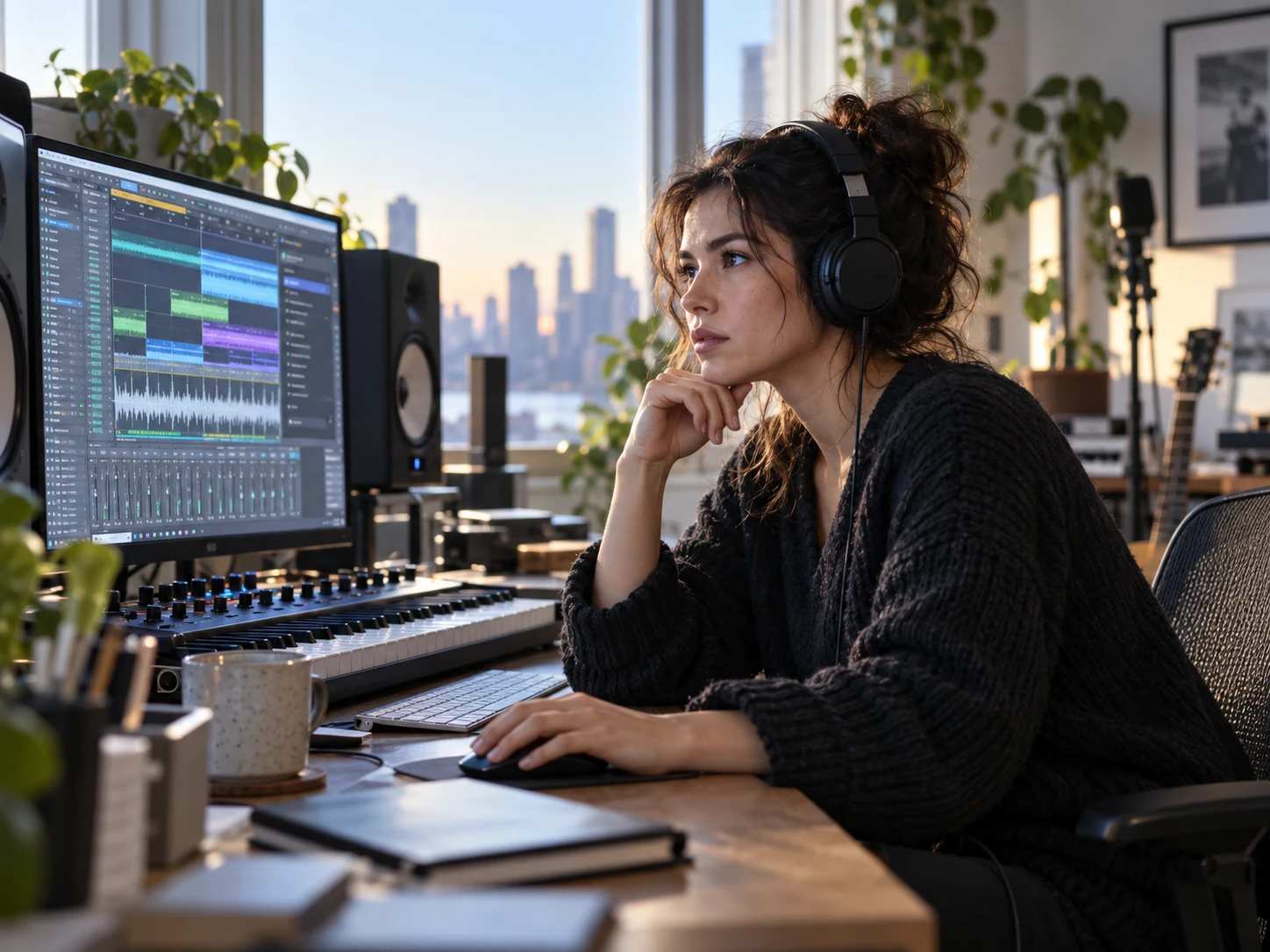
In June 2026, fully AI-generated music exceeded half of all new daily uploads to Deezer at peak, with roughly 90,000 such tracks arriving per day. Yet synthetic tracks accounted for only 1–3% of listening, while Deezer classified up to 85% of their streams in 2025 as fraudulent. The Deezer data capture the central paradox: the ability to produce almost unlimited music does not automatically create listener demand.
Forecast details
The useful forecasting question is therefore not simply “Will AI replace musicians?” It is: will AI become as routine a working tool for musicians and producers as DAWs, plug-ins, samples and digital audio processing are today?
ORBK.NET’s current estimate is about 80%. The most likely outcome is that AI becomes a standard layer of music production by the end of 2030, mainly as an assistant rather than a replacement for the human creator. Confidence is 72/100.
What “standard tool” means
“Standard” does not mean every song is prompt-generated or that composers disappear. It means regular use of AI in core creative or production work: composition and arrangement, sound generation or transformation, stem work, recording edits, mixing or mastering.
The forecast resolves YES if, by the end of 2030, at least half of professional or semi-professional music writers and producers in a sufficiently large industry survey report using AI in at least one core part of their workflow during the previous year, and native AI/ML functionality for core production tasks is present in at least four of five fixed environments: Logic Pro, Pro Tools, Ableton Live, FL Studio and Cubase.
The transition has already started
In a GEMA/SACEM study covering roughly 15,000 authors and publishers, 35% said they had already used AI in their work; among respondents under 35, the share was 51%. At the same time, 64% believed the risks outweighed the opportunities. The GEMA/SACEM study matters because it shows adoption and resistance developing together.
In 2026, Luminate found that 54% of U.S. musicians expressed positive feelings or acceptance toward generative AI tools, while 18% reported using AI to edit or remix existing music. The Luminate data do not prove that AI will become standard, but they show it entering real production workflows.
The most important shift may look ordinary
AI does not need to persuade musicians to press a “make me a song” button. It only needs to enter many smaller tasks where it saves time. Apple built Session Players, Stem Splitter and ChromaGlow into Logic Pro and explicitly described the tools as AI-powered. Logic Pro illustrates the likely direction: the human keeps creative control while algorithms handle selected technical or supporting operations.
Within a few years, many of these functions may stop feeling like a separate category called AI. They will simply be features inside familiar software. That is often how a technology becomes standard: by being absorbed into an existing workflow.
The industry is already separating AI-generated from AI-assisted music
In July 2026, IFPI, RIAA, A2IM, WIN, IMPALA, The Recording Academy, SAG-AFTRA and the Human Artistry Campaign announced a shared labeling approach distinguishing “AI-Generated” from “AI-Assisted” sound recordings. The IFPI framework does not prove mass adoption, but it shows the industry moving toward practical rules for how AI is used.
What could slow the transition
The strongest counterargument is resistance from creators combined with legal uncertainty. For many musicians, creating is part of the value of the work. The boundary between “help me realize my idea” and “invent the idea for me” may remain important, while training data, compensation, voice cloning and synthetic-content overload add further friction.
For that reason, a scenario in which generators simply replace musicians in mainstream music by 2030 is not the base case. A more plausible path is that composers, singers and producers remain human while an increasing number of operations between idea and finished recording are delegated to algorithms.
Scenarios to 2030
| Scenario | Probability | What happens |
|---|---|---|
| AI becomes a routine music assistant | 65% | AI functions become normal features of major DAWs and are regularly used for editing, stems, sound search, drafts, arrangement, mixing and mastering, while core authorship remains human. |
| Generative co-creation expands faster | 15% | Generated parts, vocals, instruments, arrangement variants and model-assisted co-writing become routine. |
| The market remains split | 15% | AI is common in selected genres and commercial workflows, but the industry-wide 50% adoption threshold is not reached. |
| Legal and cultural barriers slow adoption | 5% | Licensing, litigation, platform rules and creator resistance make generative functions costly or restricted. |
What would change the forecast
The probability will rise if independent studies show sustained growth in real AI use by professional writers and producers, major DAWs keep integrating AI features, and the industry develops workable rules for licensing, compensation and labeling. It will fall if professional adoption remains close to today’s level in 2028–2029, leading music applications remove generative features because of legal risk, or compliant AI use becomes materially more expensive.
The likely future is music with humans — and different tools
By 2030, the word “AI” may become less visible precisely because the technology is everywhere. Musicians may isolate vocals, clean noise, request alternative parts, search for sounds by description and create rough masters through functions that no longer feel like a separate AI product.
As of the 1 October 2026 snapshot, the probability that AI becomes a standard tool for music creation and production by the end of 2030 is estimated at roughly 80%.
Forecast card
| Forecast question | Will AI become a standard tool for music creation and production by 31 December 2030? |
|---|---|
| YES criterion | At least 50% of professional/semi-professional writers or producers in a qualified survey use AI in a core workflow, and at least 4 of the 5 fixed DAWs have native AI/ML functions for core production tasks. |
| NO criterion | One or both conditions are not met by the deadline. |
| Resolution date | 31 March 2031 |
| Probability | 80% (working range 75–85%) |
| Confidence | 72/100 |
| Snapshot date | 1 October 2026 |
| History | Initial snapshot |
This forecast was prepared using the ORACLE Foresight Engine methodology.
Disclaimer. This forecast does not claim that the event will occur. It presents a current probability estimate based on the information available at the time of the forecast. The estimate may change as new information appears.