
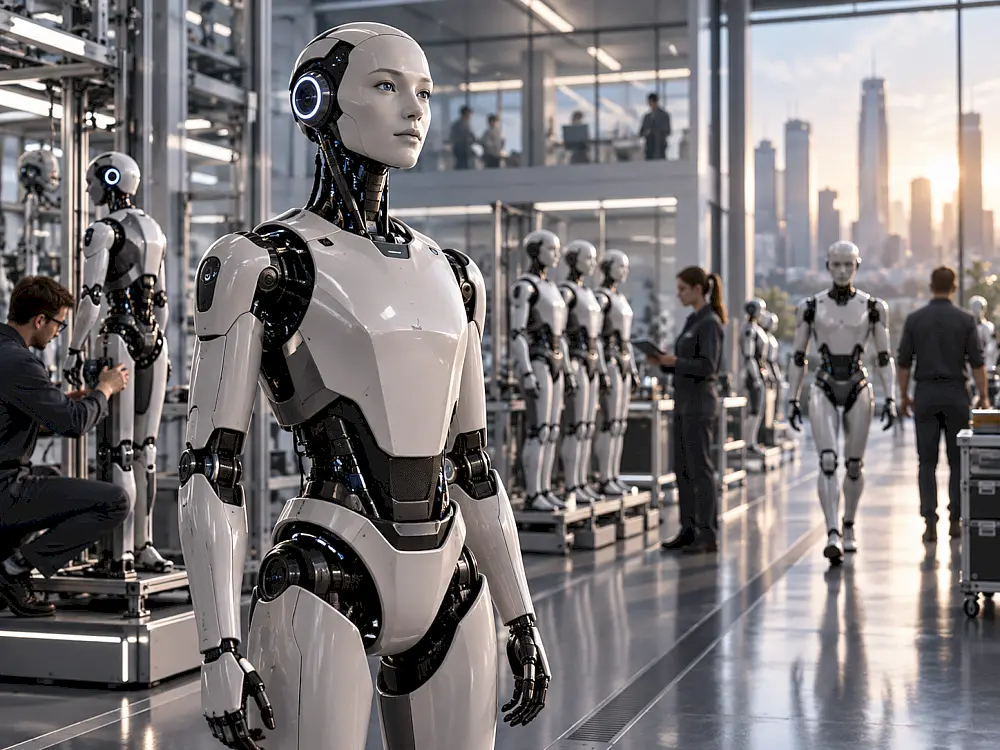
In 2025, Figure 02 stopped being merely a demonstration inside BMW’s South Carolina plant. According to BMW, during a ten-month pilot the robot supported production of more than 30,000 BMW X3 vehicles, moved over 90,000 components and logged roughly 1,250 operating hours. In 2026, BMW began another humanoid trial at its Leipzig plant.
Forecast details
This is not mass industrial robotization yet. But the line between a laboratory prototype and a machine that can be placed into a real production shift is becoming less clear.
ORBK.NET’s current estimate is that humanoid robots have about a 70% probability of moving from pilots into mass commercial use by the end of 2030, with a working range of 65–75%.
“Mass use” does not mean a robot in every home. The criterion is narrower but resolvable: at least 100,000 humanoid robots must be performing paid work in commercial or industrial environments worldwide, with deployments spanning at least 100 independent organizations across three sectors.
Robots are already shipping, but shipment is not useful work
According to IDC, global humanoid robot shipments exceeded 18,000 units in 2025. More than 85% of deployments, however, were concentrated in performances, education, data collection, guided tours and other scenarios focused mainly on demonstration or technology validation. IDC also forecasts more than 510,000 shipments in 2030.
The distinction between “a robot was built” and “a robot is doing economically useful work” is central to this forecast.
A machine that dances at a trade show, collects training data or performs a prepared factory sequence for a few hours does not prove that a mass commercial market exists. The industry needs thousands of robots doing paid work every day without constant engineering intervention.
Manufacturing scale-up has started
In April 2026, Figure said BotQ had produced more than 350 Figure 03 robots and demonstrated a one-robot-per-hour production cycle. These are manufacturer-reported figures and are not independent proof of future demand.
Still, several hundred physically manufactured machines represent a different stage from a one-off laboratory prototype. The next test is whether manufacturing capacity converts into real paid fleets that customers expand after the first contract.
Why build a humanoid when factories already have robots?
Industry has automated for decades. Robotic arms weld car bodies, autonomous vehicles move materials and specialized machines sort goods. Humanoids therefore compete not only with human workers but with mature automation.
The potential advantage is different: much of the physical world has already been designed around the human body. Doors, shelves, stairs, tools, carts, workstations and aisles are built for a roughly human-sized body with two hands.
Traditional automation often requires redesigning the environment. If a general-purpose machine can enter a human workspace and use existing infrastructure, automation may become economical for tasks that would not justify a dedicated robotic cell.
That is why the first large markets are more likely to be factories and logistics sites than homes: the environment is more controlled, tasks are repetitive and return on investment is easier to measure.
The hardest problem is no longer teaching the robot to walk
Modern humanoids can walk, run, carry loads and manipulate objects. Commercial robotics faces a different test: an action must work correctly not five times on camera but tens of thousands of times in a changing environment.
A robot must recognize an object placed slightly differently, stop safely near a person, recover from errors and avoid requiring a teleoperator every time something unusual happens.
A Reuters investigation in August 2026 highlighted this gap in China’s humanoid industry: hardware is advancing quickly, but many systems still trail conventional industrial equipment in speed, dexterity and autonomy and depend heavily on choreographed routines.
Building a robot that can perform a task is already possible. Making it reliable and inexpensive enough that a customer wants to buy thousands is much harder.
AI may matter more than the mechanics
The hardest problem may not be the motor or joint, but the ability to operate in an unpredictable physical world. A language-model error often produces a bad answer; a robot error can stop a production line or put a person at risk.
That is why developers are trying to create a data flywheel. In 2026, Apptronik expanded Robot Park, where fleets of Apollo 2 robots collect real-world task data in partnership with Google DeepMind.
The positive loop is: more robots → more real-world data → better models → higher autonomy → better economics → more robots. The negative loop runs in reverse.
The humanoid’s main competitor is not the human worker
A factory manager will compare a humanoid not only with wages. The alternative may be a conveyor, a six-axis robotic arm, an autonomous cart, a specialized machine or a modest redesign of the production process.
If a task can be automated cheaply with a fixed system, adding legs, hands, cameras and complex AI may make little economic sense. Humanoids will spread fastest where generality is cheaper than specialized automation.
By 2030, a more realistic model is one hardware platform trained for several clearly defined jobs inside a facility, rather than one universal robot that can do everything.
Three scenarios through 2030
| Scenario | Probability | What happens |
|---|---|---|
| Industrial scaling | 50% | Humanoids become ordinary equipment in some factories and warehouses; roughly 100,000–300,000 commercial units operate worldwide. |
| A fast physical-AI breakthrough | 20% | Reliability and learning improve sharply, costs fall and commercial deployments move well into the hundreds of thousands. |
| A prolonged pilot era | 30% | Production rises, but autonomy, safety and economics prevent large paid fleets. |
What would change the forecast?
The estimate should rise if several manufacturers move from hundreds to thousands of robots in real commercial operation during 2027–2028, and customers follow first contracts with second and third orders. Public evidence of thousands of autonomous operating hours, high availability and measurable economic value without constant teleoperation would be especially strong.
The estimate should fall if most high-profile projects remain fleets of only a few dozen machines through the end of 2028; if much of the work still requires remote human intervention; if customers do not renew after pilots; or if humanoids remain slower and more expensive than conventional industrial equipment.
The most dangerous signal is not a robot falling during a demo. It is a company completing a long pilot and deciding: we are not buying the second large batch.
By 2030, the humanoid may look less like the next smartphone and more like the next forklift
The popular image of the future is a universal home robot. By 2030, that is considerably less likely than robots spreading through factories and warehouses.
The industrial path is less cinematic but potentially more important economically. If one hundred thousand machines are moving parts, handling boxes and feeding production lines by the end of the decade, that already means the key transition has occurred: the humanoid has stopped being mainly a technology experiment and has become a product businesses buy because it pays for itself.
Forecast card
| Forecast ID | TECH-HUMANOID-2030 |
|---|---|
| Forecast question | Will humanoid robots reach mass commercial use by 31 Dec 2030? |
| Operational definition of “mass” | At least 100,000 humanoid robots are in paid commercial/industrial operation worldwide. |
| Additional criterion | At least 100 independent organizations across three sectors. |
| Excluded | Demonstrations, research, data collection, exhibitions, training and short pilots without commercial operation. |
| Probability | 65–75%; central estimate about 70% |
| Confidence | 64/100 — moderate |
| YES criterion | Both thresholds are met: ≥100,000 operating robots and ≥100 organizations across ≥3 sectors. |
| NO criterion | At least one threshold is not reached by the end of 2030. |
| Resolution date | 31 March 2031 |
| Historical similarity | N/A |
| Thematic index | N/A |
| Snapshot date | 9 September 2026 |
Forecast disclaimer: This forecast does not claim that the event will occur. It is a current probability estimate based on information available at the time and may change as new information appears.