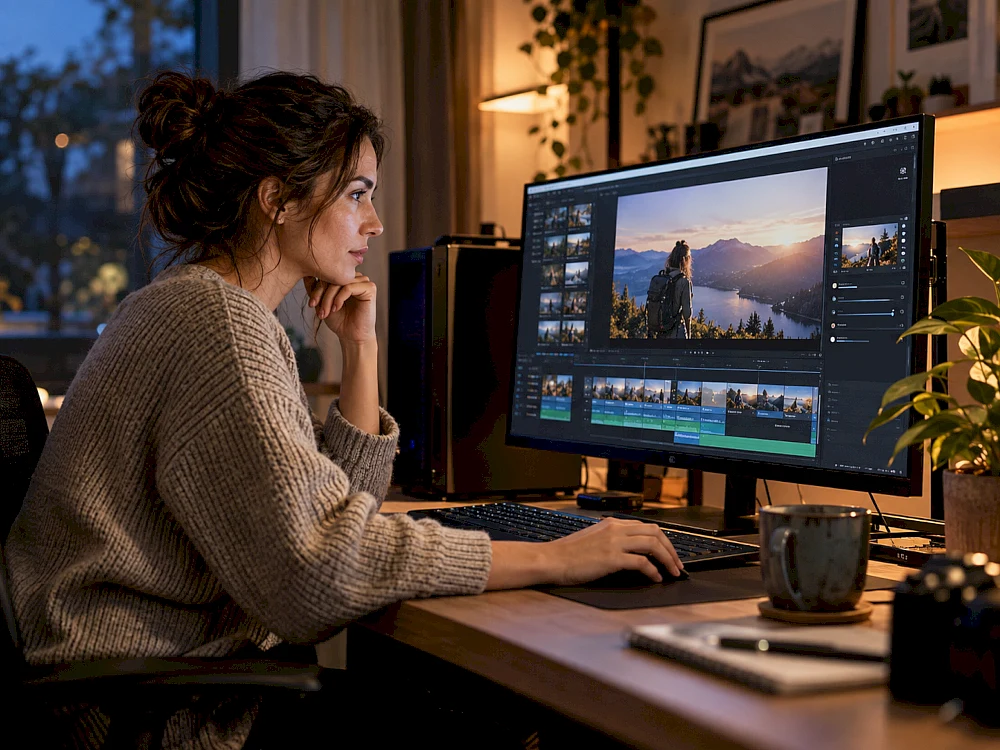
Generative video is still mostly associated with the cloud. A user opens a service, enters a prompt, sends the request to a data center and receives a clip later. Expensive GPUs do the work behind the scenes, while the user pays through subscriptions, credits or generation limits.
Forecast details
But a different model already exists in 2026: the video model is downloaded to a personal computer and the clip is generated on the user’s own GPU without sending frames or prompts to a third-party server. NVIDIA demonstrates local RTX-PC workflows with ComfyUI and LTX, including video generation and local upscaling.
An even clearer example is LTX Desktop. The current desktop client supports local text-to-video, image-to-video and related generation workflows on compatible consumer hardware. Supporting models can also be installed locally, allowing the generation pipeline itself to run offline. The most capable Pro modes may still be API-only, so the local/cloud boundary remains visible.
ORBK.NET’s current estimate is that by the end of 2030 a mainstream home PC will be able to create useful, high-quality AI video fully locally without remote inference. Probability: about 90%, with a working range of 85–95%. Confidence: 77/100.
The fundamental capability has already been demonstrated. The uncertainty is no longer whether local AI video can exist, but how cheap, fast and simple it becomes for ordinary users.
Local AI video is no longer theoretical
The biggest obstacle has been model size. An image model has to build the spatial structure of one frame. Video adds time: the system must preserve characters, objects, lighting, camera motion and scene logic across dozens or hundreds of frames.
That makes video generation far more demanding than image generation. Optimization is moving quickly, however. NVIDIA demonstrated local open-model video workflows in 2026 using lower-precision formats designed to reduce memory use and speed inference. These are vendor results rather than universal independent benchmarks, but the direction is clear.
A few years ago, “AI video on a home PC” sounded almost contradictory. Now the practical questions are how long generation takes and what class of hardware is required for acceptable quality.
GPU memory remains the critical resource
AI-PC discussions often focus on the NPU. That accelerator matters for local translation, transcription, compact language models and background AI features. Generative video, however, is a much heavier workload.
For the next several years, most of the heavy lifting is likely to stay on the GPU or on powerful integrated graphics with access to a large memory pool. Video models need not only arithmetic throughput but also enough nearby memory for parameters and intermediate states.
That is why local video generation today often targets 16 GB of VRAM or more. This is not a typical office PC, but it is also no longer a server farm. The hardware threshold is already moving down into consumer territory.
AMD points to another possible hardware path
Local video does not have to remain permanently tied to discrete NVIDIA GPUs. In 2026, AMD demonstrated image- and video-generation workflows in ComfyUI on Windows using Ryzen AI Max+ systems with a large shared-memory pool.
That may matter as much as higher TOPS. If future home computers offer large pools of fast unified memory, AI models will be able to access much more memory without a strict split between system RAM and limited VRAM.
Apple has used unified memory in its SoCs for years, while AMD is extending a similar idea into powerful AI PCs. For generative video, memory architecture may prove as important as the raw speed of the neural accelerator.
Why use local video if the cloud is more powerful?
The cloud has an obvious advantage: a data center can run a model that simply will not fit on one consumer computer. Users do not need to buy an expensive GPU, maintain drivers or store large models locally.
But generative video almost always requires iteration. One result has a bad hand motion, another has the wrong camera move, a third changes the face. Serious production often requires many attempts.
In the cloud, each attempt may consume credits, hit a limit or wait in a queue. On a local GPU, the twentieth generation does not require a new credit pack. That makes local video particularly attractive to creators, designers and editors with high-volume workflows.
NVIDIA explicitly promotes local generative workflows around iteration freedom, model control and private data.
What does “without cloud services” mean?
Local AI does not mean the computer has never been connected to the internet. The model must be downloaded first, and software and drivers need updates. The decisive test is simpler: can the network be physically disabled and the video still be generated?
If prompt encoding, model inference, frame generation and final file creation all happen on the PC, the workflow is local. If any required stage is sent to a remote service — prompt enhancement or final inference, for example — it does not count as fully offline in this forecast.
What result is good enough to count as practical?
Technically, local generation already exists. But a tiny low-resolution clip that takes several hours is not a mainstream 2030 workflow.
The forecast therefore uses a higher threshold: at least a 10-second 1080p video created from text or an input image on a mainstream home PC without remote inference. The speed threshold is no more than 10 minutes for one such generation in the normal recommended mode.
This is not a real-time requirement. It simply means that users can iterate rather than wait hours for every attempt.
1080p is only the baseline
1080p may sound modest for 2030, but a model’s internal generation resolution and the final output resolution do not have to match. Local workflows can already generate a lower-resolution base and then use neural upscaling. NVIDIA demonstrates exactly this type of pipeline.
By 2030, users may not care whether every 4K pixel was generated directly. What matters is whether the final video looks good enough for YouTube, advertising or television.
The hardest problem is consistency over time
AI video can already produce a beautiful individual frame and then lose coherence seconds later. Hands change shape, objects disappear, vehicle details mutate and a character’s face drifts.
The race to 2030 is therefore not only about inference speed. Temporal consistency — preserving people, objects and scene logic over time — is central. Professional work also needs reference images, keyframes, camera control, LoRA and other methods of directing the model.
This is one area where local open models may have a strong advantage: the user gets more than a Generate button and can customize the entire workflow for a specific project.
Local AI video may spread fastest through editing
Mass adoption does not require a one-prompt feature film. A much more practical use is generating short pieces inside a normal edit.
Need a five-second city cutaway? Generate it locally. Missing the beginning of a camera move? Extend it. Need extra background for a vertical crop? Synthesize the missing area. Need several alternative product shots for an ad? Generate them on the PC.
In this model, generative video stops looking like a separate service and becomes one more tool inside DaVinci, Premiere or a future editor.
Cloud video generators will not disappear
Even if home PCs generate video well, data centers retain the advantage of scale. The best cloud model in 2030 may produce longer scenes, more complex physics, more stable characters and higher fidelity than a local model from the same year.
But users do not always need the best model in the world. If a local system produces good-enough footage in minutes without credits, it becomes the rational choice for a huge number of tasks. The cloud remains for maximum quality; the PC becomes the place for constant work and repeated iteration.
Four scenarios through 2030
| Scenario | Probability | What happens |
|---|---|---|
| Local AI video becomes a standard creative tool | 55% | Powerful home PCs generate 1080p/4K content locally while complex workflows become simple features inside mainstream creative software. |
| Local generation becomes nearly mainstream | 35% | Optimization advances faster and local video spreads beyond expensive GPU systems into much of the mid-range AI-PC market. |
| Local works but remains a compromise | 8% | Offline generation is possible, but local models remain visibly worse or too slow for most users. |
| The cloud retains an effective monopoly on quality video | 2% | Model requirements rise faster than consumer hardware can keep up. |
The first two scenarios satisfy the YES criterion, producing a central estimate of about 90%.
What would change the forecast?
The estimate should rise if by the end of 2027, 10–20 seconds of good-quality local video runs reliably on mid-range GPUs with 12–16 GB of VRAM or comparable unified-memory systems. Native text-to-video and image-to-video inside mainstream software without complex setup would be another powerful signal.
Competition across hardware platforms would strengthen the forecast further. If local video becomes normal on NVIDIA, AMD and Apple systems, dependence on a single hardware stack falls sharply.
The estimate should fall if memory requirements rise faster than consumer hardware, leading models remain API-only, local quality falls far behind cloud systems or server inference becomes so cheap that local development loses its economic advantage.
What changes for ordinary users?
Today AI video is often treated as a service: the user rents access to someone else’s data center. Local generation turns it into a capability of the computer. The difference resembles cloud gaming versus a game installed on your own GPU.
For creative work, that matters. Editors and designers can keep characters, LoRA files, styles, product shots and unpublished material locally. Confidential assets do not need to be uploaded to a third party simply to create a short cutaway.
Once AI video becomes part of the edit, generation may stop feeling like a separate process. The user marks a space on the timeline and asks for “an eight-second wide shot of a rainy city at night”; the PC generates several options locally and the edit continues.
Will this require a very expensive computer?
In 2026, comfortable local video generation usually does. Current desktop solutions often target 16 GB of VRAM or more. But the forecast does not require AI video to run well on the cheapest office laptop in 2030.
Heavy creative workloads historically arrive first at the high end of consumer computing. 4K editing, 3D rendering and ray tracing followed the same path. The important question is whether local AI video continues to require server-class hardware. Current evidence increasingly suggests it will not.
So can AI on a PC create video without cloud services?
Yes — and technically it already can. The real forecast is that by 2030 this capability is highly likely to stop being an exotic experiment.
A home computer should be able to take text or an image, create a short video locally, regenerate a failed section, upscale the output and send it directly into the video editor. The internet will remain useful for downloading new models, updates and accessing the most powerful server systems, but it will no longer be mandatory for the generation itself.
Today the question is “which AI service can create this video for me?” By the end of the decade, for many users the more relevant question may be: “can my GPU handle it?”
Forecast card
| Forecast ID | TECH-AI-VIDEO-LOCAL-2030 |
|---|---|
| Forecast question | By 31 Dec 2030, will a mainstream home PC be able to create at least a 10-second 1080p AI video from text or an input image fully locally, without remote inference, within a practical amount of time? |
| Practical time | No more than 10 minutes for one 10-second 1080p generation in the standard recommended mode. |
| Probability | 85–95%; central estimate about 90% |
| Confidence | 77/100 — moderately high |
| YES criterion | At least two consumer hardware platforms with public software pass the offline test: ≥10 seconds, ≥1080p, text-to-video or image-to-video, ≤10 minutes, no remote inference. |
| NO criterion | That result remains reliably possible only through remote services, server/professional hardware or fails the defined time and quality thresholds. |
| Resolution date | 31 March 2031 |
| Historical Similarity | N/A |
| Thematic index | N/A |
| Data cutoff | 30 September 2026 |
| Next planned review | September 2027 |
Forecast disclaimer: this forecast does not claim that the event will occur. It is the current probability estimate based on information available on 30 September 2026.