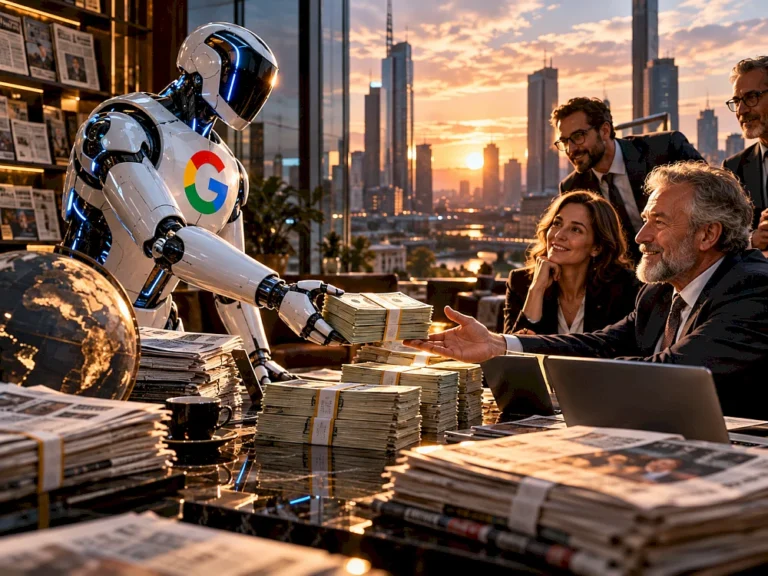
In short: if search engines and AI assistants increasingly answer users without sending them to the source, the internet will not stop producing information. Its economics will change. Governments, universities, companies, laboratories and users will continue creating large amounts of new information because doing so is part of their core activity. The hardest problem falls on professional information producers whose journalism, research, testing and analysis were financed by reader attention.
The real question is not whether AI will “run out of content.” There will probably be more text, images and video than ever. The harder question is who will pay for new, verified and expensive information that does not yet exist online and cannot be generated by summarizing what is already there.
Why the old model worked
For most of the search web’s history, publishers and Google operated under a clear exchange: search indexed pages and sent users to them, while publishers turned some of those visits into advertising, sales, subscriptions or a returning audience. AI answers change that exchange because information can be used without a visit to the original source.
The Reuters Institute reports that media executives expect search traffic to fall by roughly 43% over the next three years. At the same time, publishers are planning to invest more in original reporting, investigations and contextual analysis, and less in generic evergreen and service content that AI can easily commoditize.
Who creates facts even without search traffic
A large share of online information is produced for reasons unrelated to advertising. Governments publish laws and statistics, companies publish filings and documentation, universities and labs create research with grant and institutional funding, and users post reviews, photos and forum discussions for social and practical reasons.
This layer will not disappear even if search CTR falls sharply. The harder problem is expensive information that needs separate funding: investigations, field research, testing and long-form analysis do not appear automatically as a by-product of another activity.
| Producer | Why information is created | Funding | Dependence on clicks |
|---|---|---|---|
| Governments and regulators | Administration, law, reporting | Public budgets | Low |
| Universities and science | Research and education | Grants, institutions | Low |
| Companies | Sales, documentation, operations | Core business | Low |
| Professional publishers and analysts | News, verification, research | Ads, subscriptions, licensing | High |
| Independent authors | Reputation, audience, income | Subscriptions, services, ads | Medium/high |
AI cannot live indefinitely on summaries of summaries
Generating text and discovering a new fact are different activities. A model can write a graphics-card review in seconds, but somebody still has to measure temperature, power consumption and performance. It can explain a medical study, but it does not replace the experiment or data collection behind it.
Research published in Nature showed the risk of model collapse under some forms of repeated training on model-generated data. This does not imply that every modern AI system will inevitably degrade, but it reinforces the value of primary data. The scarce resource may therefore be less the number of words online and more information that describes reality for the first time.
Large publishers are already selling access
In February 2025, OpenAI and Guardian Media Group announced a partnership that allows Guardian journalism to support timely ChatGPT answers with attribution. For AI companies, professional journalism improves answer quality. For publishers, licensing creates a possible return even when the user never opens the story.
Large groups can negotiate directly, while smaller publishers need standardized infrastructure if machine licensing is ever going to scale beyond a few global brands.
From advertising to paid machine use
On September 30, 2026, Cloudflare launched the beta version of Pay Per Use. AI companies can define what use they are willing to pay for, publishers can accept or reject the offer, and Cloudflare meters usage and payments. It is still experimental, but it points toward a web where the relationship between a site and an AI system can be expressed not only as “allow” or “block,” but also as a price.
A different information economy
If the current trajectory continues, the model “publish an article → get Google traffic → show ads” will no longer be universal. Subscriptions keep value inside a direct reader relationship, licensing sells machine rights, pay-per-use systems can turn machine consumption into a transaction, and databases or APIs sell access to a structured resource rather than to an article alone.
The greatest pressure will fall on content whose economics depended almost entirely on search referrals: basic reference pages, shallow rewrites, interchangeable reviews and long-tail pages with little proprietary value. Primary data, specialized expertise, long-term observation, tools and structured databases should become relatively more valuable.
We do not yet know which funding system will dominate. Some information may remain fully open, premium sources may license machine access, and other resources may rely on subscriptions, APIs or commercial services. But if AI becomes one of the main consumers of online information, the economic relationship between machine and source will have to become far more explicit than it was in the era of ordinary search.