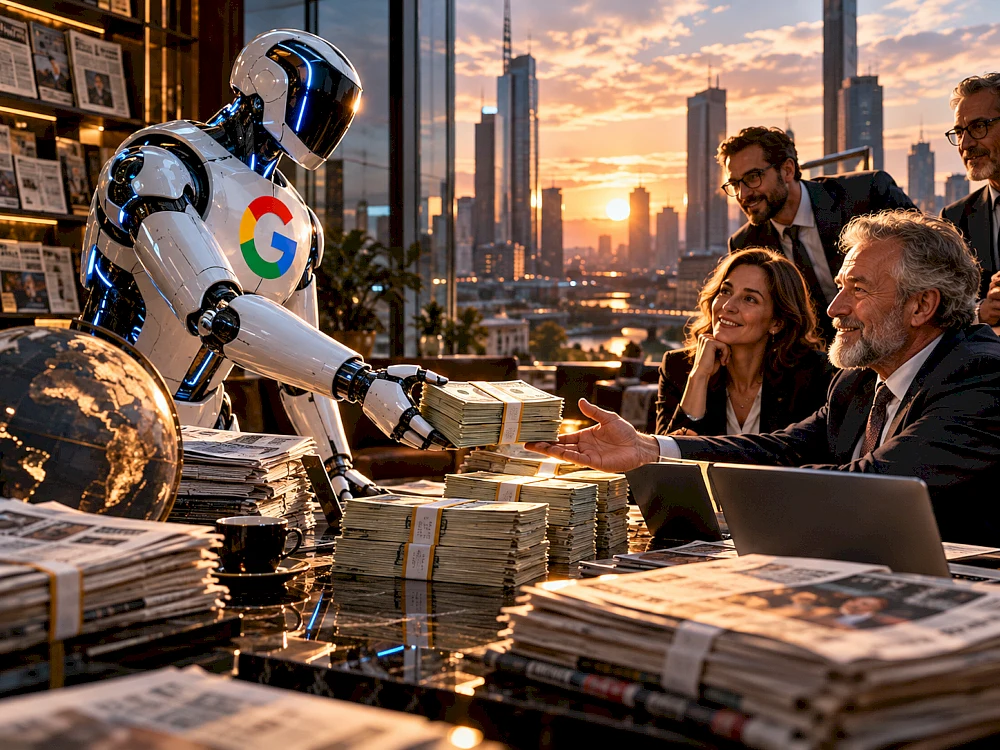
Short answer: the probability that Google will introduce a large-scale compensation system specifically for publisher content used in AI products by the end of 2030 is estimated at about 65%. The most likely outcome is not a universal fee for every quotation or answer, but a mix of licensing, commercial partnerships, revenue sharing and regulation-driven payments.
Forecast details
Probability: 65%
Confidence: 74/100
Horizon: December 31, 2030
Snapshot: October 10, 2026
For this forecast, “mass compensation” does not mean a handful of bilateral contracts. YES requires Google to launch or fund a standardized programme that explicitly compensates publishers for AI use in products such as AI Overviews, AI Mode or Gemini and reaches at least 1,000 publishers or operates in at least ten countries. If payments remain mostly limited to News Showcase, ordinary partnerships and individual contracts, the forecast resolves NO.
Google already pays publishers, but that is not the same thing
Google has paid news organizations for years and uses commercial licensing. News Showcase involves thousands of publications, but Google presents those payments as compensation for editorial curation, paywall access and special formats rather than a universal fee for content use in search.
In December 2025, Google announced additional partnerships for the AI era. The distinction remains important: these payments are part of broader commercial arrangements, not a standardized rate for every use of an article inside a generated answer.
Why Google may eventually pay more
Generative search can perform work users once did themselves: finding several pages, comparing them and synthesizing an answer. That makes Google’s product more useful, but it can also reduce publisher referrals.
Reuters Institute reports that 37% of surveyed publishing executives see platform payments through licensing or similar mechanisms as an important growth opportunity. Yet only around one fifth expect AI-company revenue to become truly substantial.
Regulators may push faster than the market
Canada has already created a framework for supporting news publishers under the Online News Act. Australia developed the News Media Bargaining Code and continues exploring mechanisms that encourage major digital platforms to sign commercial agreements with publishers.
European regulators are also examining whether content owners receive enough control and fair compensation when material is used in AI products. Even without voluntary action from Google, regulation could make broader payments more attractive than recurring legal conflict.
Why Google still has a strong reason to resist universal fees
Google has long defended the principle that ordinary indexing, linking and short excerpts should not automatically create a payment obligation. Its position is that search itself sends audiences to publishers and that a universal “include it, pay for it” model would conflict with the open-linking structure of the web.
U.S. litigation has not yet created a clear rule forcing Google to compensate every publisher for content used in AI Overviews, reducing the probability of a simple court-driven outcome.
Three likely payment models
The first is content-package licensing: broader rights, API access, paywall access or real-time feeds in exchange for a negotiated fee.
The second is revenue sharing tied to money generated inside AI products, especially if AI Mode becomes deeply monetized through advertising, commerce or premium services.
The third is a collective or regulatory model in which Google pays into a fund or through an intermediary and the money is distributed across many publishers.
The hardest problem is attribution
If an AI answer is built from twenty pages, contributions can differ widely. One article may provide the key fact, another a number, a third historical context, while others simply confirm what the system already knew. Should payment depend on use, uniqueness, quotation length, impressions or the commercial value of the query? Attribution makes universal pay-per-use much harder than conventional licensing.
Small publishers are the hardest part of the equation
Large media groups have legal teams and negotiating leverage. Smaller publishers need standardized or collective mechanisms; otherwise individual negotiations with thousands of websites do not scale.
Scenarios through 2030
Scenario 1 — large hybrid compensation system: 45%. Google expands AI-specific licensing, revenue sharing or collective programmes to thousands of publishers across multiple countries. This is the main route to YES.
Scenario 2 — payments remain substantial but selective: 30%. Google signs many contracts with important publishers but no broad standardized system emerges. Under this forecast, that resolves NO.
Scenario 3 — regulators effectively create the system: 20%. Major jurisdictions extend compensation rules to generative search. This also resolves YES.
Scenario 4 — the current model largely survives: 5%. Google relies on better referrals, citation features and publisher tools without creating mass AI compensation.
What would raise or lower the forecast
The 65% estimate would rise if major regulators explicitly require compensation for AI use of publisher content, Google expands programmes to hundreds of additional publishers, or standardized revenue-sharing and pay-per-use systems emerge.
It would fall if AI Search reliably sends enough referral traffic, courts confirm broad unpaid AI-use rights, or licensing remains effectively limited to the largest media groups.
Why 65% rather than a confident yes
Google has shown that it is willing to pay publishers when it can define the commercial structure. What it continues to resist is the principle that indexing, linking or short machine use should automatically create a universal right to payment. A mixed ecosystem of licensing, revenue sharing and regulation therefore looks more likely than a single global meter charging for every AI citation.
This forecast does not claim that the event will happen. It reflects the current estimated probability based on information available at the snapshot date. The estimate may change as new evidence appears.