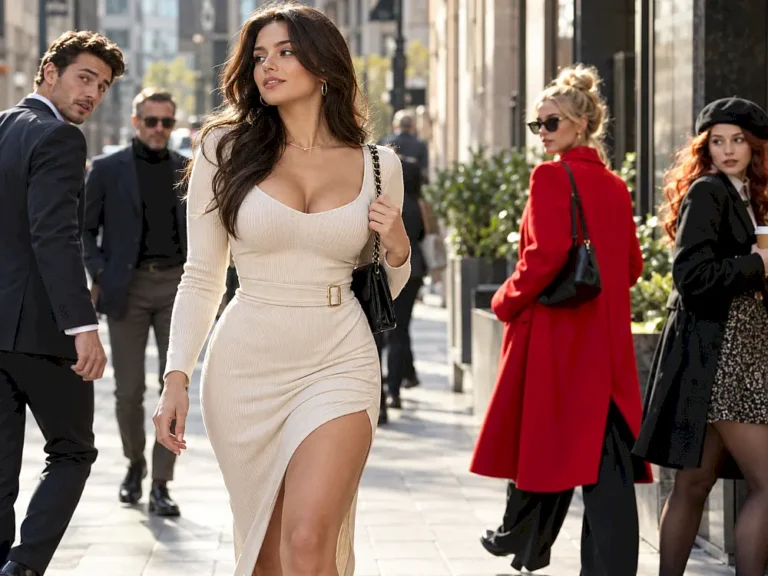
In the past, an “ideal” female body in a photograph still required a real person at the beginning of the process. Then came the pose, lighting, makeup, lens and retouching. A waist could be narrowed, skin smoothed and legs lengthened, but underneath the edits there was usually a body that had existed in the physical world.
Generative AI removes even that final constraint. It can create a woman who never existed, with a face, body, skin, hair and proportions assembled from visual patterns in training data. If the result is not attractive enough, no model needs to agree to another photo shoot; another image can simply be generated.
This is why AI and the female body is a more serious issue than another generation of retouching tools. AI did not invent unrealistic beauty standards. What it can do is manufacture them at enormous scale without having to preserve any connection to the anatomy of a real person.
When the “ordinary person” becomes thin by default
In 2025 researcher Aisha Sobey published The thinness of GenAI, a study of 649 images created with nine image generators. Some prompts asked for a generic “person” in everyday situations; other versions explicitly requested a larger body.
The result was striking. When body size was not specified, the generators almost never produced larger bodies. Only two such cases appeared without an explicit size request, and both were prompted by wording about an “unhealthy person.” Sobey argues that thinness effectively functioned as a default body type in the tested systems. The study involved particular platforms and 2023–2024 versions, so it does not prove that every current model behaves the same way. It does show a revealing mechanism: when diversity is not explicitly requested, a system can compress “normal” into a much narrower range than exists in real life.
AI does not copy one woman — it compresses a culture
An image generator does not possess a human concept of beauty. It learns statistical relationships between images and words. But the internet used to build training sets is not a neutral photograph of humanity. It contains disproportionate amounts of model photography, advertising, celebrities, retouched portraits, fitness imagery and pictures people considered attractive enough to publish.
A generative model can therefore act as a kind of cultural compression. It does not simply reproduce one photograph; it creates an image that matches patterns associated in the data with words such as “beautiful,” “attractive” or even “woman.” A large 2026 study analyzed 1,344 images from DALL·E, Midjourney and Stable Diffusion and found not one universal bias but a range of gendered differences that varied by model and prompt. The authors show how easily generators can reproduce cultural patterns even when the user does not directly request them.
This qualification matters. There is no single “AI” with one universal female beauty ideal. Models differ, they are updated, and developers alter datasets and diversity mechanisms. Yet the recurrence of certain visual patterns shows how cultural stereotypes can become technical defaults.
The most troubling body may be one that never existed
A photograph of a model with very rare proportions still depicts a possible human body. Even when the image is heavily edited, there is usually an original person underneath it. A generative image can cross that boundary without making the transition obvious.
The model does not have to respect the statistical distribution of real anatomy in the same way a biological body does. It can combine a very narrow waist, large bust, long legs, extremely low visible body fat, smooth skin and a particular facial type into one convincing image even if the full combination would be exceptionally rare in the real population.
Care is needed here: an unusual-looking generated body is not automatically anatomically impossible. Without measurements, that claim would be speculation. The more important change is epistemic. A viewer can no longer assume that a photorealistic body corresponds to a real body that ever existed. Social comparison can therefore shift from comparing oneself with another person to comparing oneself with a statistically constructed fantasy.
We already know what idealized bodies can do to real viewers
The direct question — whether AI-generated women specifically worsen women’s body image — is still less studied than the effect of conventional idealized photographs. That gap matters. We have evidence that image generators can produce narrow and stereotyped representations, but fewer strong experiments directly compare the impact of an AI woman with a retouched photograph of a real model.
The broader psychological mechanism, however, is well studied. A 2025 meta-analysis combined 20 experimental studies involving 3,603 young women. Exposure to content promoting idealized bodies reduced body satisfaction on average, while body-positive content produced a small positive effect. The meta-analysis also found particularly strong negative effects for video-based exposure.
A second systematic review and meta-analysis covering 83 studies and more than 55,000 participants found a substantial relationship between appearance comparison on social media and greater body-image concerns. This review matters because AI may not need a new psychological mechanism to create a new risk. The old mechanism of social comparison can operate with a new source of bodies.
We used to compare ourselves with exceptions. Now we can compare ourselves with fiction
A supermodel has always been a statistical exception. That rarity is one reason she appeared on the cover. With AI, exceptions can be manufactured in series.
WOW:
- >>> Why Did Leggings Become Almost Universal Clothing in the 21st Century?
- >>> Why Do We Steal Sleep from Ourselves Even Though We Know the Cost?
- >>> Does Willpower Really Control Body Weight?
- >>> Why Do We Eat When the Body Is No Longer Hungry?
- >>> Shiny Clothing and the “Second Skin” Effect: Why Does It Change How We See the Body?
Imagine a feed containing one real model with extremely rare proportions. A viewer can still think, “she is exceptional.” Now imagine hundreds of different “women”: different faces, clothing, settings and hairstyles, yet repeatedly similar waists, smooth skin, apparent age and overall body architecture. To the brain, that may begin to look less like one exception and more like a population, even though no such population exists.
For now this is better treated as a plausible hypothesis than as an established long-term effect. But it fits what we already know about repeated exposure and social comparison. Generative AI can make a rare or synthetic body type visually ordinary simply by producing it again and again.
Beauty standards are about more than waist size
It is easy to reduce “ideal bodies” to weight and proportions, but appearance standards also include age, skin, symmetry, facial features and the social qualities we unconsciously associate with attractiveness.
A 2026 FAccT study based on 26,400 synthetic faces found systematic links between perceived physical attractiveness and positive traits, describing the pattern as algorithmic lookism. The paper is important because it suggests that the issue is not only how AI draws a body, but also which social qualities become visually attached to attractiveness.
If such patterns are repeated across a huge volume of commercial imagery, advertising can end up with a very specific “ordinary woman”: young, attractive, smooth-skinned, proportionate and sufficiently close to the visual patterns a system has already learned as desirable. This does not require a designer to sit down and consciously set that standard. It can emerge statistically from the visual culture that came before the model.
But AI can also do the opposite
It would be a mistake to describe generative AI as a machine for producing one beauty ideal. The technology has a capacity that traditional fashion photography did not: it can create almost any representation without first finding a person who matches it.
A user can explicitly request a 65-year-old woman, a larger body, short stature, a prosthetic limb, visible wrinkles, a postpartum body, different ethnic features or asymmetrical appearance. Technically, AI can narrow beauty standards, but it can also make bodies that advertising historically showed less often far more visible.
The future standard is therefore not encoded in the technology alone. It will depend on what models learn to treat as typical, what users ask for, and which images brands, editors and recommendation algorithms choose to publish and amplify.
The problem may not be that AI “lies”
We have lived with images that alter bodies for a long time. Makeup changes faces, lighting hides texture, posing changes proportions, lenses can lengthen legs, Photoshop has existed for decades and smartphones routinely enhance photos automatically.
So saying that AI simply “ruined reality” would be too easy. It changes something more fundamental: it can remove the moment when reality was required in the first place. In Photoshop we modified a photograph of a person. With generative AI we can begin with an image that looks like a photograph of a person even though there was no person to photograph.
That difference may turn out to matter more than yet another digitally narrowed waist. Beauty standards used to remain loosely anchored to the most attractive, youngest, rarest and most carefully photographed real people. Now they can potentially detach from real people altogether.
So is AI making the female body an unrealistic standard?
As of 2026, the most defensible answer is this: AI can already reinforce unrealistic standards of female appearance, but there is not yet enough evidence to say that generative AI alone has created a new universal beauty standard.
The evidence is stronger for the first half of that statement. We know that generators can reproduce thin bodies and other narrow visual patterns systematically. We also know from social-media research that repeated exposure to idealized bodies can reduce satisfaction with one’s own appearance. The second step — whether AI will become the dominant source of body ideals and how strongly it will reshape real people’s expectations — still needs long-term research.
One change has already happened, however. Beauty standards once centered on people who were extraordinarily difficult to resemble. Now the standard can be a person who never existed. If we begin to see thousands of such bodies every day, the central question will no longer be whether machines have learned to draw beautiful women. It will be whether real bodies are gradually being asked to match the statistics of an invented one.