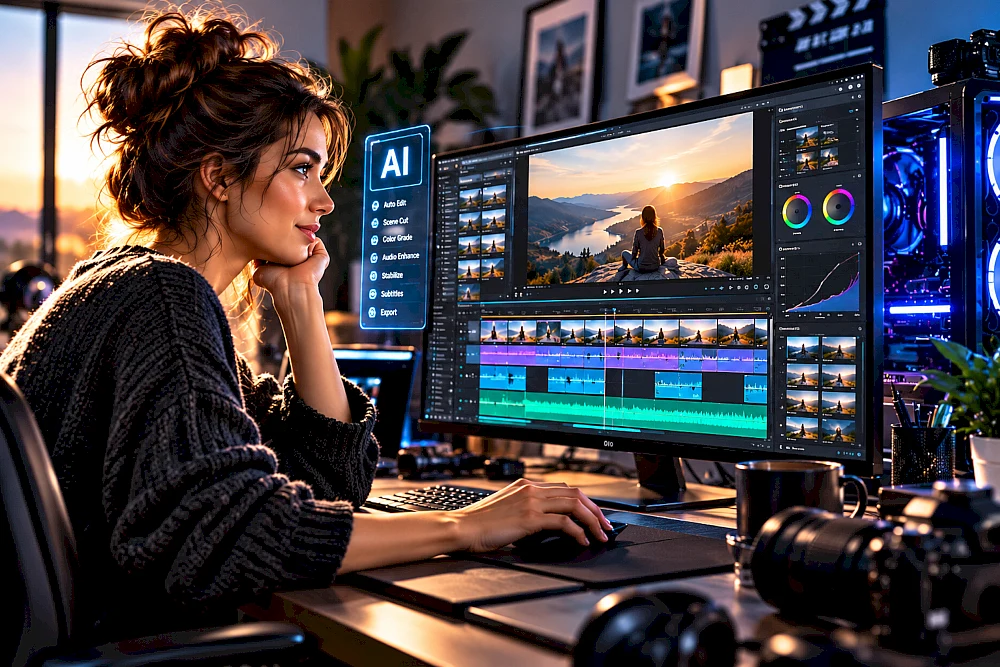
Only a few years ago, automated video editing mostly meant templates: a program could cut footage to music, stabilize a shot or generate subtitles. By 2026, the boundary has moved. DaVinci Resolve already uses AI for script and transcript workflows, Smart Reframe, subtitles, multicam decisions and audio. DaVinci Resolve is gradually becoming an environment in which AI understands the content of the footage rather than merely applying isolated effects.
Forecast details
Premiere is moving in the same direction. Transcript-based editing, local Media Intelligence and semantic clip search are changing the workflow itself. Adobe says Media Intelligence analyzes footage with models on the device, while Generative Extend in 2026 still requires an internet connection and cloud-based Firefly. That split captures the current frontier: analysis and parts of editing are moving local, while heavy generation of new video remains more cloud-dependent.
ORBK.NET’s current estimate is that by the end of 2030 a home PC will be able to perform almost the entire technical AI-video-editing workflow locally without remote inference. Probability: about 85%, with a working range of 80–90%. Confidence: 72/100.
“AI can fully edit a video” does not mean the machine becomes a great director. By 2030 it will probably be able to find the best takes, build a rough timeline, remove pauses, reframe footage, generate subtitles, clean audio, select B-roll, normalize the image and prepare the project for export. Taste, pacing and narrative judgement are much harder to automate.
Part of the future workflow already works today
Blackmagic already offers IntelliScript to match scripts with transcribed dialogue and build rough timelines, Multicam SmartSwitch for camera selection, Smart Reframe for composition changes and Audio Assistant for audio work. Newer Resolve versions also expand semantic search across people, objects and dialogue. Blackmagic is moving AI into the core logic of the editing system.
In Premiere, an editor can increasingly treat video like text: transcripts become the basis for rearranging and deleting footage. Text-Based Editing already shortens the distance between intent and edit operation.
The long-term shift is from knowing which button performs an operation to simply describing the result: “find every moment where the subject smiles; remove repetitions; cut this to three minutes; make a vertical version.”
Subtitles, reframing and audio are the easiest pieces to automate
Speech transcription has a clear target: recognize the words, align them with time and format the captions. Reframing can keep a person in the right area of a vertical frame. Audio cleanup also has relatively objective goals: reduce noise, level speech, duck music and remove unnecessary silences.
By 2030, these features may feel as ordinary as automatic white balance on a phone: AI runs in the background and the user rarely thinks about the model behind it.
The real breakthrough is when AI watches all the footage for you
A large share of editing time is spent not pressing buttons but watching: finding the strongest line, the failed take, the out-of-focus shot or the right reaction cutaway. Semantic search could therefore change editing more than any single visual effect.
With hundreds of files, a user could ask for all wide shots of a building, every silent reaction, the three cleanest versions of a sentence or all clips with strong camera shake. That combines computer vision, speech recognition, semantic search and technical quality assessment.
A rough cut may become one instruction
Once AI understands the footage, the next step is obvious: ask it to assemble the timeline. DaVinci IntelliScript already offers an early version of this idea, while Premiere’s AI direction points toward natural-language control.
By the end of the decade, an instruction could be: “make a fast five-minute video, start with the strongest moment, remove repetitions, keep the best jokes and add cutaways after longer talking sections.” AI may not create the final auteur version, but turning two hours of footage into a coherent rough cut would already transform the economics of editing.
B-roll is one of the main local-editing frontiers
There are two kinds of automatic B-roll. The easier one finds relevant cutaways in footage that already exists. The harder one creates a shot that was never recorded.
This is where the home-PC/cloud divide remains obvious. Generative Extend in Premiere uses cloud Firefly and needs internet access. At the same time, local video-generation workflows already run on personal RTX systems. NVIDIA demonstrates ComfyUI-based generation and local upscaling, showing that generated B-roll can in principle move onto the desktop GPU.
Integration is the key next step. If an editor can send a line from the script to a local model, receive a short B-roll clip, match it to the project and place it directly on the timeline, one of the last major cloud dependencies disappears.
Why a home PC can handle this
Video editing has long relied on specialized acceleration. GPUs decode video, process effects, color and rendering; NPUs now join CPUs and GPUs for neural workloads. AI editing is unlikely to become an “NPU does everything” story. Lightweight transcription or tracking can run on the NPU, heavier generation on the GPU, while the CPU coordinates the application and traditional editing pipeline.
Fast memory will matter just as much. Generative video consumes substantial VRAM, so mass-market local B-roll depends on whether enough memory and GPU performance become normal in creator PCs.
The cloud will not disappear
Even if the forecast resolves YES, data centers will retain an advantage on the hardest tasks. They can use larger models and more GPUs than a single user. Complex generated B-roll, long shots and maximum quality may continue to run in the cloud.
The user is more likely to get a choice: local for lower cost, privacy and offline work; cloud for more difficult or higher-quality jobs. The forecast is about a complete local option, not the death of cloud editing.
The hardest thing to automate is taste
Some editing operations have clear success criteria: subtitles should match speech, dialogue should not be buried by music, a face should not be cut out of a vertical frame, and an out-of-focus take is usually worse than a sharp one.
Good editing also contains decisions with no single correct answer: when to show a reaction, whether an awkward pause is funny, where music should begin or which shot should be saved for the climax. For simple content, AI may approach human editing closely. For advertising, film and strongly authored storytelling, people will continue to define what the video is trying to say.
What does “fully edit” mean?
The forecast fixes eight stages: analysis and semantic search; take selection and rough cut; transcription and subtitles; automatic reframing; audio cleanup and basic mixing; basic image matching; existing or locally generated B-roll; final timeline and export.
“Fully on a home PC” means that after the models are installed, all AI operations needed for those stages can run with the internet physically disabled. A person may review the result and change creative decisions; the test is technical autonomy.
Three scenarios through 2030
| Scenario | Probability | What happens |
|---|---|---|
| Local AI becomes a full editing assistant | 60% | A home PC automates almost the entire technical workflow while people focus mainly on creative decisions. |
| Nearly autonomous local editing | 25% | For podcasts, Shorts, interviews and simple ads, providing the footage and a text instruction is enough for an almost finished cut. |
| Key stages remain cloud-based | 15% | Analysis and captions run locally, but generated B-roll or agentic editing still depends on servers. |
What would change the forecast?
The estimate should rise if DaVinci, Premiere or another major NLE combines local semantic search, rough cut, reframing, audio and generated B-roll into one workflow during 2027–2028. Native local video generation inside mainstream editors would be a particularly strong signal.
The estimate should fall if the most powerful editing features remain primarily cloud-based, local generation continues to require memory beyond mainstream creator PCs or vendors tie key AI functions to server credits.
So can AI fully edit video on a home PC?
In the technical sense, probably yes by 2030. Most required components already exist: transcription, text-based editing, footage analysis, semantic search, reframing, audio processing and local short-form video generation.
The next step is to connect them into one local editing agent. A user adds footage and describes the desired result; AI reviews the material, builds structure, edits, reframes, cleans audio, generates captions, finds or creates B-roll and prepares versions for different formats.
AI will increasingly answer the question “how should this be edited?” The human will still own the more important question: “what should this video be?”
Forecast card
| Forecast ID | TECH-AI-VIDEO-EDIT-2030 |
|---|---|
| Forecast question | By 31 Dec 2030, will a mainstream home PC be able to perform at least 7 of 8 defined AI-assisted video-editing stages without remote inference and produce an editable timeline? |
| Eight stages | Media analysis; take selection and rough cut; transcription/captions; reframing; audio; basic image matching; B-roll; timeline/export. |
| Probability | 80–90%; central estimate about 85% |
| Confidence | 72/100 — moderately high |
| YES criterion | At least one major publicly available NLE on a mainstream home PC performs ≥7 of 8 stages with the network disabled and produces an editable timeline. |
| NO criterion | Performing ≥7 of 8 stages regularly requires remote AI models or specialized professional hardware. |
| Resolution date | 31 March 2031 |
| Historical Similarity | N/A |
| Thematic index | N/A |
| Data cutoff | 30 September 2026 |
| Next planned review | September 2027 |
Forecast disclaimer: this forecast does not claim that the event will occur. It is the current probability estimate based on information available on 30 September 2026.