
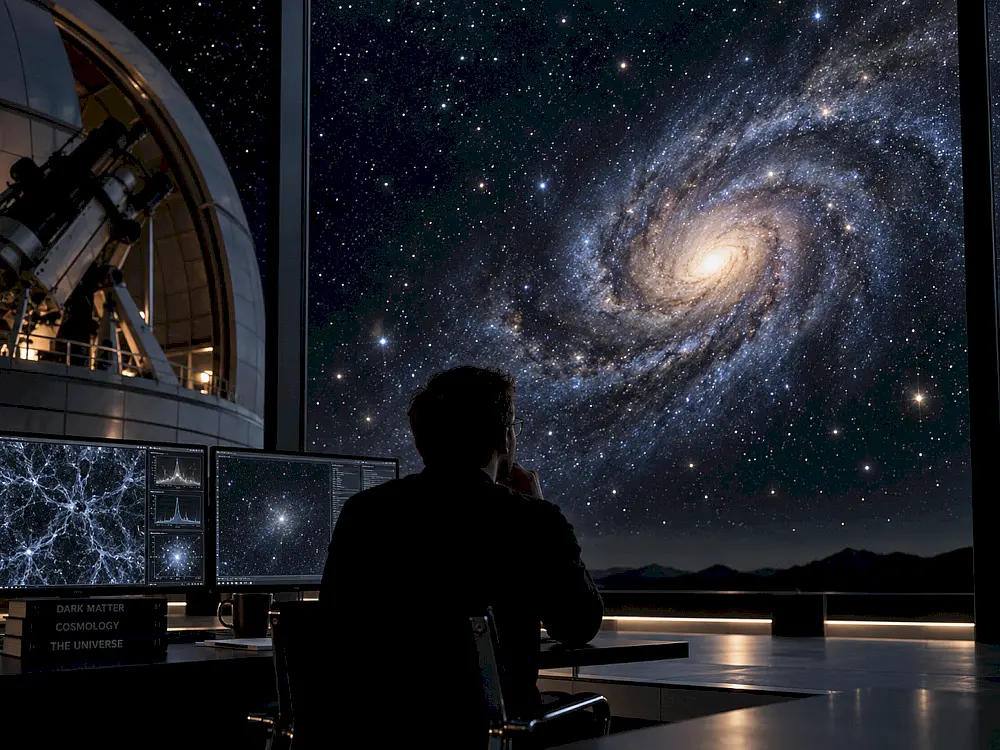
We can see dark matter through gravity in galaxies and clusters, and map its distribution through the way it bends light. Yet we still do not know what this invisible mass actually is. A forecast to 2040.
Forecast details
On 1 September 2026 one of the world’s most sensitive dark-matter detectors reported an unusual event. LUX-ZEPLIN, or LZ, recorded an interaction that is difficult to explain with known backgrounds. In an expanded search the global statistical significance was 2.6σ — far below the discovery threshold — and the collaboration explicitly stressed that it was not claiming to have detected dark matter. The result is described in the laboratory’s report on the LZ event.
The timing makes the broader question especially interesting. Today’s underground detectors are approaching a regime in which the background is no longer dominated only by imperfect instrumentation or radioactivity, but by neutrinos themselves. At the same time the High-Luminosity LHC is being prepared, axion and light-particle searches are expanding, and space observatories are mapping the invisible structure of the Universe with increasing precision.
ORBK.NET forecast question: will the physical nature of the dominant dark matter be scientifically established by 31 December 2040?
Current estimate: about 35%. Working range: 30–40%. Confidence: 52 out of 100.
The most likely outcome is therefore not a clean solution. Physics may narrow the viable parameter space dramatically and perhaps obtain one or several strong signals, while the underlying nature of dark matter remains formally unresolved at the end of 2040.
We know where dark matter is. We do not know what it is
Dark matter was not invented to explain one isolated anomaly. Its presence is inferred from the motions of stars and galaxies, gravitational lensing, the dynamics of galaxy clusters, the cosmic microwave background and the formation of large-scale structure.
The current Particle Data Group review estimates that dark matter makes up roughly 84% of all matter in the Universe while also stating that the fundamental nature of most of it remains unknown. Modified-gravity ideas can reproduce some effects, but models without dark matter face major difficulties when trying to explain the full set of cosmological observations across different scales. See the PDG review.
The central question is therefore no longer “do we see extra gravity?” but “what produces it?”. Candidates include weakly interacting massive particles, or WIMPs; extremely light axions or other fields; richer dark sectors with their own particles and interactions; and, for some fraction of the abundance, primordial black holes. A multi-component answer is also possible. The sheer breadth of the viable space is one of the main reasons the forecast remains below 50%.
One strange LZ event changes little — but it matters
The new LZ result is particularly interesting because it emerged in an extended energy range rather than only in the simplest standard WIMP search. The detector saw one event consistent with a nuclear recoil in a region with low expected background. After accounting for the fact that multiple models were examined, the global significance was 2.6σ.
This is not evidence strong enough to move the forecast by tens of percentage points. The event could be a rare unmodelled background, a statistical fluctuation, or even new physics unrelated to dark matter. What matters is what happens next. If the growing LZ dataset produces several events with the same structure, the evidentiary weight will increase. If the anomaly remains isolated, its importance will fade.
The WIMP problem: detectors are beginning to see neutrinos
For decades WIMPs were among the leading dark-matter candidates. The idea was attractive: if huge numbers of such particles pass through Earth, an extremely sensitive underground detector should occasionally record one scattering from an atomic nucleus. Experiments therefore became larger, cleaner and quieter, moving deeper underground and rejecting radioactive and cosmic backgrounds with ever greater precision.
The difficulty is that detectors are now sensitive enough to begin seeing solar neutrinos whose interactions can imitate the expected dark-matter signal. In February 2026 XENONnT reported reaching the region often called the “neutrino fog”. It is not an absolute wall — statistics, directionality, different target materials and larger exposures can push further — but each step becomes harder. The experiment’s current updates are published on the XENONnT site.
The Particle Data Group notes that next-generation projects such as DarkSide-20k, XLZD and PandaX-xT should improve sensitivity to different models by roughly another one to two orders of magnitude, increasingly entering regions where astrophysical neutrinos become an important background. By 2040 the classic WIMP picture may either produce a convincing signal or be forced into progressively less natural parts of parameter space. Both outcomes are scientifically important, but only the first solves the mystery.
If not WIMPs, axions are the other major bet
The axion has a different origin. It was originally proposed not as a dark-matter solution, but as a possible answer to a problem in quantum chromodynamics. It was later realized that such very light particles could also naturally account for dark matter.
The challenge is that axion parameter space is enormous. Different masses require different search techniques: resonant cavities, strong magnetic fields, quantum sensors, astrophysical observations and other approaches. A null result in one narrow mass range says little about the rest.
For the 2040 horizon, progress will likely come not from one single giant experiment but from a growing network of complementary searches that gradually cover more masses and couplings. If one experiment sees a signal, the measured frequency and mass would give other laboratories a specific target for independent confirmation. That makes an axion discovery potentially faster to validate than an ambiguous astrophysical anomaly.
The Large Hadron Collider gets another chance
In June 2026 the current LHC running period ended and CERN moved into a major upgrade. Around 2030 the High-Luminosity LHC is expected to begin operation. Its main advantage is not a dramatically higher collision energy but much greater statistics. CERN plans roughly a tenfold increase in integrated luminosity compared with the original LHC design, with operation continuing into the 2040s. The programme is summarized in the HL-LHC overview.
That creates a chance to see very rare processes or subtle deviations from the Standard Model. Yet even the discovery of a new stable neutral particle would not automatically establish dark matter. Researchers would still have to show that its properties match the particles inferred in galactic halos and that its abundance can account for the cosmological dark matter density.
The strongest case would be a convergence of methods: the collider measures the mass and interactions of a new particle while an underground detector independently sees a compatible signal. That kind of cross-confirmation could turn “new physics” into “the nature of dark matter”.
Astronomy can narrow the field, but may not finish the job alone
ESA’s Euclid mission is building a vast map of galaxies and gravitational lensing. One of its core goals is to investigate the dark Universe, including the distribution of dark matter and the way cosmic structure forms. ESA describes that programme in the official Euclid mission page.
Those observations can eliminate entire classes of models. Ultralight dark matter should influence small-scale structure differently from heavy cold particles. Self-interacting dark matter may alter the internal structure of halos. Primordial black holes should leave their own astrophysical signatures.
But gravitational observations usually answer “how does dark matter behave?” more readily than “what is it made of?”. The strongest solution therefore remains a convergence: cosmology narrows the allowed properties, a laboratory detects the candidate, and astrophysics confirms that the candidate behaves as the Universe requires.
Why only 35%?
The positive case is strong because the next fourteen years are unusually rich in experimental opportunities. LZ is still taking data. New xenon and argon detectors will probe deeper parameter space. Axion searches are expanding. HL-LHC will collect huge statistics. Cosmological measurements will become much more precise. Several independent methods are attacking the same problem at once.
The negative case is equally important. Decades of searching have shown how risky it is to assume that nature chose a candidate convenient for our detectors. Dark matter may interact with ordinary matter too weakly even for the next generation. Its mass may lie far outside traditional search windows. The dark sector may be complex, or the only accessible signature may remain gravitational.
There is also no useful historical base rate. Humanity has never solved a directly comparable “dark matter mystery” from which a 14-year success frequency could be estimated. The 35% figure is therefore a causal judgement about the reach of the coming experimental programme, not a frequency extracted from a historical sample. That is also why confidence remains only 52 out of 100.
Five scenarios to 2040
| Scenario | Probability | What would need to happen |
|---|---|---|
| A new dark-sector particle is established | 17% | A direct detector, collider or other experiment discovers a particle, and independent evidence shows that it accounts for the dominant dark matter. |
| Dark matter is an axion or another ultralight field | 10% | An axion search produces a reproducible signal that is independently confirmed and consistent with cosmology. |
| Another physical explanation is established | 8% | Compact objects, a complex multi-component dark sector or a substantially different physical mechanism becomes the accepted dominant explanation. |
| A strong candidate appears but the mystery remains formally open | 40% | One or more persuasive signals emerge, but independent confirmation or proof of the cosmological role is missing. |
| No decisive signal | 25% | Experiments keep excluding models, but no candidate approaches the status of an established explanation. |
The first three scenarios sum to the 35% positive probability. The fourth scenario is the single most likely outcome. Physics could obtain a dramatic signal and still fail to close the case if another experiment cannot reproduce it or if its cosmological role remains unproven.
What would raise or lower the forecast?
The 35% estimate should not move with every anomaly. A meaningful increase would require LZ or another detector to observe a repeatable population of events that known backgrounds struggle to explain; an axion experiment to produce a signal that a second setup can target and reproduce; or a collider to discover a stable neutral particle whose properties independently match astrophysical or direct-detection evidence.
The strongest trigger would be agreement between two independent channels: for example, a collider-determined mass matching the recoil spectrum in an underground detector, or an axion signal recurring in different experiments with the predicted dependence on measurement conditions.
The estimate should fall if the current LZ anomaly disappears with more statistics, next-generation direct detectors reach their planned sensitivity without a signal, the main axion windows remain empty, and HL-LHC shows no persuasive evidence of an accessible dark sector.
The biggest result of 2040 may be a nearly empty map
Failure to identify the particle would not mean no progress. If by 2040 physics excludes much of the traditional WIMP space, large regions of axion models, a substantial share of primordial-black-hole scenarios and several classes of light dark sectors, that would still be a major scientific achievement. The map of what remains possible would be much smaller.
As of September 2026 there is not enough evidence to say that a discovery is imminent. But several developments are converging: detectors are reaching the neutrino background, axion technologies are expanding the search, cosmology is producing huge dark-matter maps, and the LHC is preparing for another decade of precision physics.
ORBK.NET’s most likely answer is therefore still no: the nature of dark matter will probably remain unresolved at the end of 2040. But the probability that one of modern physics’ biggest mysteries is solved within the next fourteen years is already roughly one in three.
Forecast card
Forecast ID: SCI-DM-2040-001
Category: Science
First version: 9 September 2026
Data cutoff: 9 September 2026
Horizon: 31 December 2040
Forecast question: Will the physical nature of the dominant dark matter be scientifically established by 31 December 2040?
YES: a specific particle, field, class of compact objects or other physical mechanism is supported by at least two independent lines of observational or experimental evidence and can account for the dominant component of cosmological dark matter. Leading scientific reviews describe it as an established explanation rather than merely a candidate.
NO: several fundamentally different viable candidates remain; existing signals lack independent confirmation; or a new particle or phenomenon is detected without demonstrating that it constitutes the dominant dark matter in the Universe.
VOID: not used. If the phenomena now attributed to dark matter are instead explained by independently confirmed fundamental physics without a new form of matter, that still counts as YES because the physical origin has been established.
Resolution date: by 31 March 2041 using scientific results obtained or published no later than 31 December 2040.
Resolution source: the then-current Review of Particle Physics by the Particle Data Group together with independent peer-reviewed experimental results and major scientific reviews.
Probability: 35%
Working range: 30–40%
Confidence: 52/100 — moderately low
Historical base rate: not reliably available.
Historical similarity: N/A
Thematic index: N/A
Main scenario: a strong candidate or several signals without final identification of dark matter — 40%.
This forecast was prepared using the ORACLE Foresight Engine methodology. The initial estimate is fixed as an immutable snapshot; future changes should be published as separate dated versions.
Publication disclaimer
This forecast does not state that the event will happen. It presents a current probability estimate based on information available at the time of the forecast. The estimate may change as new information becomes available.
