
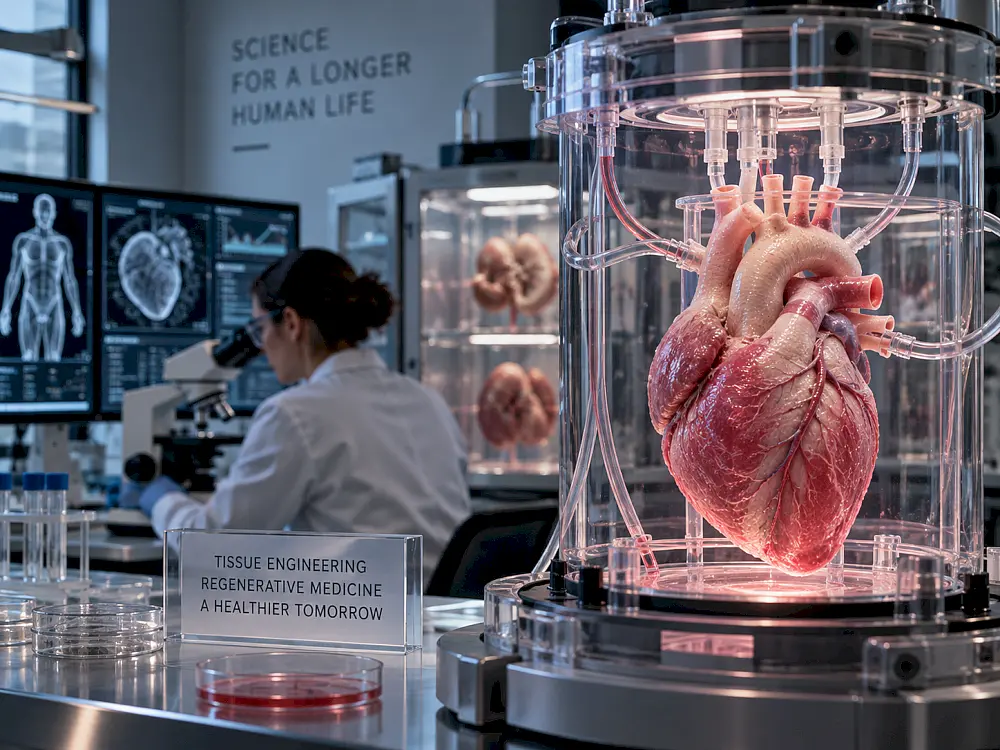
Humanity can already grow miniature kidneys, liver tissue and even partially humanized organs inside animals. But the distance between a functional piece of tissue and a kidney that can be connected to a human bloodstream and keep someone alive for years is one of the hardest engineering problems in biology.
Forecast details
Two decades ago the future seemed closer. In 2006 researchers described seven patients who received bladder reconstructions made from their own cells grown on biodegradable scaffolds. Years of follow-up showed that the engineered tissues could retain useful structure and function. It was an important proof that the basic sequence — patient cells, engineered tissue, implantation — can work in humans. The original report is available through PubMed.
A kidney, liver, heart or lung is a different level of complexity. Each contains billions of cells of many types, a branching vascular system, signalling and neural connections, drainage structures and a three-dimensional microarchitecture that cannot simply be reproduced from the outside.
ORBK.NET forecast question: by 31 December 2040, will a full-size human kidney, liver, heart or lung created predominantly from human cells using regenerative-medicine techniques be successfully transplanted into a living person and provide the organ’s main function for at least 12 months?
Current estimate: about 30%. Working range: 25–35%. Confidence: 56 out of 100.
The most likely outcome is more modest. By 2040 medicine may be transplanting increasingly complex engineered tissues and functional grafts, while a complete organ able to replace a donor organ remains experimental.
A mini-kidney can already filter. The problem is that it is still not a kidney
Recent progress is increasingly concrete. In early 2026 researchers reported a scalable method for producing vascularized kidney organoids from stem cells. Production efficiency increased more than fiftyfold, and large numbers of organoids could be assembled into tissue containing a number of nephron-like structures comparable to two rat kidneys.
After implantation into mice, some glomerular structures connected to the host circulation and showed selective filtration. That is far more than a visually convincing “mini-organ” in a dish. Yet the authors themselves describe the work as a step toward a future bioengineered kidney, not a transplant-ready human organ. The study was published in Nature.
The distinction is fundamental. A kidney does more than filter blood. It regulates water and electrolytes, controls acid-base balance, participates in hormone signalling, concentrates urine and continuously drains it through a correctly organized tubular and collecting system. Thousands of well-formed nephrons can exist without forming a complete kidney.
This captures one of regenerative medicine’s central problems: individual components of an organ are advancing faster than our ability to integrate them into one living system.
The liver may have a shorter route
The liver has one special advantage — remarkable regenerative capacity. A future replacement may not have to be fully grown in a laboratory. It may be enough to build a functional starting tissue that can continue developing after implantation.
In 2026 researchers demonstrated this principle with engineered human liver tissue. A small amount of laboratory-made tissue was implanted into mice and then stimulated to grow inside the body using controlled molecular signals. NIH described the work as proof of concept that could eventually offer an alternative route for people who need transplantation. The research is summarized in the NIH article on liver tissue.
This changes the engineering problem. The future may not be a bioprinter producing a finished liver that a surgeon lifts from a sterile container. A more realistic pathway may be: create enough correctly organized tissue, establish blood supply, implant it and let the body complete part of the organ-building process. In that model, the patient becomes the final stage of the bioreactor.
The hardest problem is not the cells, but the connections between them
The popular image of a “3D printer for organs” oversimplifies the challenge. Researchers can already produce many of the human cell types required. The harder task is persuading billions of cells to occupy the right places, mature at the right time, interact correctly and remain alive.
Blood vessels are especially critical. Every active cell requires oxygen and nutrients. Natural organs solve this with a hierarchy of large vessels that branch repeatedly down to capillaries. Human-scale engineered tissue needs the same architecture. Diffusion may be sufficient for a small organoid; it is not enough for the centre of a human-sized liver.
A few large channels are not sufficient either. An engineered organ needs arteries, arterioles, capillaries and veins lined with appropriate endothelial cells and able to withstand real blood pressure without thrombosis or leakage. After the vascular problem comes the next layer: bile ducts in the liver, a connected urine-collection system in the kidney, simultaneous airway and vascular trees in the lung, and synchronized electrical conduction across a huge mass of muscle in the heart.
A full organ is therefore not simply a large amount of correctly grown tissue. It is a network of networks.
Perhaps the organ will not need to be printed from scratch
Another route looks less futuristic but may be faster. Cells can be removed from a donor human or animal organ while preserving the extracellular scaffold. The “empty” organ already contains its overall shape, vascular tree and much of the natural microarchitecture. Researchers then try to repopulate that scaffold with human cells.
A 2025 Nature Reviews Bioengineering article describes this strategy for kidneys, livers, hearts and lungs. Organs from large animals can already provide human-scale scaffolds; the next challenge is to repopulate them with enough of the correct cells, restore the inner surface of the vasculature, mature the tissue in bioreactors and achieve stable function after transplantation. See the review.
This route may overturn the assumption that one technology — 3D bioprinting — must win. The first successful organ is more likely to be a hybrid. Part of its structure could come from a natural scaffold, its cells from the patient or a universal stem-cell line, small vessels could mature biologically, and selected elements could be printed. There is no need to print nature from zero if biology can be persuaded to finish the construction itself.
A more radical possibility: grow the human organ inside an animal
There is a fourth route. Rather than reproducing every embryonic development signal in the laboratory, researchers can use a living animal as a biological incubator.
An animal embryo can be genetically altered so that it cannot normally develop a particular organ, after which human pluripotent stem cells are introduced. In principle, those cells should occupy the vacant developmental niche and build the missing structure.
Experiments in pigs have already generated early kidney structures containing a substantial contribution from human cells. A 2026 review emphasizes both the significance of the progress and the unresolved barriers: it remains uncertain whether the human cells can complete development into a mature functional kidney; part of the tissue remains pig-derived; and human-cell contribution to other organs creates technical and ethical constraints. See the 2026 review.
This route matters because an embryo already “knows” how to build an organ. Researchers do not have to position millions of nephrons one by one; they have to create the conditions in which a natural developmental programme does the work. But a transplantable organ would still need to be human enough to avoid rejection, genetically controlled and safe from unwanted human-cell contribution to other tissues.
Why the probability is still below one half
The positive case rests on several independent technological routes rather than one breakthrough. Organoids are becoming more mature. Bioprinting offers geometric control. Decellularized scaffolds avoid rebuilding every structure from zero. Interspecies organogenesis could exploit normal development as a bioreactor. If one pathway stalls, another may bypass the obstacle.
That is why the probability is not merely 5–10%. But the negative case remains strong. As of September 2026 none of these methods has produced a full-size human-cell-derived kidney, liver, lung or heart that can replace a donor organ in a living person.
And a successful prototype is only the beginning. Function must first be demonstrated in large animals, followed by stability over months or years. Researchers must control tumour risk from pluripotent cells, thrombosis, immune reactions, abnormal differentiation and structural defects. Manufacturing must then become standardized, reproducible and acceptable to regulators. Even a first-in-human transplant would not automatically resolve this forecast: the organ has to work for at least a year.
Four scenarios to 2040
| Scenario | Probability | What it means |
|---|---|---|
| A full engineered organ works successfully in a human | 30% | A kidney, liver, heart or lung made predominantly from human cells is transplanted and provides its core function for at least one year. |
| A first transplant occurs, but the threshold is not met | 15% | A full-size bioengineered organ is transplanted, but function is insufficient, short-lived or dependent on substantial external support. |
| Engineered tissues enter medicine, but full organs do not | 40% | Liver implants, kidney tissue, cardiac patches and other constructs replace part of an organ’s function without replacing the whole organ. |
| Full-size organs remain mostly preclinical | 15% | Vascularization, maturation, safety or scaling prevent the transition to full clinical transplantation. |
The third scenario is the most important. Medicine does not have to jump directly from a donor kidney to a fully grown kidney. Between them may appear an entire class of treatments: small implants that add function, temporarily support a patient or delay the need for transplantation. Regenerative medicine could therefore transform transplant care before it can manufacture complete replacement organs.
Which organ is most likely to be first?
The heart is not the easiest candidate: it requires a powerful muscular wall, complex chambers and valves, continuous coronary perfusion and synchronized electrical rhythm. The lung is even more challenging because of its enormous gas-exchange surface and the microscopic boundary between capillaries and alveoli. The kidney is attractive because of medical demand and rapid organoid progress, but its architecture is extremely complex: building a filter is not enough; the complete processing and drainage system must also work.
The liver, or a functional liver equivalent, therefore looks like the best candidate for the first major breakthrough. This is an analytical judgement, not an established fact. The liver has strong regenerative capacity, and useful clinical function may be achieved before every feature of a natural full-size organ is reproduced. But that is also where the forecast draws a hard boundary: auxiliary liver tissue is not yet a complete engineered liver.
What would change the forecast?
The 30% estimate should rise substantially if a full-size bioengineered organ can replace the natural organ in a large animal for at least 6–12 months. The key evidence would not be survival of the tissue alone, but complete vascular integration and organ-specific function: urine production for a kidney, stable metabolism and bile drainage for a liver, or effective pumping for a heart.
A second major trigger would be regulatory approval for a human clinical trial of a complete engineered organ. A third would be reproducible scaling. One unique organ made by hand over many months is not yet a new transplant system; the process must be repeatable.
The estimate should fall if the main approaches remain limited to organoids and small tissues into the early 2030s, if large constructs continue to fail because of inadequate vascularization, or if safely producing mature cells from pluripotent lines proves much harder than expected.
There is also an external factor. If genetically modified animal organs or other organ-replacement systems achieve strong long-term clinical results much earlier, they may reduce some of the medical and economic pressure to grow complete human organs. Research would continue, but the route into routine clinical use could lengthen.
The real breakthrough may look very different from the popular image
The idea of growing a new kidney entirely from one patient’s own cells is so intuitive that it is easy to imagine it as the inevitable endpoint. Biology may choose a less elegant route.
The first “grown liver” could combine an animal-derived scaffold, patient cells, printed vascular segments and tissue that matures after implantation. The first kidney might be assembled from thousands of organoids, or partially developed inside a genetically modified animal before transplantation. The boundary between grown, printed, regenerated and transplanted organs may therefore blur.
The real question to 2040 is not whether science can create something that resembles an organ. That is already happening. The harder question is: can we create an organ to which the human body can safely entrust a life?
As of September 2026 ORBK.NET’s answer is more likely no than yes. But a roughly 30% probability over fourteen years means the idea has already moved beyond science fiction. The central obstacle is no longer simply growing human cells; it is turning them into an integrated living organ.
Forecast card
Forecast ID: SCI-ORG-2040-001
Category: Science
First version: 9 September 2026
Data cutoff: 9 September 2026
Horizon: 31 December 2040
Forecast question: By 31 December 2040, will a full-size human kidney, liver, heart or lung created predominantly from human cells using regenerative-medicine techniques be successfully transplanted into a living person and function for at least 12 months?
YES: at least one major solid organ — kidney, liver, heart or lung — is created predominantly from human cells through organoid engineering, bioprinting, recellularization of a biological scaffold, interspecies organogenesis or another regenerative technology; it is transplanted into a living patient and provides the organ’s core function for at least 12 months without permanent complete replacement of that function by an external system.
Excluded: research organoids, isolated tissue patches, bladder reconstruction, transplantation of cells or islets, mechanical artificial organs, and ordinary transplantation of an already formed pig organ.
NO: by the deadline there are only tissues, organoids, partial substitutes, preclinical full-size constructs or clinical transplants that do not meet the 12-month core-function threshold.
VOID: not used.
Resolution date: by 31 March 2041 using outcomes achieved no later than 31 December 2040.
Resolution source: peer-reviewed clinical publication plus official medical-centre or regulatory documentation of the transplant and duration of organ function.
Probability: 30%
Working range: 25–35%
Confidence: 56/100 — moderate but constrained by the long horizon
Historical base rate: unavailable for full-size bioengineered solid organs.
Historical similarity: N/A
Thematic index: N/A
Main scenario: complex engineered tissues enter clinical medicine, but a complete organ does not yet replace a donor organ — 40%.
This forecast was prepared using the ORACLE Foresight Engine methodology. The estimate is fixed as an immutable first snapshot; future changes should be published as separate dated versions.
Publication disclaimer
This forecast does not state that the event will happen; it is a current probability estimate based on available information and may change as new evidence appears. This material is for informational purposes and does not replace consultation with a physician or other qualified healthcare professional.