
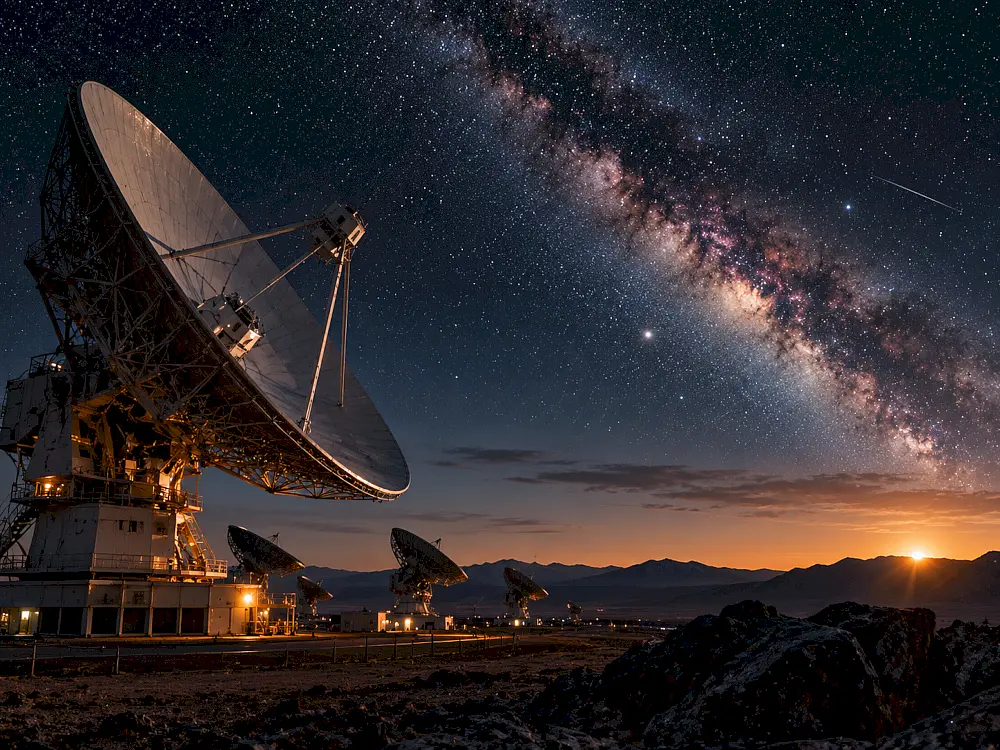
We can already see possible biosignatures on Mars and in the spectra of distant worlds. But the distance between an “interesting signal” and the discovery of extraterrestrial life is much greater than it first appears.
Forecast details
The search for life beyond Earth has a strange paradox. Humanity can now study the atmospheres of planets tens or hundreds of light-years away, drill into an ancient Martian riverbed and send spacecraft toward the hidden oceans of Jupiter’s moons. Yet NASA’s official position remains simple: there is still no convincing evidence of life beyond Earth, as its overview of the search for life makes clear.
At the same time, we are approaching the point at which such evidence could emerge. In 2025 NASA reported that the Sapphire Canyon sample collected by Perseverance from the Cheyava Falls rock contains potential biosignatures. That is not a discovery of life: non-biological explanations remain possible and the sample needs much deeper study. But this is no longer an abstract discussion about whether ancient Mars was habitable — it is a specific material sample that may preserve traces of ancient microbial processes. NASA described that status in its announcement on the biosignature.
ORBK.NET’s current estimate: the probability that humanity will obtain scientifically convincing and independently confirmed evidence of extraterrestrial life by 31 December 2040 is about 40%. The working range is 35–45%. Confidence is 55 out of 100.
The single most likely outcome is still different: by 2040 we may have candidates far stronger than those available today, while the scientific community remains unable to rule out plausible non-biological explanations.
What would “we found life” actually mean?
If every potential biosignature counted as proof, the question could almost be considered resolved already. The forecast therefore uses a much higher threshold. A single unexplained radio signal, an organic molecule, an unusual structure in a rock, a gas in an exoplanet atmosphere or a result from one research team does not qualify while realistic alternative explanations remain.
A YES outcome requires at least three elements: a scientific result published in the literature; independent confirmation or a genuinely separate second line of evidence; and a situation in which biological or technological origin becomes a substantially stronger explanation than known abiotic chemistry, terrestrial contamination or measurement error. The challenge is no longer only to find something unusual, but to show that ordinary nature cannot plausibly account for it without life.
K2-18 b shows why caution matters
K2-18 b is one of the clearest recent examples. James Webb Space Telescope observations prompted major interest in molecules that, on Earth, can be associated with biological processes.
A later comprehensive analysis using multiple data reductions and hundreds of atmospheric models confirmed methane but did not find robust statistical support for dimethyl sulfide as a biosignature. The authors showed that the inference depended strongly on spectral processing and modelling assumptions. The methodological problem is visible in the K2-18 b analysis.
The lesson matters more than the fate of one planet. Better telescopes will detect more unusual atmospheric chemistry, but the number of candidates may grow much faster than the number of discoveries that survive independent scrutiny. A distant atmosphere is not a laboratory sample. We reconstruct gases, temperature, clouds, surface chemistry and possible biology from photons, and each step leaves room for another explanation.
Mars offers a different route
Mars has one major advantage over exoplanets: we can physically investigate it. Instead of a few spectral lines, researchers can examine rock texture, mineralogy, organic compounds, isotopes and geological context. If selected samples eventually reach terrestrial laboratories, many independent teams could test them with different techniques.
If the unusual features at Cheyava Falls really preserve ancient microbial activity, Mars could provide the first convincing evidence of life beyond Earth. But geochemistry can produce structures and minerals that mimic biology. Even a very strong Martian result must also rule out contamination from Earth. For that reason, the Solar System remains the most likely single source of a first confirmation in our scenario distribution — but with only an 18% probability by 2040.
Hidden oceans may be habitable, but habitability is not life
Europa, Jupiter’s icy moon, is often presented as one of the most attractive targets. Current evidence points to a global ocean beneath the ice. Europa Clipper is already on its way to Jupiter and is expected to arrive in 2030. Yet it is not a direct life-detection mission. Its goal is to determine whether Europa has conditions that could support life, as NASA explains in the mission profile.
This illustrates the main constraint of the 2040 horizon. Over the next decade we may become much better at identifying where life should be searched for while still lacking the instrument that can settle the question. A particularly promising Europa result could strengthen the case for a follow-up lander or plume-sampling mission, but design, approval, launch and travel to the outer Solar System can consume many years.
Distant planets could beat Mars
The exoplanet route is fundamentally different. We do not need to travel tens of light-years; we need enough photons.
NASA is developing the Habitable Worlds Observatory concept with the explicit aim of directly imaging Earth-like planets around Sun-like stars and examining their atmospheres for signs of life. As of 2026 HWO remains a future mission concept: NASA is funding precursor science, but the observatory itself is not yet operating. The current programme is described in the HWO programme.
By 2040 astronomy will almost certainly know far more about exoplanet atmospheres than it does today. But there is no guarantee that the most interesting Earth-like targets will be accessible with the necessary precision early enough. Oxygen, methane or another suggestive gas combination would not automatically be proof. Researchers would have to understand the star, planetary geology, climate, oceans, photochemistry and every plausible abiotic pathway to the same molecules.
Why 40%, not 80%?
There is no meaningful historical base rate for this question. Humanity has never confirmed extraterrestrial life, so there is no series of comparable past attempts from which a clean success frequency can be calculated. That sharply limits confidence.
Instead, the estimate comes from several partially independent routes: Mars, other Solar System bodies, exoplanet atmospheres and technosignatures. Each has a relatively small chance of success by 2040, but they operate in parallel. That is why the overall probability is far above a few percent, while there is still no basis for 70–80%.
The largest unknown is more fundamental: we do not know how frequently life begins. If simple life emerges readily wherever liquid water, energy and suitable chemistry persist, 40% may be too low. If the transition from chemistry to biology is extraordinarily rare, our instruments may keep improving while returning only sterile worlds.
Five scenarios to 2040
| Scenario | Probability | What would happen |
|---|---|---|
| First confirmation inside the Solar System | 18% | Mars or another body yields several independent biosignatures that survive serious abiotic alternatives. |
| First confirmation on an exoplanet | 15% | Repeated atmospheric observations produce a coherent pattern much better explained by biology. |
| First convincing technosignature | 7% | A repeatable signal or other artificial signature is independently confirmed and localized beyond Earth. |
| Strong candidates but no final confirmation | 45% | New candidates emerge, possibly far stronger than today’s, but credible alternative explanations remain. |
| No major breakthrough | 15% | Observations improve our understanding of habitable worlds without producing a candidate near the confirmation threshold. |
The first three scenarios sum to 40%. If a discovery occurs, it is more likely to be less cinematic than popular culture suggests: microbial life, ancient microbial remains or a chemical signature of biology rather than a spacecraft or a message from another civilization.
What would change the forecast?
The estimate should rise if a promising Martian sample becomes available for independent laboratory analysis; multiple telescopes confirm a coherent biosignature package on a potentially habitable exoplanet; a direct life-detection mission to an ocean world is approved and scheduled to return relevant evidence before 2040; or a repeatable technosignature survives independent observation.
A move toward 50–60% would require at least one route to progress from “do we really see the signal?” to “is there any viable non-biological explanation left?”. One dramatic headline would not be enough. The estimate should fall if Martian candidates receive persuasive abiotic explanations, future exoplanet observations repeatedly show that the most promising biosignatures are too ambiguous, or key direct-search instruments slip beyond the 2040 horizon.
By 2040 we may be very close without having the answer
The 40% estimate is not a judgement that life in the Universe is rare. It is an estimate of our ability to prove its existence within a fixed period. Life could be common while remaining hard to detect: beneath tens of kilometres of ice, or on a planet whose biosphere barely changes its atmosphere.
A NO result on 31 December 2040 would therefore not mean that Earth is alone. It would mean only that humanity had not crossed a deliberately high evidentiary threshold. The most likely outcome is that by 2040 we will know much more about possible life beyond Earth than we do today, but the chance of having an answer that no longer needs the word “possible” will still be below one half.
Forecast card
Forecast ID: SCI-ETL-2040-001
Category: Science
First version: 9 September 2026
Data cutoff: 9 September 2026
Horizon: 31 December 2040
Forecast question: Will scientifically convincing and independently confirmed evidence of past or present extraterrestrial life be obtained by 31 December 2040?
YES: a published scientific result of biological or technological origin beyond Earth receives independent confirmation or a separate second line of evidence; realistic abiotic, terrestrial and instrumental explanations are substantially ruled out; a major scientific body, authoritative review or broad scientific consensus treats the result as evidence of extraterrestrial life rather than merely a possible or potential biosignature.
NO: by the deadline there are only potential biosignatures, unconfirmed signals, ambiguous atmospheric indicators or other results below that threshold.
VOID: not used.
Resolution date: by 31 March 2041 using evidence made public no later than 31 December 2040.
Resolution sources: peer-reviewed literature and official assessments by NASA, ESA, JAXA, CNSA, national academies or equivalent scientific institutions.
Probability: 40%
Working range: 35–45%
Confidence: 55/100 — moderately low
Historical base rate: unavailable; there are no previously confirmed cases.
Historical similarity: N/A
Thematic index: N/A
Main scenario: strong candidates without final scientific confirmation — 45%.
This forecast was prepared using the ORACLE Foresight Engine methodology. This first version is an immutable snapshot; future changes should be published as separate dated updates.
Publication disclaimer
This forecast does not state that the event will happen. It presents a current probability estimate based on information available at the time of the forecast. The estimate may change as new information becomes available.
