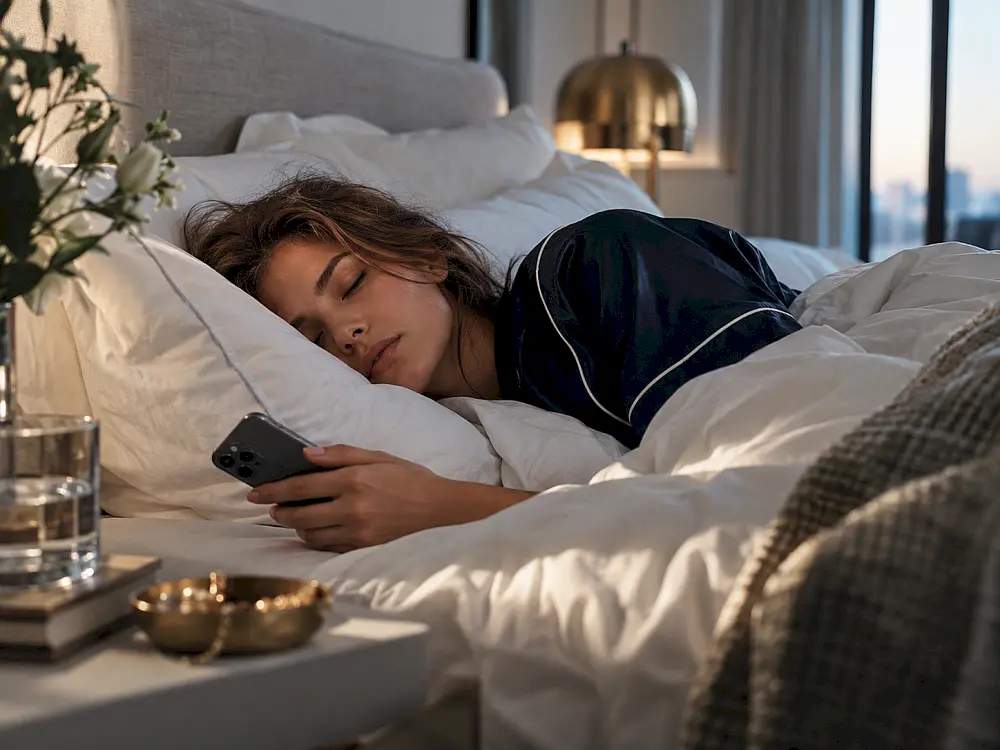
The strangest form of sleep deprivation does not begin when a person cannot fall asleep. It begins when sleep is possible, the alarm is set for early morning, the eyes are already tired, and the hand still starts the next video.
Often we are not even doing anything important enough to justify sacrificing sleep. We are not finishing work that will determine our career or solving an urgent problem. We may spend half an hour moving between short clips, reading comments under a news story that will still be there in the morning, or starting an episode we had no intention of watching an hour earlier.
Then morning brings the second half of the strange bargain. The person who decided at night that another forty minutes of wakefulness were essential would now give almost anything for forty extra minutes of sleep.
This behavior has a name: bedtime procrastination, the voluntary delay of going to bed when no external reason requires a person to stay awake. Recent research suggests that “a lack of willpower” is too simple an explanation. Sometimes we postpone sleep because of a phone, sometimes because of habit, social life or losing track of time. And sometimes the night becomes the only part of the day a person finally feels belongs to them.
In short, why we delay sleep:
- the benefit of sleep arrives tomorrow, while the reward of staying awake is available now;
- evening may be the only time without work, obligations and other people’s demands;
- series, games and recommendation feeds often have almost no natural stopping point;
- we often do not decide exactly when we are going to bed;
- social contact or a familiar evening activity can feel more rewarding than the future benefit of sleep.
This is not the same as insomnia
It is important not to mix up two different problems. A person with insomnia may want to sleep, go to bed on time, turn off the lights and still be unable to fall asleep for a long time. Bedtime procrastination begins earlier: the opportunity to go to bed exists, but the person voluntarily pushes that moment back.
Nor does the term include sleep loss caused by a night shift, caring for a child, an air-raid alert, urgent work or another external circumstance. In a systematic review and meta-analysis of 43 studies, bedtime procrastination was defined specifically as voluntarily delaying bedtime when there was no external reason to stay awake. It was associated with shorter sleep duration, lower sleep quality, greater daytime fatigue, evening chronotype and lower self-control. At the same time, the authors rated the overall quality of evidence as low, so these associations should not automatically be converted into a simple causal formula.
Sleep itself is not merely a decorative pause between two days. A joint recommendation from the American Academy of Sleep Medicine and the Sleep Research Society says that healthy adults should regularly get at least seven hours of sleep per night. Individual needs differ, and duration is only one feature of healthy sleep alongside quality, regularity and timing.
So the paradox is real: we know sleep matters, we can go to bed, and still we do not.
At night we make a deal with the person we will become in the morning
Sleep has one major disadvantage in the competition for our time. Most of its benefits are delayed. If you go to bed now, the reward for making the “right” choice may not be felt immediately. The payoff comes in the morning or the next day.
A series has a different business model. The next episode begins now. A message can be read now. One more round of a game happens now. A conversation with a friend is interesting now. The nightly decision is therefore made by two versions of the same person with different interests: the evening self receives extra time immediately, while the morning self pays for it later.
This is more than a metaphor. In 2026, researchers followed the sleep of 104 college students for two weeks using actigraphy and daily diaries. Participants went to bed later than they had intended on 54% of the nights studied. On those nights, sleep was about 0.91 hours shorter before class days and 0.86 hours shorter even when there were no classes the next day.
The most interesting detail is the second one. You might expect students without an early class simply to wake up later and recover the lost sleep. In this study, that did not happen: wake time did not shift enough to compensate for later bedtimes. The next day, participants also reported more sleepiness and worse mood.
In other words, a loan taken from the night is not necessarily repaid by sleeping later in the morning. Often the debt simply remains.
What if a person is not protecting wakefulness, but protecting personal time?
Imagine another kind of day. Wake up to an alarm, commute, work, messages, shopping, household tasks, other people’s requests. At 10:30 p.m. comes the first moment when nobody needs anything. Biologically it is already a good time to prepare for sleep, but psychologically the evening feels as though it has only just begun.
Going to bed means losing the first hour of the day that belongs entirely to you.
This scenario is popularly called “revenge bedtime procrastination.” The label is appealing, but it describes only one possible reason. In a 2026 editorial in the journal Sleep, sleep researcher Sooyeon Suh argues that we should look at bedtime procrastination as more than a simple failure of self-control. Possible functions can include reclaiming personal time, emotional regulation, reward after a difficult day, social needs, loss of time awareness or even deliberately postponing bed because falling asleep itself is unpleasant.
This is an important shift. If late-night wakefulness is serving a function, taking it away with the command “just go to bed earlier” leaves the underlying need untouched.
A person can agree that sleep matters and still not want to end the only part of the day that feels free. From the outside, that may look irrational. From inside a particular evening, the behavior can have a perfectly understandable short-term logic.
The phone did not invent bedtime procrastination. It simply made it extraordinarily convenient
The simplest explanation for modern sleep loss is that smartphones are to blame. Remove the phone from the room and everyone will finally sleep.
The problem is that people delayed sleep long before social media existed. You can read until two in the morning, talk with friends, work, watch television or simply resist ending the day. What the digital environment added is something that used to be less common: it removes natural stopping points.
A book has a last page. A film ends with credits. Television once followed a fixed schedule. A conversation ends when people leave. A short-video feed never ends. The next clip is already loaded before you have even decided whether you want to watch it.
In 2025, researchers tested an online program designed to reduce the use of electronic devices before sleep. In the REST-O randomized pilot study involving 55 people, device use before bed fell by an average of 23.4 minutes per day after the intervention, while sleep duration increased by 12.7 minutes. Improvements, however, were seen across all groups, so the authors appropriately described the findings as preliminary rather than proof of a single universal solution.
That may be a more accurate way to describe the role of the phone. It does not necessarily create the need to delay sleep. But if someone already wants to extend the evening, it is difficult to invent a more efficient tool for quietly turning ten minutes into an hour.
WOW:
A curious detail: we often never decide when we are actually going to bed
There are activities for which we almost always define the time. A work meeting starts at 10:00. A train leaves at 16:42. A doctor sees us at 14:30. The morning alarm is also usually set very precisely.
Sleep often gets a different kind of plan: “I should go to bed earlier tonight.”
A 2025 study showed how vague that decision can be. For two to four weeks, 119 students reported their bedtime intentions while actual sleep was tracked with wearable devices. On average, they planned a specific bedtime less than one night per week. Even when a plan existed, actual bedtime was on average about 46 minutes later.
Nights with a stated plan were also associated with somewhat earlier bedtimes and about 12 additional minutes of total sleep. This was an observational study of students, so it does not prove that simply saying “I will go to bed at 11:30” will add twelve minutes of sleep for everyone. What it does show is an interesting asymmetry in the day: wake-up time is often rigid, while the moment when we should stop being awake remains open.
When one boundary is fixed and the other keeps moving, the space between them shrinks.
Sometimes we take sleep away not for a screen, but for other people
There is another reason why the phone or self-control explanation is incomplete. In summer 2026, a study approached the same problem from a different angle: what happens when people delay sleep in order to spend time with others.
Over two weeks, researchers used actigraphy, daily diaries and Bluetooth beacons to assess sleep and physical proximity among 104 residents of a college dormitory. On days when participants postponed sleep in order to socialize with other people, they slept about 1.4 hours less and reported greater sleepiness and worse mood the next day.
This was a specific student sample, so it would be wrong to apply the figure of 1.4 hours to all adults. But the mechanism matters: sometimes we stay awake not because “the algorithm won.” We choose conversation, closeness, belonging to a group or simply the reluctance to end a good evening.
At this point sleep becomes almost a philosophical problem. We are asked to choose between two genuine needs: the body’s need for restoration and the life for which we want the body to be restored in the first place.
Why the advice “just go to bed earlier” often fails
If the causes are different, one universal piece of advice will inevitably miss some people. Someone who loses track of time in a feed needs a different change from someone who deliberately protects the only free hour of the day. And a person who physically cannot fall asleep has another problem altogether.
So it can be more useful to begin not by fighting the late evening, but by understanding what function it is serving.
- “I finally have time for myself.” The problem may begin long before midnight. If all personal time is systematically pushed out of the daytime schedule, sleep becomes a reserve fund from which time is borrowed. In that case, it may be more useful to protect even a small block of leisure earlier in the day than to demand that you simply give it up.
- “I did not notice how late it became.” Here, the useful change may not be banning entertainment, but creating an external stopping point: a specific time, an alarm not for waking but for beginning the end-of-evening routine, switching off autoplay, or deciding in advance what the last activity will be.
- “The phone just ends up in my hand.” The REST-O pilot study suggests that behavioral changes around evening device use are at least worth taking seriously. In practice, that can mean adding more steps between the impulse and the feed: charging the phone away from the bed, preparing an alternative activity in advance, or turning off automatic notifications.
- “I keep telling myself: I will go to bed soon.” The planning data suggest a simple point: “earlier” is not a time. A realistic bedtime window creates a boundary that the evening otherwise does not have.
- “I do not want the conversation to end.” The phone may have nothing to do with it. It can be more useful to decide in advance when to leave a gathering or end a conversation than to expect a strong desire to sleep to appear at the most enjoyable moment of the evening.
This is not a set of treatment rules for sleep disorders. It is a way to translate the abstract idea “I cannot control myself again” into a more concrete question: what exactly pushed sleep later tonight?
Maybe sleep loss starts before nighttime
This is where the subject becomes broader than sleep hygiene. If a person has to reclaim personal time from their own sleep every evening, the cause may not be only weak nighttime discipline. The day itself may be structured so that everything obligatory has a fixed place, while everything personal receives only what is left over.
Work time is fixed. The meeting is fixed. The commute takes time. The morning alarm is set. Sleep, meanwhile, is often the only large block of the day that can be moved by forty minutes without negotiation. It does not argue and it does not send overdue notices.
The digital economy only strengthens this imbalance. A product benefits when we stay with it for a few more minutes. A streaming service wants to launch the next episode, a game offers another round, a social network has one more post. Sleep offers nothing on the screen. Choosing it requires voluntarily interrupting whatever is already happening.
This does not mean technology companies “steal our sleep” or that responsibility lies entirely with the environment. But the competition is asymmetric: one side offers an immediate reward, while the other asks us to stop all rewards now for a benefit we will appreciate only tomorrow.
How to see where you are actually losing sleep
There is a simple experiment that does not require a tracker. For several evenings, pay attention not to the time you fall asleep, but to the final twenty or thirty minutes before the time you originally meant to go to bed.
What happens there?
- are you doing something genuinely necessary;
- continuing something enjoyable that you do not want to end;
- losing track of time;
- trying to get at least a little personal space;
- socializing;
- or simply moving from one small stimulus to the next?
Those answers call for different solutions. That is why the word “discipline” often explains less than it seems to.
If a person cannot fall asleep, that is a sleep problem. If they can fall asleep but cannot end the evening, it may be worth looking at what exactly they are unwilling to end.
Sometimes it is a series. Sometimes a phone. Sometimes a conversation. And sometimes the real problem is not the final hour of the day at all, but the fact that it was the first hour the person could call their own.
Disclaimer. This material is informational and analytical and is not medical advice. Persistent difficulty falling asleep, frequent nighttime awakenings, pronounced daytime sleepiness or other long-term sleep problems can have different causes and may require professional assessment.