
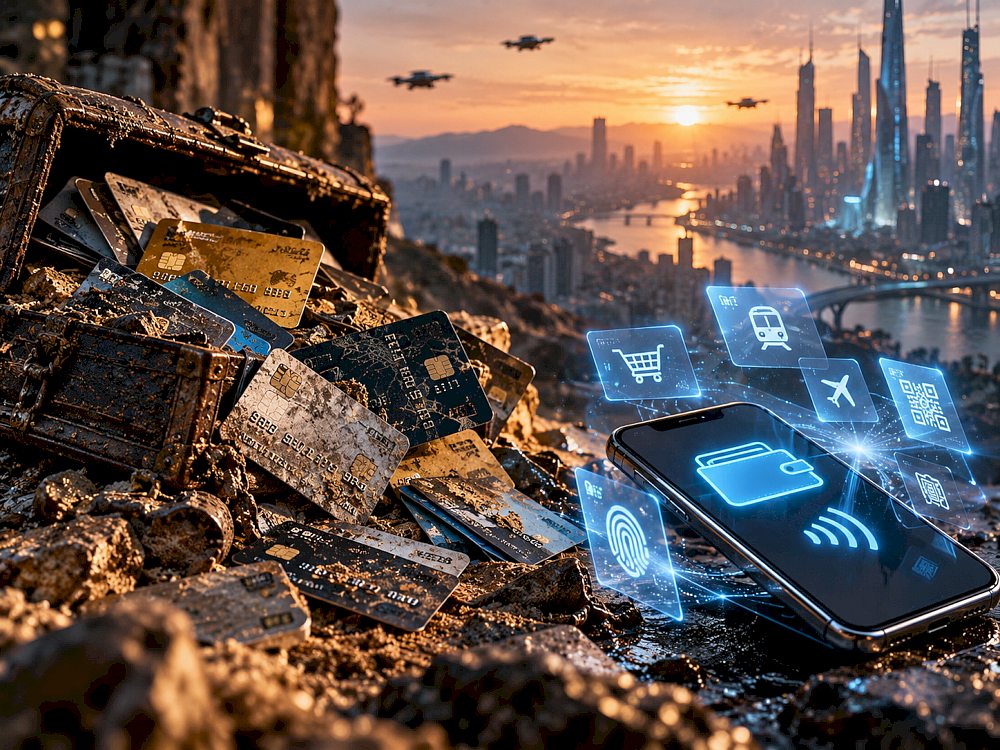
Only a few decades ago, paying by card was a visibly physical procedure. A cashier placed an embossed plastic card into a mechanical imprinter, pulled a handle across it and copied the raised numbers onto a paper form. Then came the magnetic stripe, the chip, contactless payments, smartphones and watches. Today a person can pay without ever seeing the card number involved.
The obvious conclusion is that plastic will disappear. But a physical credit card and the card payment system are not the same thing. A phone can replace the piece of plastic in a wallet while the transaction still runs through a card account, an issuing bank and a global payment network.
The more useful question is therefore whether credit cards themselves will disappear, or simply become invisible. Their history points more strongly toward the second outcome. The card has already changed form several times while preserving its core function: letting a customer receive goods now while a financial intermediary organizes payment and credit behind the scenes.
Credit existed long before plastic
Buying now and paying later predates modern banks and payment networks by centuries. Local merchants kept accounts for regular customers, companies issued their own credit tokens or cards, and department stores allowed shoppers to accumulate balances and settle them later.
The weakness was that these systems were closed. Credit from one merchant worked at that merchant. In the early twentieth century, store cards became common in the United States, and by the late 1920s metal Charga-Plate devices helped identify customers and record purchases. The Smithsonian traces this evolution from merchant credit toward modern payment cards.
The real breakthrough came when credit stopped belonging to a single seller. What was needed was a system in which one card could work across many independent merchants.
Diners Club turned debt into a network
Diners Club emerged in 1950. Its early card was used mainly in restaurants and functioned more like a charge card: the customer received a bill and was expected to pay it in full. The more important innovation was structural.
A third party now stood between customer and restaurant. Diners Club recruited merchants, paid them for customers’ purchases minus a fee, and later billed the cardholder. The Smithsonian documents the early model.
Most of the future payment-card industry is already visible in this arrangement. The physical card was merely proof of membership. The real asset was acceptance. The more restaurants accepted Diners Club, the more useful the card became; the more cardholders joined, the more attractive acceptance became to merchants.
This network effect remains one of the strongest defenses of card systems today.
BankAmericard added modern revolving credit
The next turning point came in 1958 when Bank of America launched BankAmericard. Unlike merchant cards or early charge cards, the system combined broad acceptance with revolving credit — the ability to carry part of a balance forward and pay interest rather than clearing the entire account every month.
The Smithsonian identifies BankAmericard as a key step toward the universal credit card; the network later evolved into what is now Visa.
The card was no longer simply a convenient way to delay payment for a few weeks. It became a continuously available credit line. Consumers could access bank money without applying for a new loan before every purchase, while merchants could receive payment without personally underwriting customer credit.
The magnetic stripe made the card part of a computer network
Early card transactions were mostly analog. Embossed card details were copied to paper, merchants checked printed warning lists or called for authorization on larger transactions. That system could not scale efficiently to millions of daily purchases.
IBM engineers worked on attaching magnetic material to plastic cards in the 1960s. Standardization followed, allowing machines to read account information electronically. IBM links the magnetic stripe to the automation of banking, retail and transport transactions.
The card looked almost the same, but the system behind it changed completely. It became a machine-readable key to an account. A terminal could read the data, send a request through a network, receive the bank’s response and approve or reject the transaction in seconds.
The chip and token began separating payment from plastic
The magnetic stripe had a basic weakness: its information could be copied. EMV chips made transactions cryptographically more difficult to clone, and the same technological foundation later supported contactless payments.
The next step matters even more for the future. Digital wallets began separating the card account from the physical card. When a card is added to a smartphone or watch, the merchant may receive a payment token rather than the actual card number. The token can be limited to a device or specific use case.
From the customer’s perspective, the phone appears to replace the card. From the financial system’s perspective, the card account may still be operating underneath.
Cards do not yet look like a dying technology
Looking only at smartphones and digital wallets can create the impression that cards have already lost. Current payment behavior says otherwise. In the Federal Reserve Financial Services study of U.S. consumer payments in 2025, debit and credit cards together accounted for roughly two-thirds of payments. The results were published in the Diary of Consumer Payment Choice.
There is no contradiction with the rise of phones. When someone pays through a mobile wallet, a card may still be doing the financial work behind the interface. The access method changed; the payment rail did not necessarily change.
An ATM did not eliminate the bank account, and online banking did not eliminate the bank. Technology removed part of an older product’s physical interface. The same process now appears to be happening to the card.
What could actually displace card networks
Replacing plastic with a phone is not enough to eliminate credit cards as a system. A genuine substitute must take over the major functions now handled by card networks: authorization, connectivity between buyer and merchant banks, international acceptance, risk handling, disputes and refunds, and access to credit.
Alternatives already exist: instant bank transfers, open banking, account-to-account payments, QR ecosystems and digital wallets. Yet winning one transaction is not enough. A new network has to become attractive to millions of merchants and consumers at the same time.
The network effect that once helped universal cards defeat closed merchant systems now protects them from rapid replacement.
The physical card can fade much faster
The future is easier to understand if we separate two layers. The first is the plastic card. Its role can decline substantially. In many situations a phone already performs everything required: the card does not need to be carried, its number does not need to be typed, and biometric authentication can replace part of the traditional verification process.
Over time, the physical card may become a backup for a dead phone, an unsupported terminal, travel or a temporary digital failure. The transition will be uneven because payment infrastructure, habits and smartphone access vary widely across countries.
The second layer is the card account and the network behind it. That is likely to change much more slowly.
The most likely future is an invisible card
The historical sequence is revealing: merchant ledger, metal or paper credential, plastic card, magnetic stripe, chip, contactless payment, tokenization. Each stage separated the financial function a little further from the object carrying it.
The next logical step is to remove the card almost entirely from the user’s view. A person will choose a funding source — credit account, bank balance, corporate account or installment plan — while a phone, watch, browser or other device provides the appropriate digital credential and biometrics confirm identity.
That is why, over the next several years, the disappearance of the card as an object looks more plausible than the disappearance of credit cards as a financial system. Plastic can lose its monopoly on access while the network, credit line and acceptance infrastructure remain deeply embedded.
The future of the credit card may therefore be that we stop noticing it. It becomes less a thing we carry and more an invisible function of digital life.