A shopper entering a grocery store at the beginning of the twentieth century would have seen a very different form of retail. Much of the merchandise sat behind a counter. Customers told a clerk what they wanted, and the clerk retrieved, weighed, wrapped and totaled the order. Meat, vegetables, bread and fish were often bought from separate specialist shops.
Today we push our own carts past thousands of products, compare prices, scan loyalty accounts and increasingly check inventory on a phone before entering the store. The routine feels natural, yet the supermarket is a relatively young invention. It emerged primarily as a way to make retail cheaper, faster and more productive.
That origin tells us a great deal about its future. Supermarkets are unlikely to disappear simply because grocery shopping is moving online. A more plausible transformation is already under way: the store is becoming a combination of sales floor, neighborhood warehouse, pickup point, prepared-food kitchen and digital service.
When shoppers began serving themselves
One of the defining ideas of modern retail now sounds almost trivial: let customers take products from shelves themselves. In the early twentieth century, it was a much more radical change.
In September 1916 Clarence Saunders opened Piggly Wiggly in Memphis. His self-service system sent shoppers through open aisles where they selected merchandise before paying at a central checkout. The Smithsonian documents both the concept and Saunders’ patent.
At first glance only the customer’s behavior changed. In reality, the store’s economics changed. When shoppers find the can, box or bottle themselves, the same staff can serve more people. A clerk no longer has to retrieve every item, while the customer sees far more merchandise than originally planned. The shelf begins doing part of the selling.
Self-service therefore was not merely a more convenient store layout. It cut the labor required per transaction while increasing the amount of merchandise exposed to each customer. That mechanism became the foundation of the supermarket’s later growth.
Scale changed the business model
Piggly Wiggly was not yet a supermarket in the full modern sense. The next step was to combine self-service with a much larger assortment, bigger premises, low margins and high turnover. King Kullen, opened in Queens in 1930, is often associated with this transition toward the modern supermarket format.
The shift was fundamental. A traditional grocery store depended heavily on personal service and neighborhood proximity. The new model could make money through scale. The more shoppers passed through the store and the more goods they bought in a single trip, the more efficiently floor space, labor, purchasing and logistics could be used.
After the Second World War, mass car ownership, suburbanization, refrigeration, packaged foods and expanding road networks created an almost ideal environment for this format. A family could drive to a large store, buy a week’s worth of groceries and take them home.
The supermarket did not win because of one invention. It combined self-service, packaging, the automobile, refrigeration, centralized logistics and economies of scale into a single system.
The barcode gave the store a memory
The next major turning point happened in information rather than on the shelf. On June 26, 1974, a checkout scanner at a Marsh supermarket in Troy, Ohio read a UPC barcode on a pack of Wrigley’s gum in one of the first commercial barcode transactions. The Smithsonian preserves one of the early scanners.
The familiar beep was only the visible part of a much larger shift. Scanning accelerated checkout, reduced manual entry errors and, more importantly, automatically recorded exactly which product had been sold. Retailers could track inventory movement, analyze sales and build increasingly sophisticated supply chains.
Loyalty programs, electronic payments, customer databases, mobile apps and personalized offers followed. A store that once knew only what a shopper placed on the counter could begin to recognize purchasing patterns over time.
Why the internet did not kill the supermarket
Groceries appear ideally suited to e-commerce. Many items are bought repeatedly: milk, cereal, water, household supplies. An algorithm can remember those purchases better than a shopper, while a fulfillment operation can assemble an order without anyone walking every aisle.
Online grocery has indeed expanded quickly. FMI and NielsenIQ reported that e-commerce accounted for a large share of grocery sales growth in the United States in 2025, while most shoppers combined physical and digital channels rather than choosing only one. The emerging omnichannel model is described in FMI research.
Yet stores retain advantages that go beyond habit. A supermarket offers immediate possession, lets customers choose fresh products themselves, change their minds at the shelf, discover something unexpected and avoid the cost of last-mile delivery. For the retailer, the physical location can also function as a local warehouse and pickup point.
Online and offline grocery therefore increasingly look less like rival systems and more like layers of the same one.
The store is already changing its job
Modern supermarkets increasingly combine self-checkout, online ordering, curbside pickup, delivery, electronic shelf labels, loyalty programs and algorithmic inventory management. FMI has documented heavy retailer investment in both digital and in-store technology in its industry analysis.
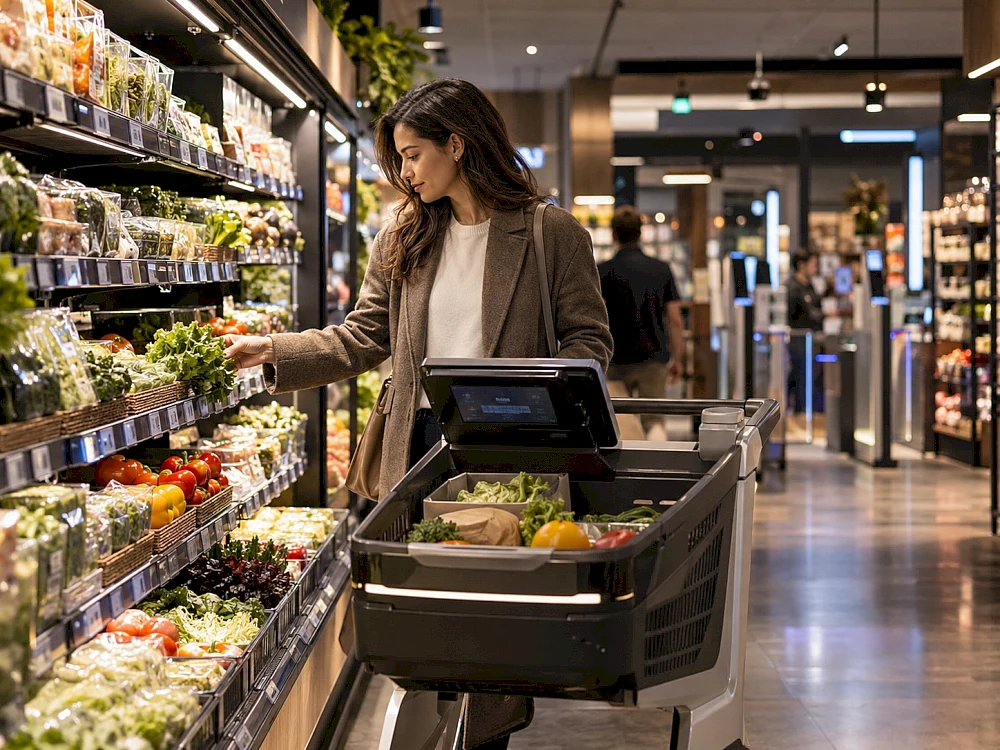
Artificial intelligence can improve demand forecasting, assortment planning, replenishment, markdowns and loss detection. Smart carts and mobile checkout move part of the cashier function into the shopping process itself. The store app becomes shopping list, loyalty card, catalog, payment tool and personalized marketing channel at the same time.
None of this proves that the supermarket of the future will be an empty automated warehouse. In fact, the easier it becomes to order standardized packaged goods online, the more valuable physical stores may become for things a warehouse app cannot reproduce as well: fresh food, prepared meals, bakery, advice, immediate selection and instant possession.
What comes next
The best-supported direction today is not the disappearance of the store but the erosion of the boundary between store and digital service. A purchase may begin on a phone at home and end at the shelf; an item discovered in person may be delivered later; the same store may fulfill neighborhood online orders.
A second shift concerns the use of retail space. Standard packaged products are easy to move online, so physical locations have a stronger incentive to compete on freshness, ready-to-eat food, speed and services. A third shift is economic: loyalty data, personalized offers and retail media turn the customer relationship itself into a valuable asset beyond the traditional merchandise margin.
At the same time, traditional supermarkets face pressure from discounters, mass retailers, warehouse clubs, delivery services and specialist stores. The successful supermarket of the future may therefore be less universally designed than its predecessor but clearer about why customers should visit it.
The supermarket is not disappearing — the reason to visit it is changing
A century ago, the breakthrough was to let the shopper take products from the shelf. Larger stores added economies of scale. The barcode automated information. The internet moved part of the store onto the phone.
All of these changes share one logic: retail repeatedly removes friction between a product and a buyer. The next major step is therefore unlikely to depend on one spectacular technology. It will come from eliminating another set of small tasks — remembering a list, searching every aisle, waiting in line, checking promotions or deciding where online shopping ends and the physical store begins.
The first self-service stores transferred work from the clerk to the customer. The supermarket of the future may increasingly reverse that transfer, taking routine work back from the shopper through data, automation and artificial intelligence.