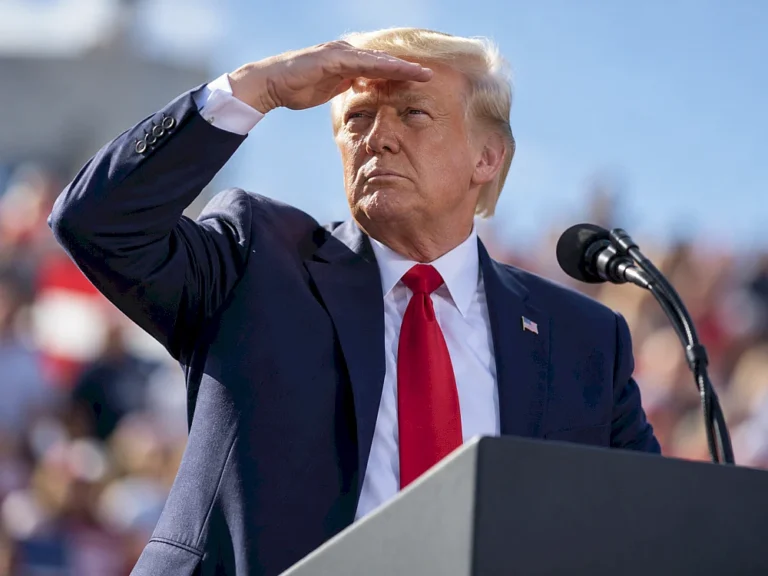

Imagine January 2027. Donald Trump is still president, but Democrats control both chambers of Congress. He continues to run the executive branch, speak for the United States abroad and command the armed forces. Yet major spending programs, appointments and controversial foreign-policy choices now face a legislature led by his opponents.
For Ukraine, that could be an important change at a moment of difficult relations with the White House. Kyiv would gain another powerful center of influence in Washington. European allies might see steadier congressional backing for NATO, while Moscow would face greater scrutiny of any sanctions relief. The trade-off is a higher risk of partisan gridlock in the United States.
The most likely effect of full Democratic congressional control would be stronger legislative support for Ukraine and closer oversight of Trump’s Russia policy — not an automatic return of large weapons packages. Turning sympathy into assistance still requires appropriations, legislation, implementation and often cross-party bargains.
Why Congress matters more than friendly statements
The president exercises substantial executive authority, but Congress controls federal appropriations and can attach conditions to spending, demand testimony and investigate the administration. The executive branch usually decides how programs are carried out. That distinction is especially important for military assistance: an approved budget does not immediately create finished air-defense systems or deliver ammunition to the battlefield.
Congress showed in 2024 that a sufficiently broad coalition can approve major Ukraine-related assistance even amid partisan confrontation. Democratic control would make it easier for pro-aid proposals to reach hearings and floor votes, but presidential veto power and Senate procedure would still matter.
Russia sanctions could become the defining confrontation
The October 16, 2026 White House executive order implementing the Graham Act illustrates the issue. Congress provided for sanctions and tariffs connected to Russian energy trade but also allowed a presidential waiver on national-interest grounds. Trump invoked that authority to suspend important restrictions. Critics argue that the move rewards Moscow while the war continues; the administration can point to energy prices and diplomatic flexibility.
A Democratic Congress could hold hearings, draft tighter limits on sanctions waivers and require more detailed reporting about trade with Russia. But a bill approved by both chambers can still be vetoed. Under the constitutional lawmaking framework, overriding a veto requires two-thirds in each chamber; Senate debate rules pose a further obstacle to many ordinary bills.
The result would be greater friction, not an automatic reversal of every Trump decision. Putin could still deal with the White House, but favorable arrangements might face stronger public and legislative scrutiny.
Would Ukraine actually receive more weapons?
Democratic leaders would be more likely to press for funding for air defense, ammunition, defense production and long-term security partnerships. Committee chairs could also investigate implementation delays and challenge administrative decisions that restrict assistance.
Still, Congress cannot manufacture equipment on command or directly operate the Pentagon. Democrats themselves differ on spending priorities, and a narrow majority would make individual members unusually influential. Kyiv would therefore need to engage both parties, the executive branch and European governments rather than rely on one election outcome.
NATO and Europe: greater reassurance, but no return to dependency
European capitals might welcome a Democratic majority as a more predictable voice on NATO and transatlantic cooperation. Yet Europe has already learned that Washington’s political direction can change with elections. The 2025 NATO Hague Summit Declaration commits allies to an overall 5% of GDP in defense and defense-related spending by 2035, with separate components for core defense and broader security needs.
That longer-term shift would probably survive a Democratic victory. The best outcome for Ukraine would combine renewed congressional cooperation with continued growth of European defense capacity. The worst institutional complication would be budgetary paralysis in Washington despite broad rhetorical support for Kyiv.
China, the Middle East and the world economy
Competition with China now crosses US party lines. Democrats might subject Trump’s trade deals to more scrutiny and emphasize work with Asian allies, but tensions over Taiwan, technology and industrial resilience would not disappear. A change in Congress is not the same as a strategic rapprochement with Beijing.
In the Middle East, Democrats could demand more information about military operations and their legal basis. Yet the president would remain commander in chief, and Congress would not have a simple one-vote mechanism to terminate every deployment. Oversight would become more assertive, while practical outcomes would depend on law, funding and executive compliance.
For investors, divided government could limit abrupt tariff decisions while increasing the risk of budget standoffs and federal shutdowns. The net economic effect would depend less on the party labels than on whether the institutions can agree on timely legislation.
How much could Democrats really constrain Trump?
The first Trump presidency offers a useful comparison. Democrats captured the House in 2018 and expanded oversight, eventually impeaching the president; the Republican Senate did not convict him. Control of both chambers in 2027 would provide Democrats with stronger tools, including influence over Senate confirmations, but Trump would retain his executive powers and veto.
Even a fully Democratic Congress cannot simply replace the president’s foreign policy with its own. Political pressure can be substantial, yet practical outcomes require coalition-building across institutions.
What Ukraine might notice first
| Policy area | Likely change | Not automatic |
|---|---|---|
| Military aid | More proposals and oversight of appropriations | Immediate weapons deliveries |
| Russia sanctions | Efforts to narrow presidential waivers | Instant restoration of every sanction |
| Peace negotiations | Stronger congressional backing for Kyiv’s position | Congress running diplomacy |
| NATO | More reliable legislative partnership | Europe abandoning defense buildup |
| Global economy | More checks on unilateral policy | An end to budget conflicts |
The real test is whether political solidarity becomes enacted funding, contracts and delivered capabilities. That is what matters to Ukraine beyond the headlines.
A conditional forecast for the end of 2027
Question: If Democrats control both chambers on January 3, 2027, will a new US federal law providing at least $1 billion in previously unapproved appropriations specifically for military or security assistance to Ukraine take effect by December 31, 2027?
Conditional Probability YES: 55%. Confidence: 59/100. Working range: 40–65%. This probability is conditional on Democrats controlling Congress; it is not the probability that they win the midterms. The strongest obstacle is Trump’s veto, while the strongest positive signal would be a concrete funding bill backed by a sufficiently large bipartisan coalition.
| Scenario if Democrats control Congress | Probability |
|---|---|
| At least $1 billion of new Ukraine security aid becomes law | 55% |
| Both chambers approve, but the measure fails at the final stage | 25% |
| A package of that scale does not pass both chambers | 20% |
The estimate would rise if congressional majorities were stable and Republicans joined a detailed funding proposal. It would fall if Trump promised a veto, the Senate lacked enough support to advance the measure, or the Democratic majority proved too fragile.
| Forecast field | Definition |
|---|---|
| Forecast ID | ORBK-GEO-USCONGRESS-UA-2026-001 |
| Snapshot / cutoff | October 19, 2026 |
| Condition | Democratic control of both chambers on January 3, 2027 |
| YES | By December 31, 2027, a law takes effect providing at least $1 billion in new, previously unapproved appropriations for Ukraine security/military assistance |
| NO | Condition holds but no qualifying law takes effect |
| VOID | Democrats do not control both chambers on January 3, 2027 |
| Probability YES, conditional | 55% |
| Confidence | 59/100 |
| Historical Similarity / Oracle Index | N/A / N/A |
| Resolution sources | Enacted US federal statutes and official congressional budget materials |
| Resolution date | January 10, 2028 |
| Next review | After November 3 election and confirmation of Congress membership |
Forecast History: October 19, 2026 — conditional YES 55%, Confidence 59/100. The original snapshot remains unchanged even if subsequent elections or budgets alter the outlook.
A Democratic Congress would likely give Ukraine a stronger ally within US institutions. The decisive question would be whether that leverage produces usable legislation rather than a prolonged confrontation that delays help.
A forecast does not claim that an event will happen. It presents a current probability assessment based on the information available at the time. The estimate may change as new evidence emerges.