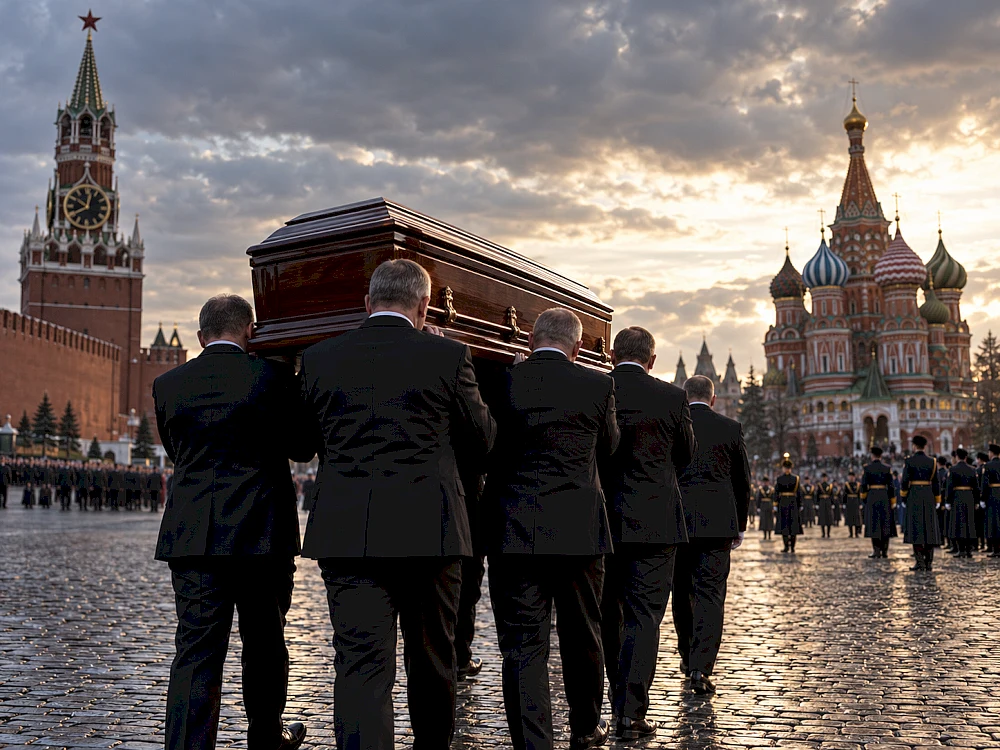
Imagine the morning of October 20, 2026. Russian television interrupts its programming to announce that Vladimir Putin has suddenly died. Foreign governments seek to establish who now makes decisions in Moscow. In Ukraine, the question is immediate and deeply personal: could this finally create a path toward ending the war?
The most likely immediate answer is that Russia would not collapse and the fighting would not stop the following day. State institutions and military chains of command would keep functioning while powerful groups negotiated a succession. Yet the loss of the man who shaped Russian politics for decades could create an opening to reconsider decisions that a personally invested leader was unwilling to reverse.
ORBK.NET’s conditional scenario assigns a 35% probability to a broad bilateral ceasefire within six months after the hypothetical death, with Confidence 46/100. This is not a prediction about Putin’s death or health. We assume only for analytical purposes that he dies on October 20, 2026. If that premise does not occur, the formal scenario is VOID.
Who would legally succeed him?
Under Article 92 of the Russian Constitution, presidential duties temporarily pass to the prime minister when the president cannot perform them, and an early presidential election must be held within three months. In the hypothetical scenario, Prime Minister Mikhail Mishustin would therefore become acting president under the constitutional procedure.
Formal office, however, is not the same as effective authority. Russia’s security services, armed forces, presidential administration and state-owned companies control substantial resources. Their willingness to accept a common political arbiter would matter more than a simple announcement of a name.
Alexandra Prokopenko’s Carnegie Endowment study describes Russia’s elite as a managerial system with little independent political agency. Putin personally balanced important factions, while habits of loyalty and vertical control became deeply institutionalized. That legacy could help an orderly transition or, if factions disagreed, prolong bargaining behind the scenes.
The first public statements would probably promise stability and continuity. Even leaders who wanted a policy change would face strong incentives not to denounce the Putin era before securing the support of the security apparatus.
Would the war stop in the first days?
A president’s death does not cancel existing military orders, dismantle supply chains or remove commanders. Russian forces would retain weapons, logistics and operational plans. Ukraine therefore could not responsibly interpret the leadership change as an immediate ceasefire.
A successor might even adopt harsher rhetoric to show that the state remained in control. Such signaling could be aimed partly at rival factions inside Russia. Kyiv would have to maintain military readiness even if new diplomatic contacts began.
The strategic opportunity would emerge later. Unlike Putin, a successor would not be personally tied to the 2022 decision to launch the full-scale invasion. A policy shift could be framed as economic stabilization or consolidation of supposed achievements, rather than admission that the previous ruler had been wrong.
Why a successor might seek peace — or continue the war
A new leader would need the backing of the military, security agencies and groups economically or politically invested in the war. These actors could resist concessions for fear of losing influence or facing blame. At the same time, prolonged fighting imposes heavy spending, workforce shortages, sanctions pressure and infrastructure risks.
One imaginable bargain would involve a ceasefire that reduces costs without an explicit declaration of defeat. Another would see a weak successor continue or intensify operations to secure the loyalty of hard-line elites. Putin’s death alone does not tell us which coalition would prevail.
What would ordinary Russians notice?
The first weeks might feature state ceremonies, carefully managed broadcasts and nervous financial markets. The ruble could fluctuate and savers might seek safer assets, although much would depend on whether the government and central bank displayed continuity.
For many families, mobilization would be the most pressing issue. A move toward talks could reduce the risk of further large-scale recruitment, yet even a ceasefire would not automatically bring every serviceman home. Some citizens might also hope for less censorship, repression and isolation.
A rapid democratic transition is not the base case. Independent political competition has been severely constrained, and the next leader could consider tight control of information and security institutions essential for survival. Less personalistic language might coexist with an authoritarian system.
Would the Russian Federation break apart?
The collapse scenario attracts attention but should not be treated as an automatic consequence of one death. Moscow controls major fiscal transfers, security institutions and regional appointments. Territorial fragmentation would require additional developments, such as sustained command breakdown, fiscal failure and strong rival regional power centers.
Elite factions may compete, but they also have a shared interest in preserving the state structures that underpin their wealth and positions. An agreed successor is therefore more structurally plausible than an immediate national breakup.
The Stalin precedent — and its limits
Joseph Stalin died on March 5, 1953. Less than five months later, on July 27, the parties signed the Korean Armistice Agreement, ending large-scale fighting on the peninsula. This is a valuable historical example of how the loss of a powerful leader can create room for diplomatic movement.
It is not a one-to-one analogue. Korean armistice negotiations had begun long before Stalin’s death, and the Soviet Union was not an overt principal belligerent in the same way Russia is in Ukraine. Conversely, Leonid Brezhnev’s death in 1982 did not bring the Soviet war in Afghanistan to an immediate close.
The lesson is a modest one: leadership change can relax political constraints on negotiation, but it cannot erase military and institutional interests. There is no defensible large base-rate dataset for this exact combination of circumstances.
Washington, Europe, China and nuclear stability
The United States would first want to know who actually controlled Moscow. Trump might try to establish a channel to the successor, but a new Russian leader could be reluctant to make dramatic concessions before consolidating authority.
Europe would see a possible opening for talks alongside real risks: instability in a nuclear-armed state and uncertainty about military decision-making. NATO would probably focus on readiness and clear communications. China would have strong reasons to favor an orderly succession, since a stable Russia remains important to its resource trade and strategic planning.
Russia’s nuclear arsenal belongs to the state and operates through institutions rather than the personal ownership of the president. His death would not automatically trigger a launch or loss of control. The concern would be continuity of lawful and effective command, especially during a period when outside powers might misread signals.
Four scenarios for the first six months
| Scenario after assumed death on October 20 | Probability | War outcome |
|---|---|---|
| Orderly succession; war continues | 45% | New leadership maintains the overall course, no broad ceasefire |
| Orderly succession; ceasefire follows | 30% | Consolidated successor reaches a broad truce |
| Elite infighting; war continues | 20% | Internal competition complicates government without ending war |
| Domestic crisis accelerates ceasefire | 5% | Instability pushes new authorities toward a broad pause |
The largest single scenario is orderly succession combined with continuing war. The two ceasefire scenarios together account for the 35% conditional estimate. These are not probabilities that Putin will die or that Russia will disintegrate.
A formal conditional forecast through April 20, 2027
Forecast question: If Vladimir Putin dies on October 20, 2026, will Ukraine and Russia agree to a broad cessation of fighting covering the main front line and long-range strikes, entering into force by April 20, 2027 and remaining effective for at least seven consecutive days?
Probability YES, conditional: 35%; Confidence: 46/100; working range: 25–45%. Confidence is limited by uncertainty over the successor, conflicting elite incentives and weak historical comparability. No Oracle Index is calculated for a one-off hypothetical shock.
Probability would rise if new Russian leaders showed willingness to negotiate without demanding every territorial concession upfront, agreed reciprocal conditions and accepted credible monitoring. It would fall with a major new mobilization, expanded war aims or elite confrontation that blocked decision-making.
| Forecast field | Definition |
|---|---|
| Forecast ID | ORBK-GEO-RUSSIA-SUCCESSION-2026-001 |
| Type | Counterfactual conditional forecast |
| Snapshot / cutoff | October 19, 2026 |
| Assumed trigger | Putin dies specifically on October 20, 2026 |
| YES | By April 20, 2027, a broad agreed ceasefire takes effect and lasts at least 7 consecutive days |
| NO | Trigger occurs but qualifying ceasefire does not |
| VOID | Assumed death does not occur on October 20, 2026 |
| Conditional Probability YES | 35% |
| Confidence | 46/100 |
| Historical Similarity / Oracle Index | N/A / N/A |
| Resolution sources | Official statements from both sides and independent verification of implementation |
| Resolution check | April 27, 2027 |
| Status | Hypothetical scenario, not an active death prediction |
Forecast History: October 19, 2026 — conditional YES 35%, Confidence 46/100. If the premise fails, the scenario is VOID and cannot be counted as a resolved ceasefire forecast.
For Ukraine, the biggest change would be the appearance of a new negotiating uncertainty. A successor might revisit Russia’s war aims, or might preserve them to maintain power. Even a signed truce would require security arrangements and credible monitoring. Putin’s departure could open a door, but his successors would decide whether anyone walks through it.
A forecast does not claim that an event will happen. It presents a current probability assessment based on the information available at the time. The estimate may change as new evidence emerges.