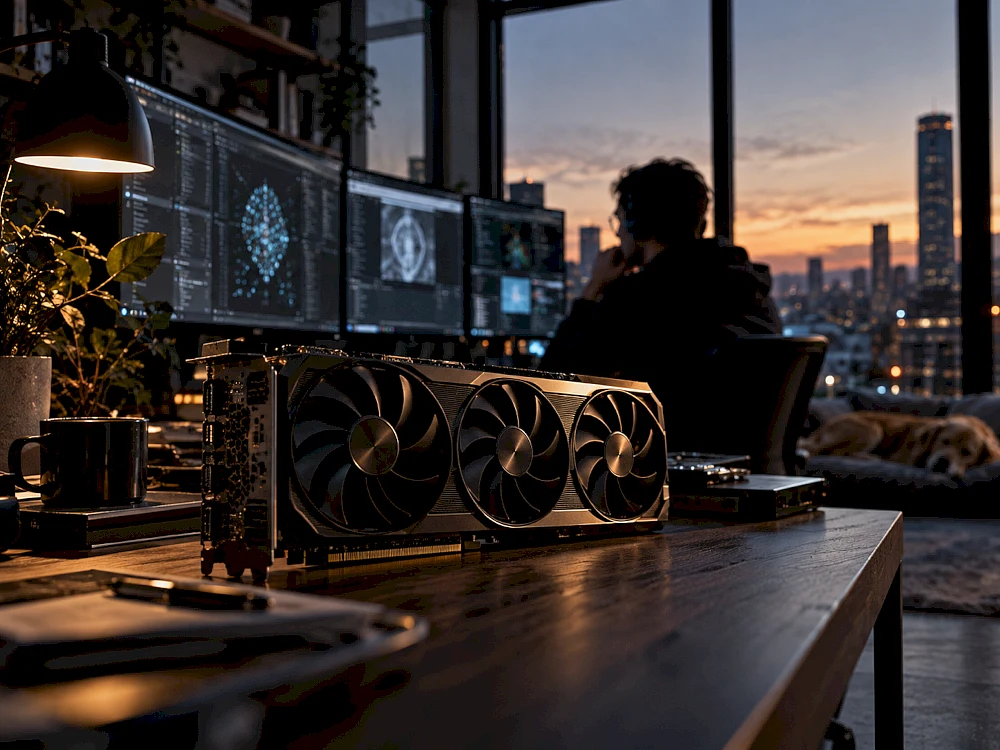
Until recently, most buyers judged graphics-card memory almost entirely through gaming. In 2026, local AI is changing that logic: VRAM is not only a frame buffer. It must also hold the model, context and intermediate computation.
Forecast details
The market is already split. In the GeForce RTX 50 family, higher-end cards offer 16–32 GB while parts of the mid-range still sit at 8–12 GB. NVIDIA shows that 16 GB has already moved below the purely professional tier, but it has not yet become universal.
Local video generation is particularly revealing. LTX Desktop targets CUDA GPUs with at least 16 GB of VRAM for local generation on Windows and Linux, while lower-memory systems fall back to API-only operation. One model will not define the entire 2030 market, but it clearly illustrates how quickly memory becomes the bottleneck.
ORBK.NET’s current estimate is that by the end of 2030 at least 16 GB of GPU-accessible memory will become the practical minimum for a new consumer PC bought specifically for serious local generative AI. Probability: about 80%, with a working range of 75–85%. Confidence: 70/100.
This does not mean 8 or 12 GB cards stop running AI. Small LLMs, transcription, translation, OCR and many background models will still work on lighter hardware. The forecast concerns a different class of use: local LLMs/VLMs, image and video generation, AI-assisted editing and complex multimodal workflows.
Why memory matters so much for local AI
A neural model may need to keep billions of parameters in memory, plus context, caches, embeddings and intermediate activations. If everything fits in VRAM, the GPU can work from its fast local memory. If it does not, some weights must be offloaded into system RAM, and performance can fall sharply.
That creates a situation that is less familiar in gaming: a slower card with more memory can be more useful for AI than a faster card with less VRAM simply because it can hold the model at all.
AMD also identifies available memory as a major constraint for local LLM and VLM inference and is developing systems built around much larger memory pools.
16 GB may mean “it runs,” not “it is comfortable”
Current local video models illustrate the difference between minimum and comfortable. A 16 GB card may run a workload through streaming and offload. More memory means fewer model weights have to move constantly between VRAM and system RAM.
By 2030, quantization, distillation and lower-precision formats will make models more efficient. At the same time, users will demand longer context, video understanding, large reference images, agent memory and several models running together. Optimization lowers the requirement; new capability pushes it back up.
For text AI, 16 GB may be unnecessary
If local AI means only chat, document summarization, translation or transcription, there is no reason to assume a hard 16 GB floor. Compact quantized models are increasingly able to run on CPUs, NPUs and integrated graphics.
That is why an AI PC and a creator AI PC are different categories. A mainstream laptop may have excellent AI features with no large discrete GPU. The 16 GB threshold is more relevant to users who want to run heavy generative workloads locally on a regular basis.
Image generation can survive longer on 8–12 GB
Image generation is much lighter than video. Models can be quantized, partially offloaded to RAM, and a single image does not require temporal consistency across hundreds of frames. That means 8–12 GB will remain useful for local image models for quite some time.
But creative workflows are becoming more complex: multiple reference images, LoRA, ControlNet-style guidance, upscaling and background models can run at the same time. Total memory pressure rises quickly.
Video could make 16 GB the real entry point
Generative video is the strongest candidate to drive VRAM requirements upward. A video model must preserve not only one frame but characters, motion, camera behavior, temporal structure and additional reference data.
In that world, 8 GB quickly becomes a compromise-heavy configuration. 12 GB may remain viable longer because of quantization and offload, but a buyer purchasing a new PC specifically for local video will be reluctant to start with a capacity that is already near its limit on day one.
A plausible 2030 VRAM ladder
| GPU memory | Likely role |
|---|---|
| 8 GB | Light AI features, small LLMs, basic image generation and many compromises on heavy models. |
| 12 GB | Solid baseline local AI, but growing restrictions in video/VLM workflows. |
| 16 GB | Practical entry level for serious generative AI. |
| 24 GB | Comfortable creator tier for LLM/VLM, image/video and AI editing. |
| 32 GB | Strong local-AI class with less offload and larger models. |
| 48 GB+ or a large unified-memory pool | Large multimodal models, long context and heavy professional workflows. |
This is not a forecast of specific NVIDIA or AMD product names. By 2030, the series will have changed. The point is the hardware class: 16 GB is “a serious starting point,” while 24–32 GB is “room to work without constantly fighting memory limits.”
24 GB may become the rational creator choice
For AI, extra memory often gives access to a different model class rather than a few percentage points of performance. If 16 GB becomes the floor for a normal video workflow, 24 GB provides room for a larger model, longer context, higher resolution and several components running together.
That makes 24 GB a plausible sweet spot for a PC bought to last several years across DaVinci, local LLMs, image generation and video generation.
32 GB may stop looking exotic
Consumer flagship GPUs already reach 32 GB. For gaming, that capacity can be excessive. For AI, it enables larger VLMs, longer context, heavier video models and less offload.
By 2030, 32 GB could become a normal creator tier — not mainstream, but entirely rational for users who choose their GPU mainly for AI, video and 3D workloads.
VRAM may partly give way to unified memory
Another architectural trend complicates the forecast. Traditional Windows PCs separate system RAM and VRAM, while SoCs with unified memory can expose a much larger shared pool to the CPU and GPU.
AMD is developing large shared-memory AI platforms, while Apple has used unified memory for years. Apple already sells systems with very large unified-memory configurations.
By 2030, the more useful question may be not “how much VRAM?” but “how much fast memory can the local AI workload actually use?” On a discrete GPU that is still VRAM; on unified-memory systems it is part of the total memory pool.
Will the NPU replace a powerful GPU?
For heavy generative AI, probably not. An NPU is excellent for always-on, energy-efficient workloads such as speech recognition, translation, webcam effects and small LLMs. Video generation and large VLMs require much more memory and matrix throughput.
The likely 2030 AI-PC architecture is a division of labor: NPU for background AI, GPU for heavy generative work, CPU for system logic and coordination.
Four scenarios through 2030
| Scenario | Probability | What happens |
|---|---|---|
| 16 GB becomes the minimum; 24–32 GB becomes the comfortable creator range | 55% | 8–12 GB remains useful for lighter tasks, but a new local LLM + image + video AI PC effectively starts at 16 GB. |
| The real minimum moves to 24 GB | 25% | Video, VLM and agentic workflows increase memory demand so much that 16 GB is already a compromise. |
| Optimization keeps 12 GB viable | 15% | Quantization, distillation and streaming let most generative workflows run comfortably on 12 GB. |
| Heavy AI stays mostly in the cloud | 5% | Consumers run mainly compact models locally, so the market never develops a high VRAM floor. |
What would change the forecast?
The estimate should rise if new local video/VLM systems broadly move to 16–24 GB as their standard minimum and the mid-range GPU market adopts 16 GB by default. A rapid spread of 24–32 GB below flagship pricing would strengthen the forecast further.
The estimate should fall if 12 GB remains enough for new multimodal and video models without systematic compromises, quantization and streaming sharply reduce memory footprints, or heavy AI remains primarily cloud-based.
So will 16 GB of VRAM become the new minimum?
Not for every PC. But for a new 2030 PC bought specifically for serious local generative AI, probably yes.
8–12 GB will not become useless. It will still run small LLMs, transcription, translation, image generation and many other workloads. But local AI video, large multimodal models and agentic systems will increasingly be limited not by raw GPU speed, but by whether the model fits in memory.
If the current trend continues, 16 GB in 2030 will look less like a generous buffer and more like the entry point.
Forecast card
| Forecast ID | TECH-AI-VRAM-2030 |
|---|---|
| Forecast question | By 31 December 2030, will at least 16 GB of GPU-accessible memory be the practical minimum for a new consumer PC positioned for serious local generative AI? |
| Serious local AI definition | Fully local use of at least two of three classes: LLM/VLM, image generation/editing, short-form video generation. |
| Probability | 75–85%; central estimate about 80% |
| Confidence | 70/100 — moderately high |
| YES criterion | At least three widely used local generative-AI desktop solutions covering at least two of the three classes officially require or recommend ≥16 GB of GPU-accessible memory for their standard fully local mode; below 16 GB implies substantial offload, limited capability or cloud/fallback operation. |
| NO criterion | 8–12 GB remains a sufficient standard tier for most defined generative-AI classes without systematic compromises. |
| Resolution date | 31 March 2031 |
| Base Rate | N/A |
| Historical Similarity | N/A |
| Thematic index | N/A |
| Data cutoff | 1 October 2026 |
| Next planned review | October 2027 |
Forecast disclaimer: The forecast does not claim that the event will occur. It is the current probability estimate based on data available at the time of the forecast and may change as new information appears.