Strange footage, portraits of people around the US president and an old story about hidden rulers of the world have collided online. What do the images actually show, and why is the reptilian conspiracy theory finding an audience again?
A woman in a blue jacket walks down a corridor and answers a question. Her neck looks unusually long on camera, and viewers begin examining her movements frame by frame. Another clip shows a woman beside Donald Trump. Social media users slow it down, concentrate on her facial expression and claim to see something unnatural. A diplomat’s official portrait is then added to the collection, with online commentators comparing it to photographs from earlier years.
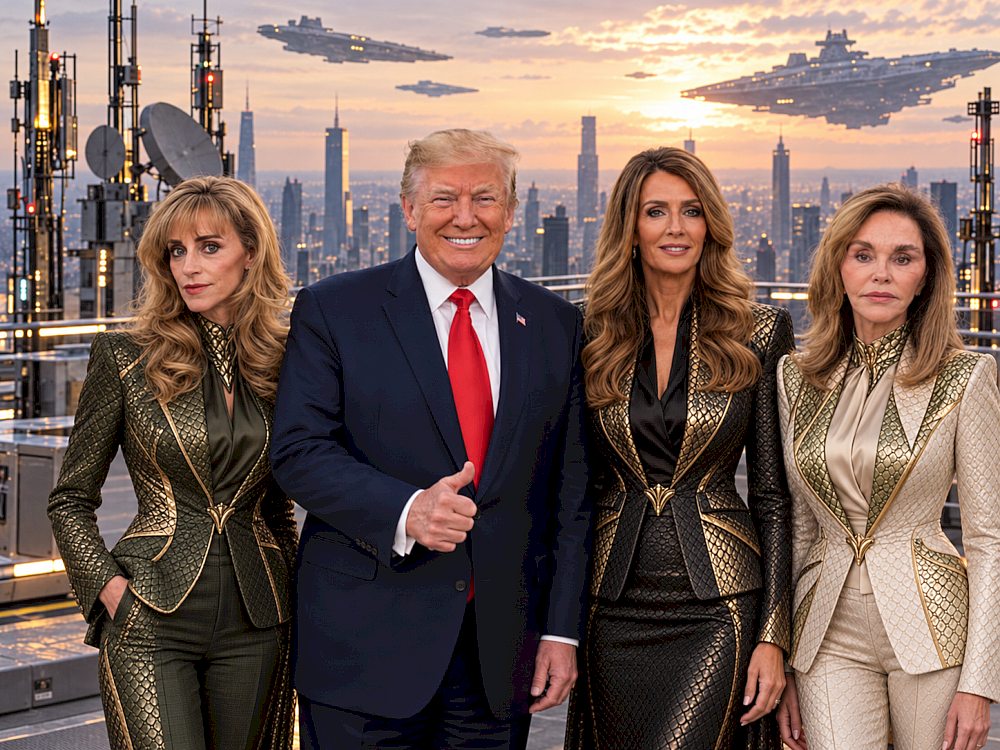
These unrelated images have been assembled into one striking claim: reptilian beings that can disguise themselves as humans are supposedly moving among people close to the US president. Some posts are clearly jokes; others appear to take the idea seriously. Online, the distinction is rarely obvious.
There is no credible evidence that Trump is surrounded by reptilians. Nothing in these photographs or videos establishes that any of the people depicted are anything other than human. The interesting question is why the claim has become appealing again — and how a visual oddity can turn into a political story about secret power.
Three women drawn into the same myth
Susan Dell, Kelly Loeffler and Barbera Thornhill are different public figures with different backgrounds. Their supposed connection exists in compilations made by internet users, not in evidence of a shared secret identity.
Susan Dell is an American philanthropist and the wife of Dell Technologies founder Michael Dell. The couple have appeared at White House events concerning investment accounts for children. Some viewers focused on Susan Dell’s expression rather than the substance of the occasion. An earlier video from December 2025 had already attracted similar claims. In a fact-check, Lead Stories found that slowed playback and poor picture quality had made her movements appear peculiar. Another recording of the same event gave a notably different impression.
Kelly Loeffler, a former Georgia senator, heads the US Small Business Administration. A widely shared clip shows her speaking while walking through a corridor. Some viewers point to the apparent length of her neck and the proportions of her face. Yet camera angle, perspective, posture, hair and the cut of clothing can all alter how proportions are perceived. The short clip does not demonstrate any biological transformation. Without the original recording, it would also be unwise to make definitive claims about every aspect of the file’s processing.
Barbera Thornhill, an American diplomat, was considered in US Senate nomination hearings in June 2026. After an official portrait circulated online, people compared it with older photographs and speculated about changes in her appearance. Different lighting, age, facial expression, makeup and photographic techniques can produce substantial differences between images. Photographs alone cannot establish cosmetic procedures, medical conditions or a person’s supposed nonhuman origins.
There is a human cost to this style of speculation. A person whose appearance seems unusual to strangers can become the target of ridicule or fantastical accusations. Physical features are not evidence of dishonesty, criminal activity or political influence.
Why an odd image can feel like proof
Humans are remarkably skilled at recognising faces. We are also sensitive to small departures from familiar expressions and proportions. Tell viewers beforehand that a clip allegedly shows an alien, and they may begin searching for gestures, reflections or facial movements that appear to support the suggestion.
Video compression, dropped frames, slow-motion playback and lighting can make movements look strange. Artificial intelligence makes it easier than ever to alter images and video, but the existence of these tools does not prove that a particular clip has been manipulated. That is a question for evidence, not intuition.
A useful investigation starts with the complete original recording: when and where it was filmed, whether several angles exist and whether the unusual detail remains visible at normal speed. A freeze-frame circulated with a dramatic caption provides far less information than the full event.
The same caution applies to portraits. Comparing photographs taken years apart does not reveal a person’s medical history, and it certainly cannot justify claims about their species. Good fact-checking separates what is visible from what an observer imagines it means.
Where the reptilian story came from
Reptile-like creatures have appeared in legends and fiction for centuries. The modern conspiracy theory about shape-shifting reptilians secretly controlling governments and financial institutions, however, is closely associated with British author David Icke. He popularised the idea in the 1990s, notably in his 1999 book The Biggest Secret.
Its appeal lies partly in its flexibility. A disputed election, an economic downturn or a president’s strange remark can all be presented as evidence of the same hidden plot. The theory supplies a single agent behind events that are actually shaped by many competing institutions and individuals. That emotional neatness is not the same as explanatory accuracy.
Stories about secret all-powerful elites also deserve historical caution. Some have recycled older conspiratorial tropes used to justify prejudice against religious and ethnic minorities. A dramatic narrative can become harmful when it assigns collective guilt without evidence.
Popular culture has helped keep the image alive. In John Carpenter’s 1988 film They Live, the protagonist finds sunglasses that expose concealed messages and aliens disguised as humans. But the story is also a satire of consumerism, inequality and manipulation. In a 2026 interview, Carpenter discussed the political atmosphere behind his work. Treating a fictional allegory as documentary evidence misses what makes the film powerful.
Why Trump’s circle is such fertile ground
Donald Trump is an exceptionally visible and polarising political figure. His statements, policy decisions and public style generate constant coverage and strongly divergent reactions. An unusual frame captured at an event involving him can therefore reach an audience far larger than the same frame of an unknown person.
There is a deeper issue beneath the joke. Wealth, private meetings, powerful networks and political appointments can make decision-making appear remote from ordinary citizens. When people struggle to understand whose interests influence the government, a fictional story about hidden rulers can offer an emotionally satisfying shortcut.
Yet the real questions are more productive: Who funded a campaign? Which companies benefited from a policy? How were officials appointed? Were conflicts of interest disclosed? These questions can be investigated with documents, financial records and accountable institutions. None requires speculation about a person’s physical appearance.
Nor should every viral post be treated as evidence that large numbers of people believe the theory literally. A meme may express satire, anxiety, curiosity or genuine conviction. Determining the proportions would require representative research rather than counting reposts.
What happens next?
The current wave could fade as attention moves to the next news story. Alternatively, every unusual public appearance by someone associated with Trump could revive the familiar joke. A third possibility is that the reptilian image remains a durable metaphor for mistrust of political and financial elites, long after the original clips are forgotten.
These are scenarios about information and society, not predictions about mythical beings. Their development would depend on new viral material, the behaviour of online platforms and the intensity of political distrust. There is no sound basis for assigning exact probabilities to them.
What remains after the spectacle is a serious question about political accountability. If citizens do not understand how power operates, they may look for an explanation so dramatic that ordinary evidence seems inadequate. But while we search for imaginary creatures in political portraits, the real instruments of influence — money, appointments, decisions and responsibility — may escape scrutiny.
This article may discuss legends, hypotheses, disputed accounts and editorial interpretations. They are not presented as established facts. Verified evidence is distinguished from speculation and unsubstantiated claims.