
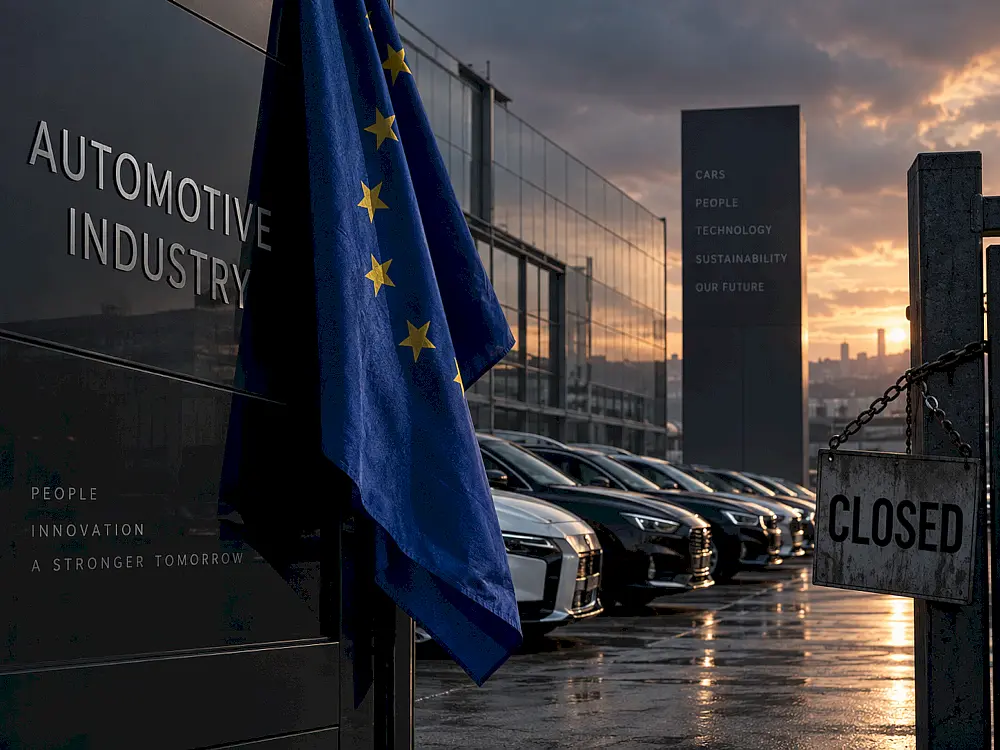
On September 7, 2026, two automotive stories arrived from Europe almost at the same time that would have looked extraordinary only a few years earlier. Volkswagen found a future for its Osnabrück plant outside carmaking: vehicle production is due to end in 2027 and the site is expected to be redirected toward defense projects. The same day, Jaguar Land Rover announced plans to cut roughly 4,000 jobs, close to a tenth of its workforce. Yet a factory that stops building cars is not the same thing as an automaker bankruptcy. Nor are tens of thousands of job cuts, a plant sale to a Chinese partner, or the disappearance of an individual brand.
Forecast details
Current estimate: about a 15% probability that by the end of 2030 Europe will see a large wave of formal bankruptcies among established passenger-car manufacturers under the criterion defined below. The more likely future is different: Europe loses plants, jobs, some brands and some corporate independence, while most large producers survive through restructuring, partnerships, asset sales, mergers and political support. This forecast was recorded on September 7, 2026.
Europe’s auto crisis has started, but consumers have not stopped buying cars
If the problem were simply disappearing demand, the forecast would be easier. But the European market is not in free fall. According to ACEA, new passenger-car registrations in the EU rose 5.7% in the first six months of 2026. Battery-electric cars reached a 20.7% share and hybrids 37.3%.
The buyer has not disappeared. What is changing is which car is purchased and who receives the money. The European Central Bank had already highlighted the rapid rise of Chinese competition in high-tech manufacturing. Car imports from China into the euro area rose by roughly 150% over five years. ECB By mid-2026, Chinese brands accounted for about 6.4% of the EU car market and roughly 15% in the United Kingdom. Reuters
European manufacturers therefore face several costly transitions at once: electrification, software, batteries and new platforms; the burden of legacy production systems; defending their home market; rebuilding their China businesses; and managing trade conflicts while Chinese competitors increasingly bring the fight into Europe itself.
Volkswagen shows what a crisis without bankruptcy can look like
Volkswagen is going through one of the deepest restructurings in its history. In early September, the supervisory board approved a broad transformation plan involving further job cuts, a smaller model range, decisions on several German plants and a push to eliminate excess capacity. The group wants to reduce complexity and restore its operating margin to 9% by 2030. Reuters
The financial statements tell a different story from headlines about collapse. Volkswagen generated €158.1 billion in revenue and €5.9 billion in operating profit in the first half of 2026. Its automotive division produced €3.2 billion in net cash flow, while forecast year-end net liquidity for the automotive business was €32–34 billion. Volkswagen The core problem is very low profitability, not an immediate inability to meet obligations.
Profits are falling, but financial buffers remain large
Stellantis is undergoing a difficult restructuring, particularly in Europe. Even so, the group reported €0.3 billion in net profit for the second quarter and had €44.1 billion in available industrial liquidity. Stellantis
Mercedes-Benz is operating with lower automotive margins and continues to cut costs, but its industrial business had €30.4 billion in net liquidity at the end of the first half and generated €3 billion in free cash flow over six months. Mercedes-Benz BMW experienced a sharp profit decline, especially because of China and tariffs, but remained profitable and continued to generate positive automotive free cash flow.
Renault reported €1.6 billion in operating profit for the first six months of 2026, a €6.6 billion net cash position in the automotive business and €17.7 billion in liquidity reserves. Renault Even Volvo Cars, where the position is weaker, returned to a positive operating result in the second quarter of 2026 after a large 2025 loss.
The picture is not comfortable. Margins are low, China hurts, plants are underused and restructuring is expensive. But there is a long distance between “the business has become much less profitable” and “the business can no longer finance its obligations”.
The real danger zone may be somewhere else
The European auto crisis is not distributed evenly. Volkswagen can close a plant, cut its model range, sell an asset or use tens of billions in liquidity. A small manufacturer or supplier has far fewer escape routes.
Aston Martin is illustrative. In the first half of 2026, the British manufacturer carried roughly £1.54 billion in net debt and continued burning cash. In July it raised £550 million in new debt financing, increasing liquidity but at a high borrowing cost. Financial stress is even stronger among suppliers. A Strategy& study reported by Reuters found that in 2025 large German auto suppliers on average spent the equivalent of about 102% of operating profit on debt servicing. Reuters
That creates a paradox: Europe could experience a wave of bankruptcies inside the automotive ecosystem by 2030 without experiencing a wave of bankruptcies among the major automakers themselves. Suppliers can disappear, plants can close, sites can be sold to rivals, and companies can divest assets or pool platform development.
History suggests large automakers are often rescued before bankruptcy
In 1975, British Leyland deteriorated so far that the British state ended up with a 78% stake. Hansard MG Rover had a different fate: after talks with China’s SAIC failed, it entered administration in April 2005 and production at Longbridge stopped. Parliament Saab Automobile went bankrupt in 2011. Saab
Other crises ended differently. PSA Peugeot Citroën raised €3 billion in new capital in 2014, including investments by Dongfeng and the French state. PSA Opel lost money for General Motors for years but did not go bankrupt; GM eventually sold it to PSA. Volvo Cars moved from Ford to Geely ownership in 2010. Volvo
WOW:
- >>> Will Big Tech Cut AI Spending Because Returns Fall Short by 2027?
- >>> Gold Price in 2026: Will It Hold Above $4,500 an Ounce?
- >>> Frozen Russian Assets: Will Ukraine Receive Tens of Billions More by Mid-2027?
- >>> Will Ukraine’s Official Dollar Rate Cross 50 Hryvnias by the End of 2026?
- >>> What Is ORBK? The Difference Between Ordibank and ORBK.NET
This is not a homogeneous enough sample to produce a precise base rate. But a recurring mechanism is visible: the larger the manufacturer, the more ways there are to restructure it before legal bankruptcy. Automakers own plants, brands, finance units, patents, dealer networks, land, joint ventures and political influence.
China can capture part of Europe’s auto industry without destroying it
Chinese producers do not necessarily need to push Europeans out of their factories. They can enter those factories. In 2026, Stellantis explored options for excess European capacity including partnerships or partial plant sales. Reuters Ford agreed to work with Geely in a plan under which Chinese electric vehicles would be produced at the Valencia plant. Reuters
A European badge may survive. The plant may survive. Some jobs may survive. Yet the platform, battery, software, capital or even ultimate owner may increasingly come from outside Europe. Bankruptcy statistics would not look dramatic. The question of who controls Europe’s car industry would.
Four scenarios through 2030
| Scenario | Probability | What we are likely to see |
|---|---|---|
| Hard adaptation without a bankruptcy wave | 44% | Plant closures, job cuts, fewer models and lower margins, while major groups remain solvent. |
| Consolidation and ownership changes | 28% | New alliances, asset and brand sales, and more Chinese or other external capital. |
| Isolated bankruptcies | 13% | One or two established manufacturers enter formal insolvency, but no systemic wave develops. |
| A major bankruptcy wave | 15% | At least three established manufacturers enter formal insolvency proceedings by the end of 2030. |
What would raise the probability
The forecast would rise if major groups begin generating persistently negative free cash flow; net liquidity falls quickly; debt rises despite asset sales; automotive operating margins stay near zero or turn negative; Chinese brands gain several percentage points of European market share each year; and new EV platforms fail to deliver enough sales.
A particularly strong signal would be a refinancing problem not at a small startup but at a large established manufacturer. The forecast would fall if Volkswagen and Stellantis restore margins after restructuring, BMW and Mercedes stabilize China, Renault retains a strong cash position, and Chinese producers increasingly enter Europe through joint ventures rather than direct displacement.
Factories may disappear faster than automakers
Europe’s car industry is genuinely facing a structural crisis. EU passenger-car production fell to roughly 11.5 million vehicles in 2024, about 750,000 fewer than a year earlier. At the same time, the EU and United Kingdom still had about 260 vehicle, engine and battery production sites in 2026. ACEA
Those points on the map may change far more than the list of badges on the road. Some plants will close, some will be repurposed and some will gain Chinese partners. Platforms and model ranges will shrink. But a large group can survive a plant closure and remain solvent. As of September 7, 2026, a major wave of bankruptcies among Europe’s large automakers by 2030 is possible but not the most likely outcome. Current probability: about 15%.
Forecast card
Forecast question: Will a major wave of formal bankruptcies among established European passenger-car manufacturers occur by December 31, 2030?
Probability: 15%. Confidence: 72/100 — moderately high. Snapshot: September 7, 2026.
Sample definition: passenger-car manufacturing groups headquartered in the EU, United Kingdom or Switzerland that sold at least 40,000 vehicles globally in at least one calendar year from 2024 through 2026. Brands inside the same group count as one company.
YES criterion: at least three different groups in the fixed sample enter formal bankruptcy, insolvency, administration or a court-led restructuring process because they cannot meet financial obligations by December 31, 2030.
Excluded: voluntary mergers of solvent companies, brand sales, changes of ownership, closure of a single plant, discontinuation of one model, supplier bankruptcy or ordinary restructuring without insolvency.
NO criterion: no more than two groups meet the YES criterion by the deadline. Resolution date: January 31, 2031. Forecast history: 2026-09-07 — 15%, initial snapshot.
Disclaimer
This article does not claim that the event will occur. The probability is a current estimate as of the forecast date and may change. The material is for information and analysis only and is not investment advice or personal financial advice.