
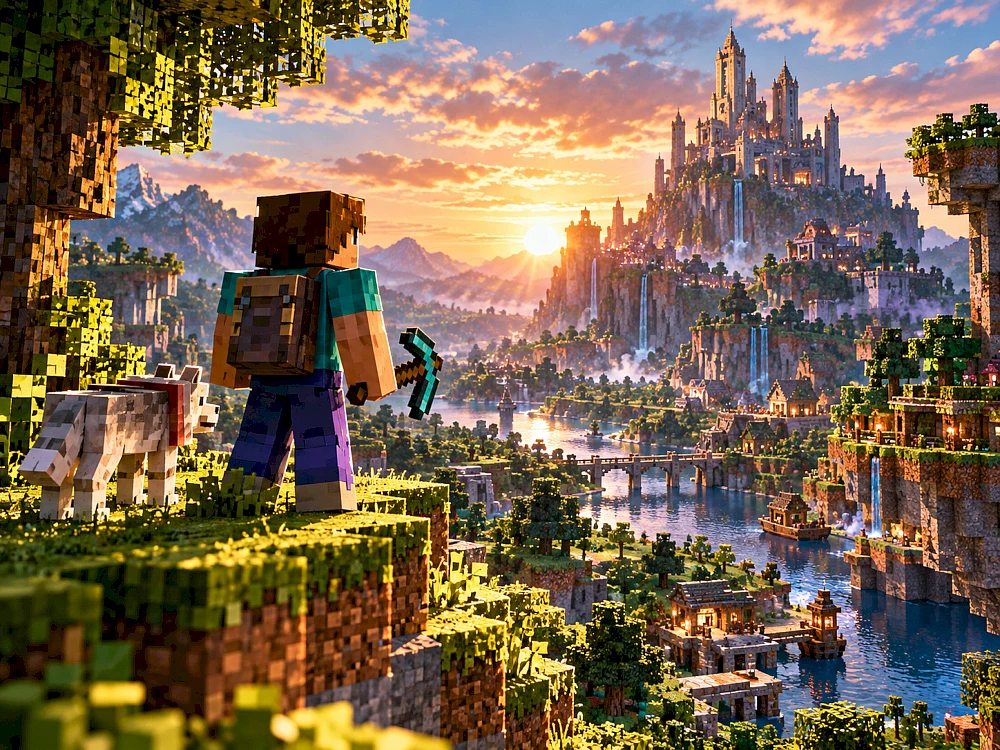
Minecraft has been around for more than seventeen years, outlasting several console generations without a direct sequel. Some of the children who built their first dirt shelters are now introducing the game to their own children. Minecraft 2 may sound like an obvious next commercial step, but Mojang and Microsoft have strong reasons to resist.
Forecast details
ORBK.NET puts the probability of a full Minecraft 2 release by December 31, 2030 at 10%. A long-running original Minecraft, rebuilt and expanded through updates, is considerably more likely. The game may change dramatically by the end of the decade while preserving its name and the continuity of players’ worlds.
Probability: 10%. Confidence: 65/100. Horizon: December 31, 2030. Initial snapshot: October 19, 2026. Next review: April 2027. No dependable base rate exists for a franchise with this combination of longevity and community-created assets; no Oracle Index is calculated.
Mojang has already addressed the sequel question
In March 2025, Minecraft executive producer Ingela Garneij was asked whether Mojang planned a direct sequel. She compared the idea of Minecraft 2 to having a second Earth and spoke about supporting the existing game for many more years. The remarks appeared in an IGN interview.
It would be wrong to treat that as a binding promise never to release another game. Management, technology and commercial priorities can change. But it is a strong public signal that Mojang does not view Minecraft as a conventional title that needs replacement every five or ten years.
Why a sequel could undermine a successful product
Story-driven franchises offer the next chapter and a new campaign. Minecraft has no single ending after which players naturally need the next installment. Players establish their own goals, build cities over several years, maintain servers and create a history that exists only in their worlds.
A separate sequel would have to answer a difficult question: what happens to those worlds, mods and communities? Radical new technology might break compatibility. Too little change would leave customers wondering why they should buy the same game again. Minecraft’s greatest strength—its persistent player-created universe—makes the ordinary sequel model risky.
In October 2026 Xbox reported more than 425 million Minecraft copies sold over the franchise’s lifetime. The figure is not an active-player count, but it illustrates why Microsoft has little immediate financial incentive to replace a remarkably successful premium product.
The original game is already getting sequel-sized work
Mojang has been modernizing underlying technology as well as adding creatures and biomes. Vibrant Visuals changes how light and atmosphere look in Bedrock. For Java Edition, the studio has described substantial rendering work, including a shift from OpenGL toward Vulkan, in its technical update.
Investing in that foundation looks much more like a commitment to the current game than preparation to abandon it. Graphics, world generation, creator tools and new mechanics can offer an experience that feels like a sequel without breaking ownership or continuity.
The Sift is coming to the existing Minecraft
At Minecraft Live 2026 Mojang announced The Sift, a new dimension planned for the existing Java and Bedrock editions in 2027. According to the Xbox announcement, it involves fresh biomes, creatures and building materials and represents the first major new dimension in many years.
Such a feature could easily have been marketed as the headline innovation of Minecraft 2. Instead, Mojang is bringing it to the game people already own. This reinforces the case against an imminent standalone sequel.
The strongest argument for Minecraft 2 is technological debt
Minecraft began in a different software era. Years of expansions have layered new systems on top of older architecture, while compatibility obligations have increased. Ingela Garneij acknowledged that the age of its technical foundations sometimes slows development. Certain new features may be harder to implement in a legacy codebase than in a modern engine.
By 2030, demands might include sophisticated AI characters, dynamic worlds, improved simulation, new graphics and easier game creation. If Mojang eventually concludes that a fresh foundation is more practical than another reconstruction, a sequel becomes conceivable. That is why the estimate is low rather than zero. The current public direction, however, favors continuous modernization.
What World of Warcraft, Counter-Strike 2 and Overwatch 2 tell us
World of Warcraft has continued for decades without World of Warcraft 2, protecting accumulated player progress through updates and expansions. Valve chose a different path in 2023, replacing CS:GO with Counter-Strike 2 and substantial technical changes. Blizzard similarly turned Overwatch into its second iteration with a different business model.
Both routes are viable. What makes Minecraft distinctive is the importance of personal worlds, mods and community servers. In that respect, its economics resemble a persistent online universe more than a competitive shooter. These cases offer useful comparisons but not a statistical base rate.
Minecraft Dungeons II does not satisfy the prediction
Minecraft has multiple spin-offs and adaptations, including Dungeons, Dungeons II, Legends and film projects. They borrow the recognizable setting but are not direct replacements for the core sandbox. The forecast concerns a new mainline survival-and-creative Minecraft, not simply any new product carrying the brand.
Unambiguous YES and NO rules
RESOLVED — YES: by December 31, 2030, Mojang or Microsoft has publicly released a standalone Minecraft 2 or explicitly identified direct successor to the main sandbox, featuring an open world, building, Survival and Creative play. A full release or broadly accessible early access counts if it is an independent game available on at least one major platform.
RESOLVED — NO: no such game is publicly available by the deadline. A reveal trailer, closed beta, large update to the original, graphical overhaul or spin-off does not qualify. Resolution date: January 1, 2031; verify through minecraft.net, Mojang, Xbox Wire and official stores. A differently titled product explicitly positioned as the mainline successor also counts as YES.
Four scenarios through 2030
| Scenario | Probability | Principal outcome |
|---|---|---|
| Normal evolution of Minecraft | 50% | More biomes, mechanics and mobs with no wholesale relaunch |
| Major technical overhaul within Minecraft | 25% | Rendering and architecture change without a separate product |
| Large new Minecraft spin-offs | 15% | Franchise expansion into other game types, without a mainline sequel |
| Full Minecraft 2 release | 10% | Public standalone successor to the original sandbox |
Signals that would change the estimate
Probability would increase following a confirmed separate sequel team, an official migration plan for existing worlds, a new engine explicitly tied to Minecraft 2, or a mainline release page and date. Evidence that Mojang considers the current editions impossible to modernize would matter as well.
Probability would decrease if The Sift is followed by a long-term 2028–2030 roadmap for the original game, continued deep investment in Java and Bedrock, and explicit commitments to compatibility. An isolated rumor or executive appointment is not enough for a major revision.
What players should expect
No Minecraft 2 does not mean a stagnant Minecraft. The game may become much richer while allowing people to revisit the worlds they have spent years building. A sequel would make sense only if the benefits of an entirely new foundation outweighed the cost of breaking that continuity. For now, Minecraft’s future looks more like a growing, persistent creative platform than a franchise approaching its next numbered installment.
Forecast History: October 19, 2026 — Probability 10%, Confidence 65/100. Initial immutable snapshot.
This independent ORBK.NET forecast is not an account of Microsoft’s or Mojang’s confidential plans. Future estimates may change without rewriting the initial forecast or its resolution rules.