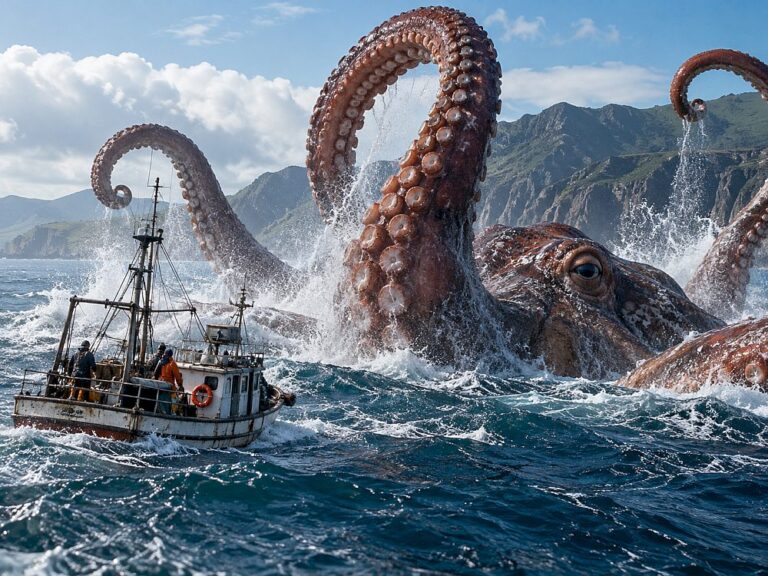

Scientific and philosophical article about Atlantis. What if it’s not just a legend, but an echo of a past civilization? Hypotheses, evidence, meanings that open another perspective on our present.
Imagine a world that disappeared in one night. A continent that was the heart of civilization sank into the sea, leaving behind only shadows in tales, legends, and ancient manuscripts. But what if the legend of Atlantis is not just a fiction of Plato, but an echo of a real past that humanity was not ready to accept? Is it possible that we are searching for it in the ocean, while it hides… under our feet?
For more than two millennia, Atlantis has been a symbol of lost power. The philosopher Plato described it as an ideal state—technically advanced, morally pure, but blinded by its own greatness. Its fall was the punishment of the gods who could not reconcile with human pride. It sounds like a parable. But what if Plato, telling of Atlantis, used sources older than Greece itself? What if behind his words lies a real catastrophe, the memories of which were passed down through generations?
There are hypotheses that Atlantis might not have been a separate island, but a generalized image of ancient civilizations that perished due to climate change or tectonic disasters. For example, some researchers believe that this refers to the flooding of the island of Thera (modern Santorini), which caused the disappearance of the Minoan civilization. Others are convinced that Atlantis is a lost continent in the Atlantic Ocean, the fragments of which are now called the Azores. But the boldest theories link Atlantis with Antarctica, suggesting it was once green rather than an icy desert.
However, the greatest mystery is not in geography, but in why this legend does not disappear. Why is humanity so obsessed with searching for Atlantis? Perhaps because it embodies our fear and our hope at the same time. We fear that even the most advanced societies can disappear in an instant, and at the same time, we hope that somewhere, under the layers of time, there still exists lost knowledge that can save us.
In the middle of the 20th century, science fiction assumptions emerged that the Atlanteans had technologies exceeding even modern ones: energy sources, flying machines, telepathy. But does this not resemble our modern era? And here a rhetorical question arises: are we not already Atlantis? Our world is a complex structure, dependent on climate, resources, digital systems. And as fantastic as it may sound, every earthquake, every break in the ecosystem can turn a civilization into another legend.
Perhaps the legend of Atlantis is a coded warning. Human memory is a complex network that stores not only events but also lessons. Sometimes they are hidden in myths. And instead of looking for a lost island, it would be worth asking ourselves: what exactly have we lost?
If Atlantis was only an allegory, why is it so resilient in the human imagination? Perhaps because we recognize ourselves in it. We see in it a projection of the modern world, where development is often accompanied by losses—moral, ecological, human. The idea that a powerful state perished due to its own arrogance is frightening precisely because it seems familiar.
And here it is worth mentioning one little-known but striking hypothesis: Atlantis might not have been a specific location, but a stage. A stage in human development that was erased—not only by water but also by memory. Archaeologists increasingly find artifacts that do not fit into the official chronology: megalithic structures carved from hard rock as if the tool was not stone, but a laser. Maps showing Antarctica without ice, created long before the discovery of the continent. Embedded in all this are questions like uncomfortable shadows that refuse to disappear.
What if Atlantis is our own shadow history? Fragments of civilizations that reached a peak and vanished. If today’s world suffered a global catastrophe, how much time would it take for all our buildings, data, and memory to disappear? In a thousand years, only fragments would remain, from which future people would create their legends. So, perhaps we are not looking for Atlantis—we are afraid of becoming it.
Some scientists put forward the concept of the cyclical development of civilizations. Supposedly, humanity does not progress linearly upwards, but moves in spirals—flourishing, falling, forgetting, and again. This approach explains why the oldest myths of almost all cultures mention floods, fire from the sky, and vanished kingdoms. These are not just fantasies, but fragments of collective memory, encoded in fairy tales and legends.
Then another question arises: can we learn from these traces? Are we ready to admit that history is not just a set of facts, but also a system of warnings? When Plato wrote about Atlantis, he seemed to urge: do not forget that pride and technology without wisdom are a path to destruction.
However, there is also light in this story. Because if Atlantis existed, it means that maybe we can build it again. Not from marble and gold, but from ideas, compassion, and understanding. To create a civilization that remembers. And then the legend of Atlantis will become not a warning, but a hope.
We do not know if Atlantis existed. But we know for sure—it lives within us. In our dreams, fears, and searches. And while we search for it—we are not just looking for a lost island. We are looking for ourselves.
Share this article if you felt that somewhere deep in your heart… Atlantis is still waiting for us.